


Commercial Fridge Buying Guide: Types, Brands, Sizing and Site Checks
Upright, underbench, bar, display, prep or drawer? How to route your kitchen to the right commercial fridge configuration, then compare the exact models — with verified brand and retailer coverage from the KitchenCompare catalogue.
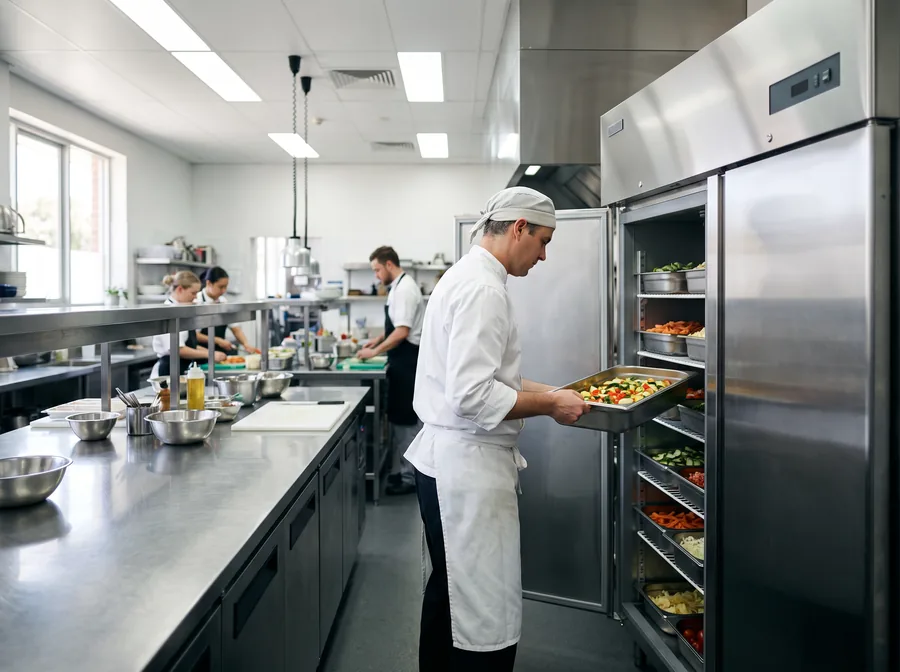
In this article
- The quick answer: which fridge does my venue need?
- What is a commercial fridge?
- Commercial versus domestic refrigeration
- Which type of commercial fridge do you need?
- Which fridge suits your venue?
- Sizing around workflow, not around the wall
- Temperature: the food, not the dial
- Climate class, ambient temperature and recovery
- Site preflight and installation
- Cooling system, refrigerant and construction
- Energy efficiency and GEMS
- Specifications buyers need to compare
- What the KitchenCompare catalogue actually shows
- Commercial fridge brands available in Australia
- Comparing actual products
- Customer concerns and objections
- Price and total ownership cost
- Compare exact models, not series names
- Maintenance, cleaning and lifespan
- Questions to ask a supplier
- Final buying checklist
- Frequently asked questions
- Where to go next
Pick a commercial fridge by answering four questions in order: what food or product it holds, where it physically lives, how much you need to hold between deliveries, and how hard the doors get worked. Those decide the configuration. Capacity, brand and price come after.
This is the focused fridge hub. For the broader refrigeration picture across chillers, freezers and cold rooms, start with how to choose commercial refrigeration.
The quick answer: which fridge does my venue need?
| If you need to | The cabinet is | Where it lives |
|---|---|---|
| Hold reserve stock between deliveries | Upright storage fridge | Back of house or store room |
| Keep service stock within arm's reach | Underbench fridge or drawers | Under the pass or prep bench |
| Serve chilled drinks at the point of sale | Bar or back-bar fridge | Behind the bar |
| Let customers see and pick cold product | Drinks display fridge | Customer-facing shopfront |
| Hold gastronorm ingredients at the line | Prep or sandwich fridge | On the prep line |
Configuration comes before capacity, brand and price. A cabinet in the wrong place with the right litres is still the wrong purchase.
What is a commercial fridge?
A commercial fridge is a chilled cabinet built for food-business duty: repeated door openings through a service, a stated ambient it is designed to work in, replaceable wear parts, and a parts and service network behind it.
This guide covers chilled cabinets only. Freezers, cold rooms, blast chillers and ice machines are different equipment with different selection rules — see how to choose commercial refrigeration for the category-wide picture, and the refrigeration category for everything we track.
"Commercial refrigeration" is the whole category. "Commercial refrigerator" and "commercial fridge" mean the same chilled cabinet, and Australian suppliers use both.
Commercial versus domestic refrigeration
The difference is intended duty rather than snobbery, and it shows up in five specific places.
- Door openings. Commercial cabinets are designed and warranted for repeated openings through a service. Domestic units are not, and recovery after each opening is where they fall behind.
- Ambient rating. Commercial units carry a climate class stating the ambient temperature and humidity they are designed to work in. A kitchen line in an Australian summer is a harsher ambient than a domestic kitchen, and a unit rated for cooler conditions will run continuously and still struggle.
- Construction. Stainless surfaces, replaceable magnetic door gaskets, castors, and shelving designed around gastronorm pans rather than domestic shelves.
- Serviceability. Accessible condensers, available spare parts and a local technician network. When a domestic unit fails you replace it; when a commercial unit fails you get it repaired.
- Warranty. Most domestic warranties exclude commercial use outright. Check the terms before you assume you are covered — this is the exclusion that turns a cheap cabinet into an uninsured one.
Whether a domestic unit is a false economy depends on the duty you actually put it through. A low-traffic staff-room fridge in an air-conditioned office is not the same proposition as a cabinet on a service line. What is not conditional is the warranty position: if the terms exclude commercial use, a failure is yours to wear regardless of how gently the cabinet was treated.
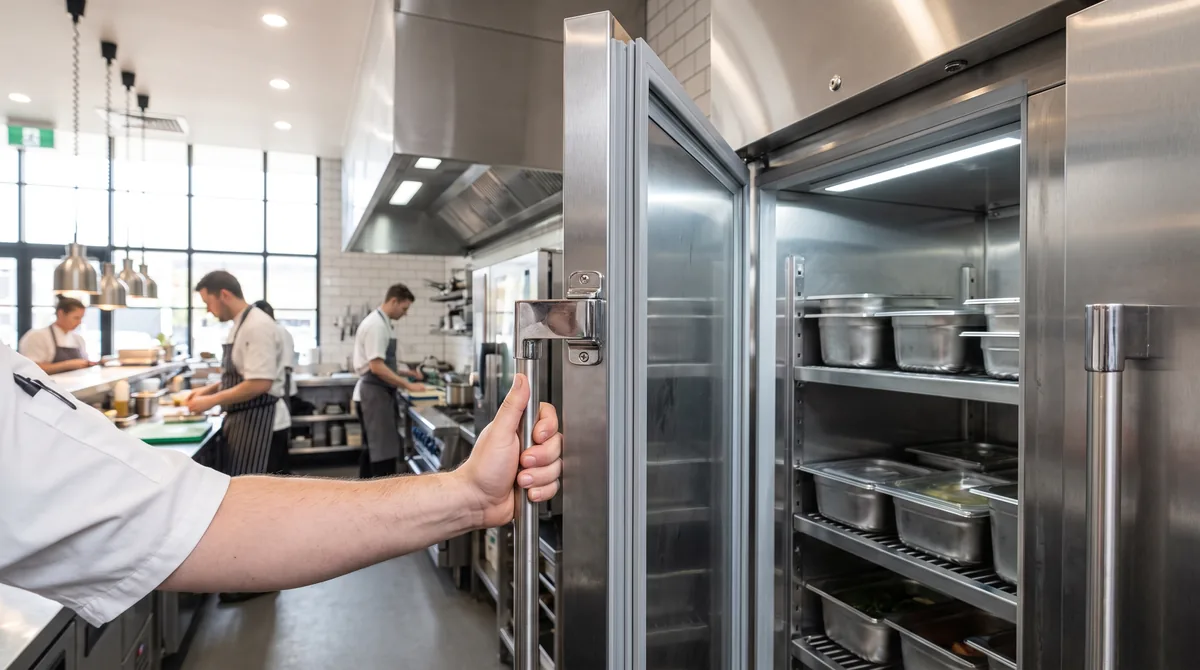
Which type of commercial fridge do you need?
| Type | The job it does | Where it lives | Compare |
|---|---|---|---|
| Upright storage fridge | Bulk reserve stock between deliveries | Back of house, store room, dry area | Upright fridges |
| Underbench fridge | Service stock at the point of use | Under the pass or prep bench | Underbench fridges |
| Bar and back-bar fridge | Chilled drinks at the point of sale | Behind the bar, front of house | Bar and back-bar fridges |
| Drinks display fridge | Merchandising cold product to customers | Customer-facing retail or shopfront | Display fridges |
| Prep and sandwich fridge | Chilled ingredients in gastronorm pans at the line | On the prep line | Salad prep fridges |
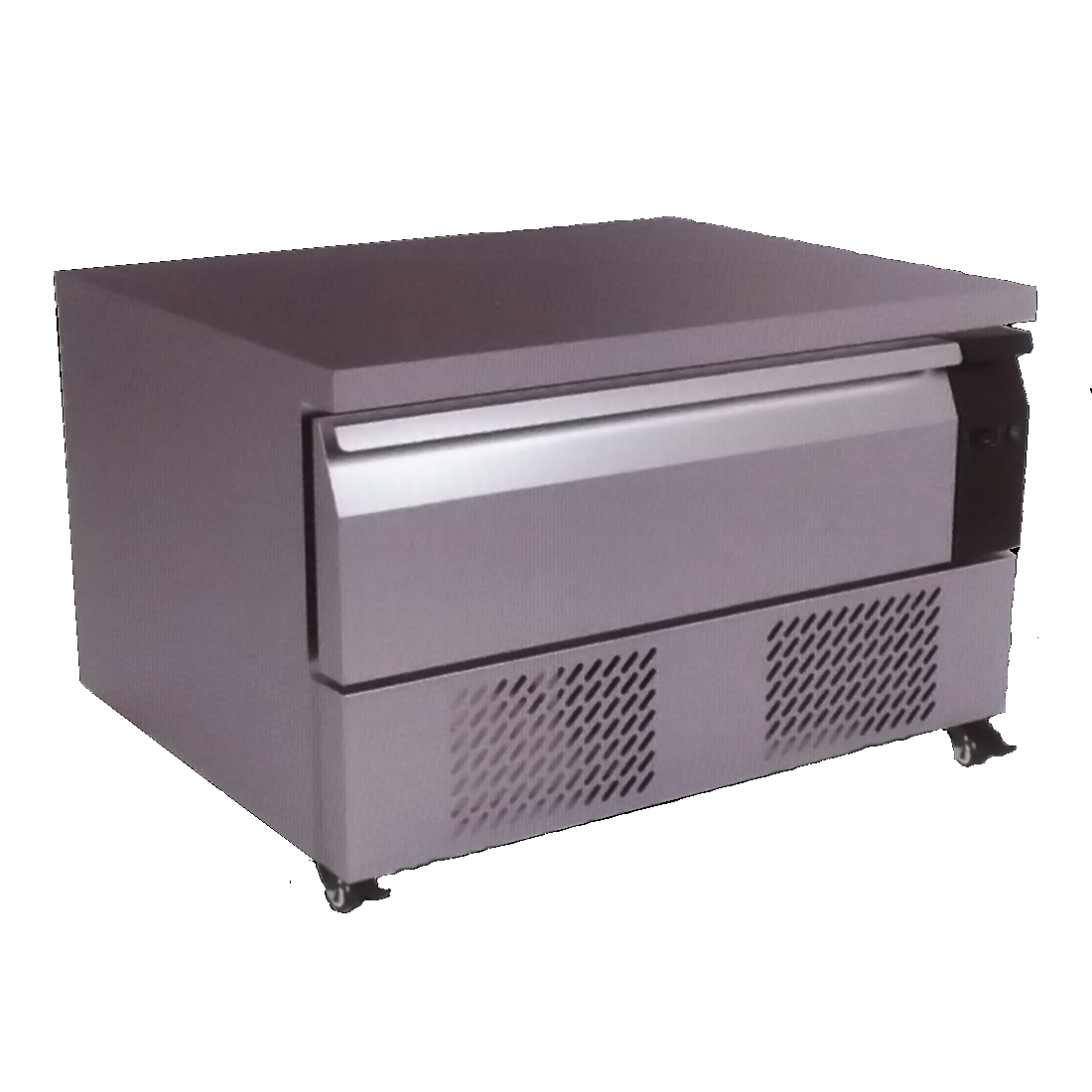
| Drawer fridge | Fast, low-spill access on a busy line | Under the pass, prep line | Drawer fridges |
| Bottle cooler | High-volume bottled drinks behind the bar | Under or behind the bar | Bottle coolers |
Most kitchens end up with two or three of these rather than one large unit: an upright for reserve stock, underbench or drawers at the line, and a bar or display unit if you sell cold drinks. A long run of underbench units placed where the work happens usually beats one bigger cabinet at the end of the room.

Upright storage fridges
The reserve-stock workhorse and the deepest segment in the Australian market. One, two or three doors, full-height shelving, and the volume to carry a venue between deliveries. Strengths: most litres per square metre of floor, easiest to load a delivery into. Limits: it is a walk away from the line, so anything used during service should not live here. Solid doors are the norm; glass costs more to run and is only worth it if someone needs to see in without opening.
Underbench fridges
Service stock at arm's reach, built into the bench void. Strengths: no steps during service, and a run of them puts cold storage exactly where each station needs it. Limits: much less volume than an upright, and a cabinet under a hot bench works harder. Measure the void height, the door swing and the kick space before you shortlist. See the underbench fridge buying guide for the detail.
Drawer fridges
Drawers instead of doors under the pass. Strengths: fast, low-spill access, less cold air lost per opening than a swinging door, and they suit a line where hands are full. Limits: fewer litres for the same footprint, more moving parts, and a higher purchase price. Best where the access pattern genuinely justifies it.
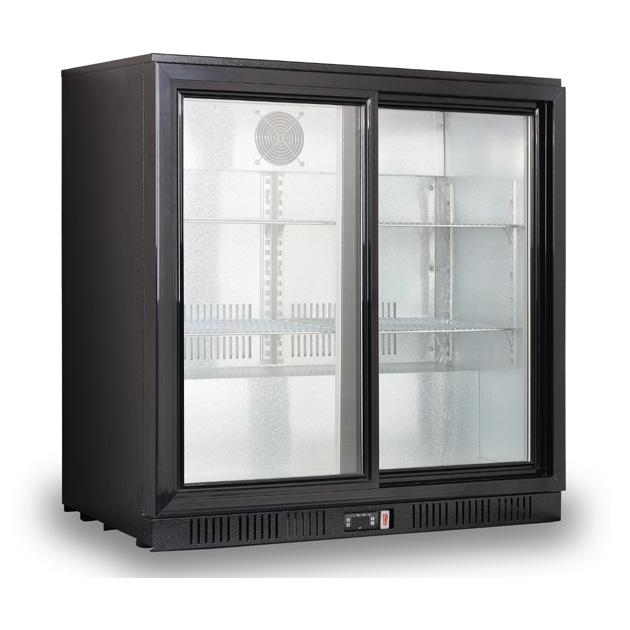
Bar and back-bar fridges
Low-height cabinets sized to sit under a bar counter, usually with sliding or hinged glass doors and interior lighting. Strengths: drinks at the point of sale, merchandising built in. Limits: front of house means the heat they reject goes into the customer space, and noise matters in a way it does not in a kitchen.
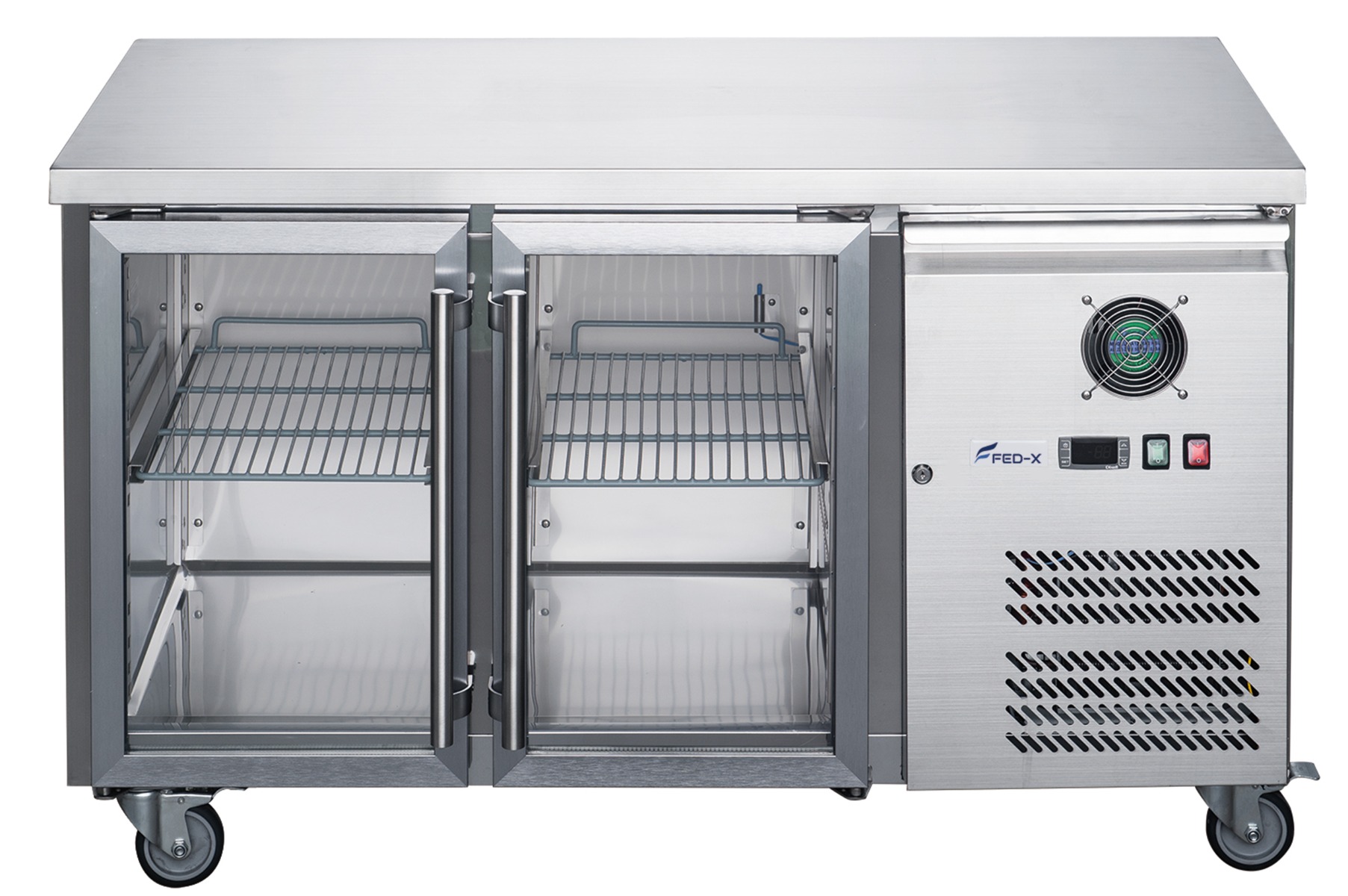
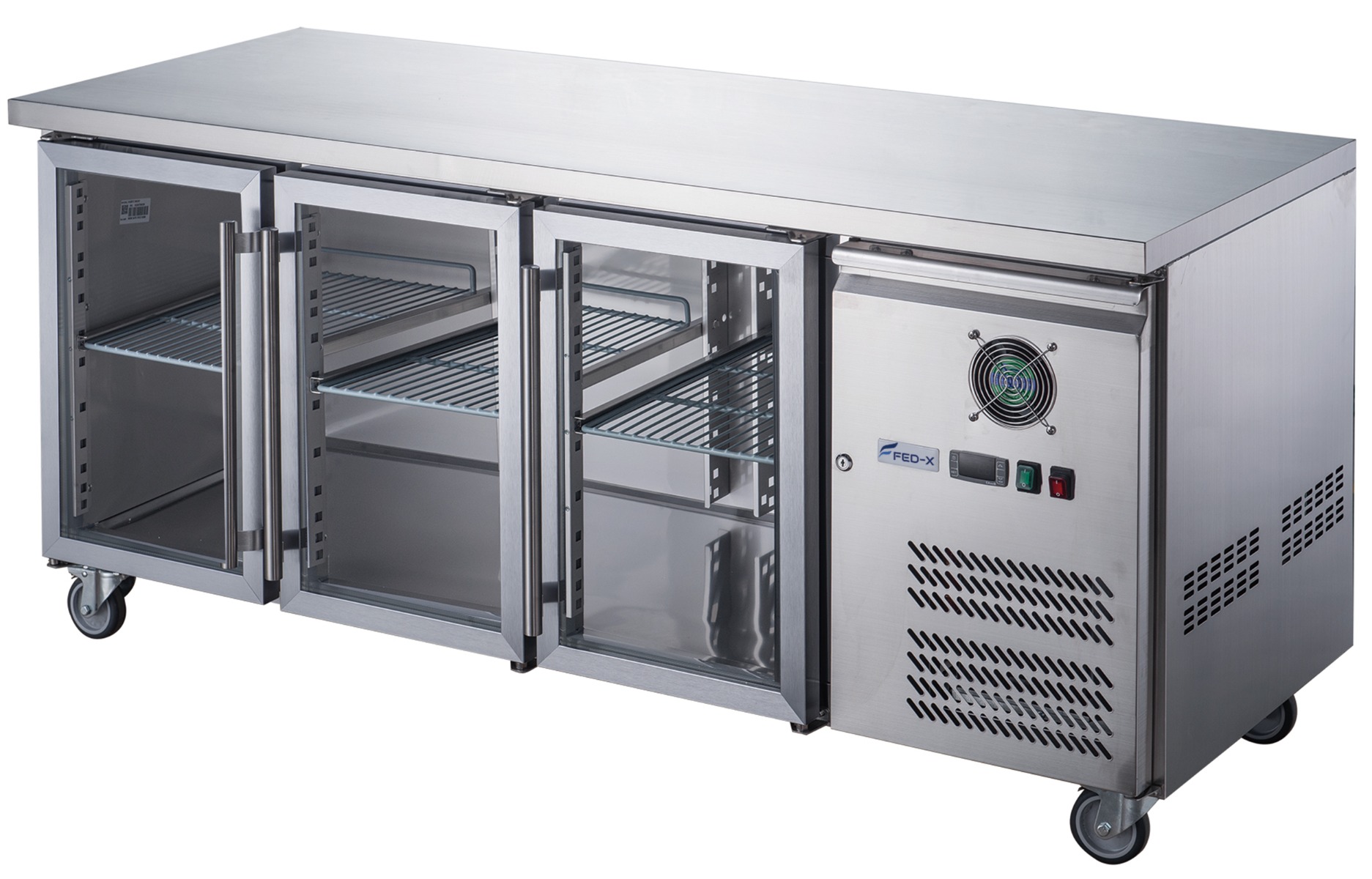
Drinks display fridges
Customer-facing glass-door merchandisers. Strengths: they sell product, which is the whole point. Limits: glass doors and lighting cost more to run than a solid-door cabinet of the same volume, and they recover more slowly every time a customer opens one. See the commercial display fridge guide.
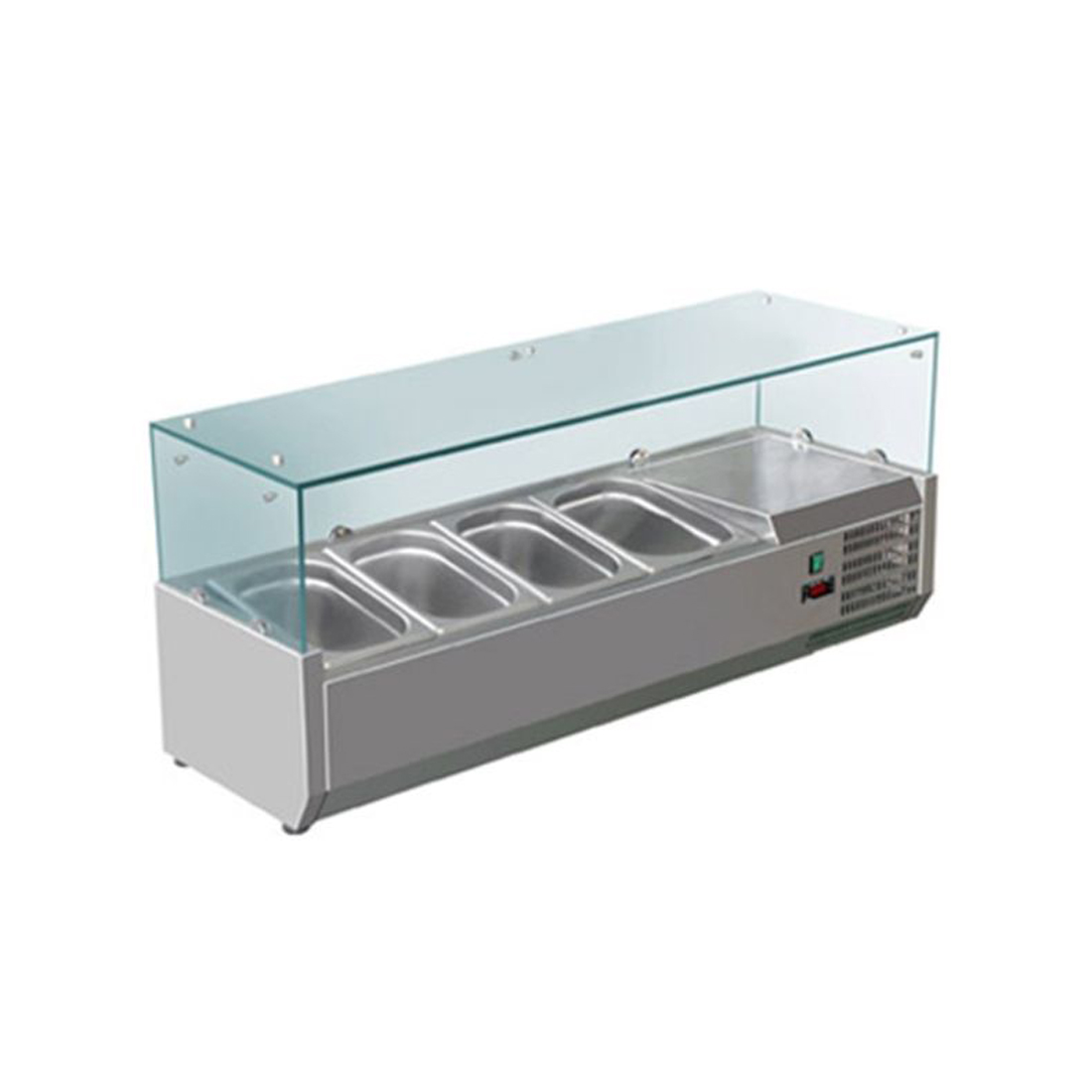
Prep and sandwich fridges
A refrigerated base with a chilled gastronorm well on top. Strengths: ingredients at the line in the pans you actually use. Limits: the well is holding equipment, not a chiller — it holds prepared product at temperature and will not pull warm food down. Pizza and salad variants differ in well depth and bench width.
Solid doors, glass doors and door count
Solid doors hold temperature better and cost less to run. Glass doors sell product. Across the cabinets we track that publish a door type, 63% are solid and 37% are glass — the split you would expect in a market where most cabinets live back of house.
Door count is a capacity and a workflow decision at the same time. Every door is another opening that loses cold air, so more doors is not automatically more useful. Across the models that publish a door count, 49% are single-door, 29% two-door and 13% three-door.
Which fridge suits your venue?
| Venue | Typically holds | Usual combination | Biggest buying risk |
|---|---|---|---|
| Café | Milk, prepped food, cold drinks | Upright + underbench + small display | Under-sizing the milk fridge for the morning rush |
| Restaurant | Prep, proteins, service mise | Upright + underbench or drawers at the line | Buying volume instead of point-of-use access |
| Bar or pub | Bottled and canned drinks, garnish | Bottle coolers + back-bar + upright reserve | Heat and noise rejected into the customer space |
| Bakery | Dough, dairy, fillings, finished product | Upright + display cabinet | Humidity and product drying in the wrong cabinet |
| Pizzeria | Dough, toppings in gastronorm | Pizza prep fridge + upright | Prep well depth not matching the pans used |
| Takeaway | Drinks, prepped ingredients | Display fridge + underbench | Display running cost underestimated |
| Convenience or supermarket | Packaged chilled goods | Multi-door display, open merchandisers | Ambient and door discipline in a shopfront |
| Hotel | Everything, across several kitchens | Multiple uprights + point-of-use units | Service coverage across all sites |
| Institutional kitchen | Bulk prepped food | Large uprights + cold room | Recovery under bulk warm loading |
Almost no venue is served by one cabinet. The common mistake is buying one large fridge and then walking to it forty times a service.
Sizing around workflow, not around the wall
Capacity questions get answered backwards. Start with the workflow.
- Delivery interval. How many days of stock do you have to hold? A venue with three deliveries a week needs far less reserve volume than one with a weekly drop.
- What the stock actually is. Gastronorm pans, cartons and crates all pack differently. Internal litres is a comparison figure between models, not a promise about your stock.
- Where each item is used. Anything touched during service belongs at the line, not in the store room. Every trip to the back of house is time out of your service.
- Circulation. Doors have to open fully without blocking a walkway or another appliance. Measure the swing, not just the cabinet.
- Recovery. A cabinet whose door opens every ninety seconds through a rush needs headroom that a store-room unit does not.
Advertised litres are not usable litres
Gross volume is the empty box. Net volume is what the shelves, ducting and evaporator leave you. What you can actually store is smaller again, because your stock does not tessellate: cartons leave gaps, gastronorm pans need clearance to lift out, and a shelf loaded to the roof blocks the airflow the cabinet needs to work.
Treat published litres as a comparison figure between two cabinets, never as a stock plan.
A worked example
A 70-seat bistro takes two deliveries a week. Proteins and dairy arrive in cartons, prepped mise lives in gastronorm pans, and the bar carries bottled drinks.
Reserve stock has to cover three to four days, which is carton-shaped and belongs in an upright at the back. Service mise is gastronorm-shaped, gets touched constantly, and belongs in underbench cabinets or drawers directly under the working bench. Bottled drinks are front of house and belong in a bottle cooler under the bar.
That is three cabinets, and the arithmetic that gets you there is about where the hands go, not about total litres. A single 1,200 L upright holding all of it would be cheaper to buy and would cost the kitchen a walk on every single plate.

Temperature: the food, not the dial
Australian food safety requirements are expressed as food temperature, not as a cabinet set point. Potentially hazardous food has to be kept at or below the temperature your food safety requirements specify, and the number that matters is the temperature of the food itself.
A set point is a means to that end. The relationship between set point and food temperature depends on load, door openings, airflow and ambient. In practice that means:
- Use a probe or a monitored thermometer to verify food temperature, not just the cabinet display.
- Log it. Your food safety plan, and any inspection, is about records of food temperature.
- Follow Food Standards Australia New Zealand guidance and your state or territory food authority for the requirements that apply to your business. Do not rely on a manufacturer's default dial setting as a compliance answer.
Three things routinely pull food temperature away from the set point: loading warm product, which a storage fridge is not designed to pull down; door openings during a rush, which dump the cold air the cabinet has just made; and overpacking, which blocks the airflow the cabinet needs to move cold around the shelves.
A commercial fridge holds food cold. It does not chill hot food down. Cooling cooked food to a safe temperature is a separate process with its own requirements — a blast chiller does that job, and putting a hot pot in a storage fridge risks both the food in the pot and everything else in the cabinet. See FSANZ temperature guidance and FSANZ on thermometers.
Temperature compliance is about the food, not the dial
Australian food safety requirements are expressed as the temperature of the food itself. Verify with a probe rather than the cabinet display, log it as your food safety plan requires, and follow Food Standards Australia New Zealand guidance and your state or territory food authority. A manufacturer's default dial position is not a compliance answer.
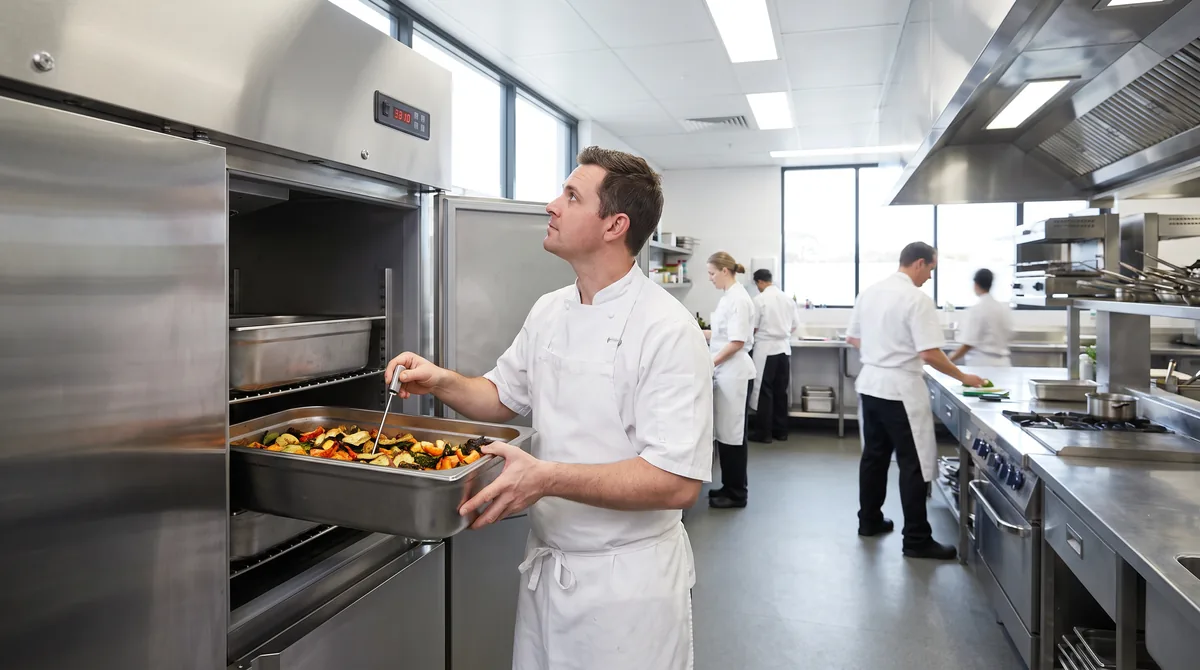
Climate class, ambient temperature and recovery
Climate class is the single most useful specification on a commercial fridge, and the one buyers most often skip. It states the ambient temperature and humidity the cabinet was tested to hold temperature in. Outside that ambient, the manufacturer is not claiming anything.
Australian suppliers overwhelmingly sell tropical-rated cabinets. Across the fridges we track that publish a usable climate class, 96% are class 4 (tropical, tested around 40°C). That is the market responding to Australian kitchens, and it means a cabinet without a stated tropical rating deserves a direct question to the supplier.
Three things decide whether the rating survives contact with your kitchen:
- Local ambient, not room ambient. A cabinet beside a fryer, oven, grill or dishwasher exhaust sits in a microclimate far hotter than the room. So does one in direct afternoon sun through a shopfront window.
- Door-opening frequency. Each opening exchanges cold air for room air. A back-bar fridge in a Friday rush and the same model in a store room are doing completely different work.
- Warm loading. Product loaded above cabinet temperature has to be pulled down by a system sized for holding, not chilling.
"Why does my fridge struggle during service?" is nearly always one of those three, not a fault. Confirm the climate class of the exact model before you buy, and be honest about where it will stand.
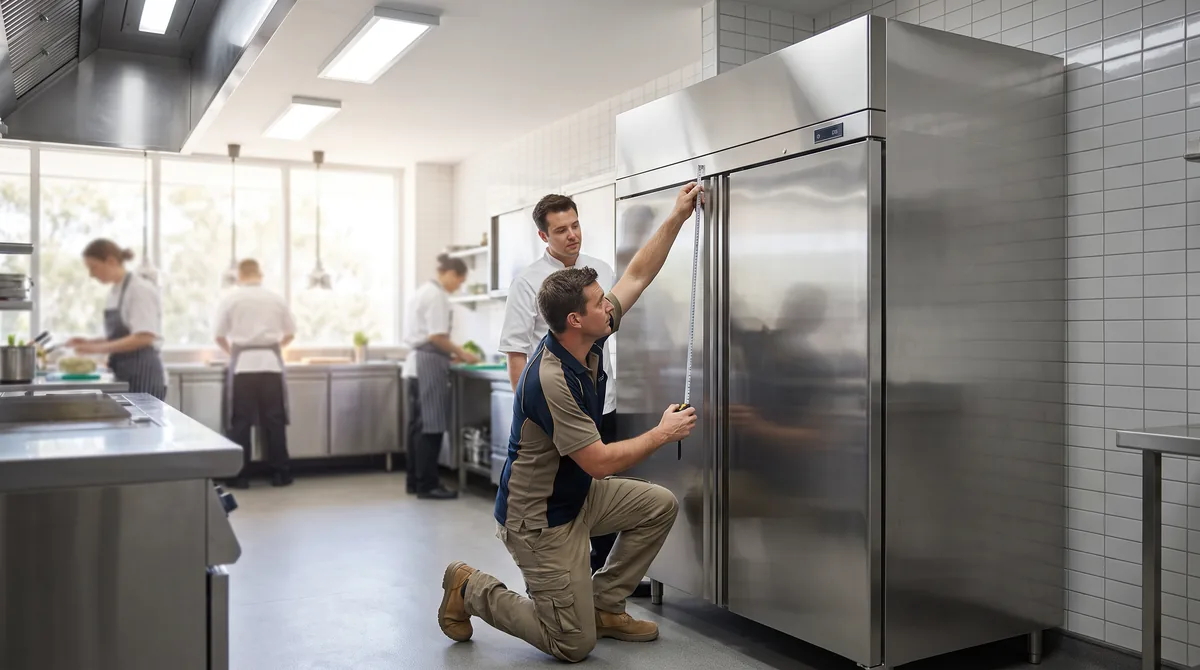
Site preflight and installation
Check these before you shortlist. Each one has ruled out an otherwise ideal cabinet.
- Ventilation and heat rejection. Every fridge moves heat out of the cabinet and into the room. It needs the manufacturer's clearances at the condenser, and the room needs somewhere for that heat to go. A cabinet boxed into a tight recess will run hot and fail early.
- Neighbours. A fridge next to a fryer, grill, oven or dishwasher exhaust is working against a local ambient far above the room temperature. Move it, or accept that you are buying a shorter life.
- Access. Measure the delivery path — doorways, corners, lifts, ramps — as well as the final position. Commercial cabinets are heavy and do not tilt easily.
- Door swing and clearance. Confirm the door opens fully without hitting a bench, a wall or another appliance, and that a full shelf or pan can come out at that angle.
- Castor height and kick plates. Castors add height. Check the cabinet still fits the void, and that a kick plate or plinth is not blocking the condenser intake.
- Power. Confirm the circuit at the location. Note whether the unit needs a dedicated circuit.
- Condensate and drainage. Some units evaporate condensate, some need a drain. Know which before the cabinet is in position.
- Floor and levelling. Castors or legs, and whether the floor is level enough for the doors to self-close properly.
- Noise, front of house. A bar or display cabinet runs where customers sit. Compressor noise and rejected heat are part of the customer experience, not just the spec sheet.
Verify the exact model's requirements against manufacturer documentation and with licensed trades before purchase.
Cooling system, refrigerant and construction
Integral or remote. Most commercial fridges are integral: the compressor and condenser are built into the cabinet, and the heat goes into the room. Remote systems put the condensing unit elsewhere — quieter and cooler in the space, more expensive and more involved to install. Almost every cabinet in this guide is integral.
Fan-forced airflow. Commercial cabinets circulate cold air with a fan rather than relying on convection. That is why an overpacked shelf or a blocked duct produces warm spots, and why loading patterns matter more than they do at home.
Refrigerant. Australian commercial fridges have moved almost entirely to natural hydrocarbon refrigerants. Across the cabinets we track that publish a refrigerant, 75% use R290 (propane) and 25% use R600a (isobutane). Both are low global-warming-potential hydrocarbons and both are flammable, which is why charge sizes are limited and why servicing needs a technician who works with them. Ask which refrigerant the exact model uses, and whether your service contractor handles it.
Defrost and condensate. Automatic defrost is effectively standard — around 96% of the cabinets we track that publish a defrost type are automatic. The meltwater has to go somewhere: most units evaporate it using compressor heat, some need a drain. Confirm which before the cabinet is positioned.
Condenser access. The single most important construction detail for ownership cost is whether the condenser can be cleaned without a technician. A front-accessible, filtered condenser is a five-minute in-house job. One buried at the back of a built-in cabinet becomes a service call.
Energy efficiency and GEMS
Energy is a real cost over a ten-year life, and it is also where the worst claims get made.
Compare using the manufacturer's published or registered figures for the exact model, under comparable test conditions. Two cabinets of similar internal volume can differ substantially, and the difference compounds over the years you own them.
What not to do: convert a nameplate wattage into an annual dollar figure. Nameplate power is not duty-cycle energy consumption, your tariff is not the national average, and your ambient is not the test ambient. A number built that way looks precise and is not.
In Australia, refrigerated display and storage cabinets are covered by the Greenhouse and Energy Minimum Standards (GEMS) framework — see the GEMS Refrigerated Cabinets Determination 2024. Where a model is covered, registration produces test data on a consistent basis, which is the only honest footing for a like-for-like comparison. Registrations can also be cancelled, so ask a supplier for the registration details of the exact model rather than accepting a general efficiency claim about a brand.
Only convert energy into dollars when you have verified consumption for that model and your own tariff. Anything else is a guess wearing a decimal point.
Specifications buyers need to compare
| Specification | What it means | Why it changes your decision |
|---|---|---|
| Gross vs net volume | The empty box vs what shelving and ducting leave | Net is closer to reality, and neither equals usable stock |
| Temperature range | The band the cabinet is designed to hold | A chiller range and a "fridge-freezer" range are different machines |
| Climate class | The tested ambient and humidity | Decides whether it survives your kitchen; see above |
| External dimensions | Footprint plus door swing and castor height | Rules cabinets out before any other spec matters |
| Door configuration | Count, glazing, hinged or sliding | Sets capacity, running cost and how much cold you lose per service |
| Shelving | Number, material and adjustability | Decides whether your stock actually fits |
| Gastronorm compatibility | Whether shelves and wells take GN pans | Critical at the line, irrelevant in a store room |
| Refrigerant | R290, R600a or other | Affects servicing and who is qualified to do it |
| Registered energy data | GEMS or published test consumption | The only comparable energy number |
| Power requirement | Voltage, amperage, dedicated circuit | A site constraint, not a preference |
| Defrost type | Automatic or manual | Automatic is standard; manual is a daily job |
| Condensate handling | Evaporative or drained | Decides whether plumbing is involved |
| Castors or legs | Mobility and cleaning access | A cabinet you cannot move is a cabinet you cannot clean behind |
| Warranty | Term, and what it excludes | Commercial-use exclusions are the trap |
| Weight | Loaded and unloaded | Decides the delivery path and the floor |
Fields frequently missing from retailer listings. Across the 1,552 fridges we track, dimensions are published for 71%, warranty for 55%, capacity for 54%, door type and door count for 51%, temperature range for 44%, and climate class and refrigerant for only 32% each. That is not a criticism of retailers so much as a warning: the two specifications that decide whether a cabinet survives your kitchen are the two least often published. If a listing does not state a specification, do not assume the cabinet has it — ask for the manufacturer's data sheet on the exact model.
What the KitchenCompare catalogue actually shows
These figures come from the KitchenCompare database, as at 21 August 2026. They cover chilled cabinets only — freezers, cold rooms and accessories such as shelves, dividers and castor kits are excluded — and count only listings that pass the platform's price-validity contract: matched on the exact supplier model number, from an active Australian retailer, new condition, seen within the freshness window, with one price per retailer.
| Fridge type | Models tracked | Australian retailers listing them |
|---|---|---|
| Upright | 776 | 45 |
| Underbench | 418 | 43 |
| Bar and back-bar | 273 | 42 |
| Drawer | 64 | 35 |
| Bottle cooler | 13 | 22 |
| Combination fridge-freezer | 8 | 33 |
| All chilled cabinets | 1,552 | 45 |
Upright and underbench together are three-quarters of the market by model count, which matches how kitchens actually buy: bulk storage at the back, service storage at the line.
Retailer coverage per model. Across those 1,552 cabinets, the median model is listed by 9 Australian retailers and the average is 10.3, with the most widely stocked model carried by 31. About 80% are listed by three or more retailers, so most of this category is genuinely comparable. Only 7% are listed by a single retailer — a much healthier picture than the warewashing category, and it means you should almost always be able to price-check a fridge against a second dealer.
Capacity. Of the cabinets publishing a capacity, the median is 420 litres, ranging from 37 L bar units to 2,039 L multi-door uprights.
Climate class, doors and refrigerant. 96% of cabinets publishing a usable climate class are class 4 (tropical). 63% of those publishing a door type are solid-door, 37% glass. 49% are single-door. 75% of those publishing a refrigerant use R290, 25% R600a.
Sample sizes differ by attribute because retailer listings publish different fields — the counts behind each of those percentages are 472, 579, 789 and 474 models respectively, out of 1,552 tracked.
Commercial fridge brands available in Australia
Twenty-eight fridge brands meet our publication floor — at least two models, listed by at least three active Australian retailers — as at 21 August 2026. The table shows the twenty largest by model count, which measures catalogue depth. It is not a ranking, not a quality judgment, and not influenced by any commercial relationship.
| Brand | Models tracked | Retailers listing them |
|---|---|---|
| Williams | 373 | 20 |
| Skope | 175 | 29 |
| True Refrigeration | 139 | 11 |
| Polar | 114 | 26 |
| Atosa | 110 | 25 |
| Thermaster | 101 | 33 |
| Turbo Air | 68 | 22 |
| Adande | 60 | 15 |
| Skipio | 46 | 20 |
| FED-X | 36 | 30 |
| Exquisite | 34 | 13 |
| AG Equipment | 32 | 13 |
| Anvil | 28 | 31 |
| Hoshizaki | 27 | 24 |
| Bonvue | 26 | 31 |
| Airex | 25 | 17 |
| Bromic | 24 | 30 |
| Inomak | 20 | 23 |
| Glacian | 13 | 23 |
| Fagor | 12 | 15 |
Read the two columns against each other. A brand with many models and fewer retailers — True Refrigeration at 139 models across 11 dealers — runs a deep range through a narrower distribution, so you will find the cabinet but have fewer prices to compare. A brand with a tight range across many dealers — Anvil at 28 models across 31, Bonvue at 26 across 31, FED-X at 36 across 30 — is widely stocked, so the same model is easy to price-check. Neither pattern is better; they are different buying situations, and knowing which one you are in tells you how hard to shop a quote.
There is no best commercial fridge brand, and we will not name one. What matters is whether the brand's range includes a cabinet in your configuration and climate class, whether the exact model suits your site, and whether there is a technician who services it in your postcode. On refrigeration that last point matters more than on almost any other equipment, because a fridge that fails takes your stock with it.
Comparing actual products
Product-level comparison belongs on the catalogue rather than in an evergreen guide, because specifications, availability and prices change and a hard-coded table in an article goes stale silently. The refrigeration category shows each model with its current listings, how many retailers carry it, and the price history behind the number.
When you get there, compare like this:
- Filter to your configuration first — upright, underbench, bar and back-bar, drinks display, drawer or salad prep.
- Rule out on external dimensions, door swing and climate class before you read anything else.
- Check the retailer count on each model. Most fridges have three or more; if yours has one, there is no second price to check.
- Compare exact model numbers, never series names.
Customer concerns and objections
"Will it hold temperature in my kitchen?" That is what climate class answers, and 96% of the market is tropical-rated. Confirm the class on the exact model, then be honest about the local ambient where it will stand — beside a fryer is not the same room as the room.
"Will it be big enough?" Published litres is not usable stock. Size from delivery interval and stock shape, and put service stock at the line rather than buying one larger cabinet.
"Will it fit through the door?" Measure the delivery path, not just the final position — doorways, corners, lifts and ramps. Then check door swing and castor height at the destination.
"What happens if it fails?" This is the real refrigeration risk, and it is not the repair bill. It is the stock inside and the trade you lose. Ask where parts are held, what the response time is in your postcode, and what temperature alarming the cabinet offers. For a venue carrying serious stock value, local service coverage is worth more than a purchase-price saving.
"Will a display fridge cost more to run?" Yes, generally. Glass doors and interior lighting both add load, and customer openings are less disciplined than staff openings. That cost buys sales — it is a merchandising decision, not a mistake.
"Is a cheaper unfamiliar brand worth it?" Sometimes. Judge it on the same criteria as anything else: climate class, registered energy data, warranty exclusions, parts held in Australia and a local technician. A brand you have not heard of is not evidence either way. A brand with no Australian parts support is a real risk on equipment that fails with your stock inside it.
"Is the quote complete?" Check delivery, placement, any electrical work, shelving supplied and removal of the old cabinet. Those are the items most often missing.
Price and total ownership cost
Current market prices belong in a dated report rather than an evergreen guide, because they move. What does not move is the shape of the cost:
| Cost | Timing | Frequently underestimated because |
|---|---|---|
| The cabinet | Purchase | Shelving beyond the standard set is often extra |
| Delivery and placement | Purchase | Heavy cabinets and awkward access are charged separately |
| Electrical work | Install | A dedicated circuit is found late |
| Drainage | Install | Only some models need it, and nobody checks until delivery |
| Energy | Ongoing | The largest lifetime cost after the cabinet itself |
| Gaskets and wear parts | Ongoing | Gaskets are consumables, not faults |
| Planned servicing | Ongoing | Condenser cleaning is in-house; gas work is not |
| Food loss on failure | On failure | Usually exceeds the repair cost |
| Downtime | On failure | A venue that cannot hold stock cannot trade |
A lower purchase price can carry a higher service and energy risk. A cabinet with no local technician, no registered energy data and a warranty that excludes your use is cheaper only until the first failure.
When the dated commercial fridge price report is published it will carry verified figures from live dealer listings with a stated as-at date.
Compare exact models, not series names
Series names are close to meaningless. One series can span different door counts, glass and solid doors, different refrigerants, different climate classes and different power connections, behind model numbers that differ by a suffix. Every comparison on this site is matched on the exact supplier model number rather than on product names; see why model numbers matter.
Compare like for like on: internal volume, climate class, door configuration, shelving supplied, refrigerant, power requirement, registered energy data, warranty terms and local service coverage.
Know the type and where it will live? Compare commercial refrigeration on the exact supplier model number, with live retailer prices and price history — never matched on product names.
Compare commercial fridgesMaintenance, cleaning and lifespan
Weekly or monthly, in house. Clean the condenser or its filter. This is the single highest-value maintenance job on any commercial fridge, and on most cabinets it takes five minutes with a brush. Dust on a condenser makes the compressor work harder, run hotter and fail sooner.
Daily and weekly. Wipe door gaskets and check them for splits — a perished gasket runs the compressor all day. Keep the drain path clear. Keep shelves from blocking the evaporator airflow.
Scheduled service. On the manufacturer's stated interval, by a technician who works with the cabinet's refrigerant. Gas work is not an in-house job.
How long does a cabinet last? It depends on ambient, workload, how it was installed, whether the condenser was ever cleaned, and whether parts remain available. A store-room upright in a cool back of house and the same cabinet jammed beside a fryer are not the same asset, so a single number would mislead. The more useful question at purchase is parts and service availability in your area.
"Why is my fridge running constantly?" is usually a blocked condenser, a failed gasket, a blocked airflow path, or a cabinet asked to work above its climate class. Check those four before you call anyone. General habits that extend equipment life are in maintenance habits that extend commercial equipment life.
Questions to ask a supplier
- What climate class is this exact model rated to, and what ambient will it hold temperature in?
- What are the required clearances at the condenser and behind the cabinet?
- Does it need a drain, or does it evaporate condensate?
- What shelving is included, and does it suit gastronorm pans?
- Which refrigerant does it use, and does my service contractor work with it?
- Are door gaskets a user-replaceable part, and are they stocked locally?
- What is the registered energy figure for this exact model?
- Is the condenser cleanable from the front without a technician?
- Where are spare parts held, and what is the response time in my area?
- What does the warranty exclude, and does it cover the way I will use the cabinet?
- What is included in delivery — placement, levelling, commissioning, removal of the old cabinet?
- What is the return policy if the cabinet does not fit or does not suit?
Final buying checklist
Before you request quotes, have these written down:
- What the cabinet holds — food, packaged product or drinks.
- Where it will physically stand, and what stands next to it.
- Days of stock to hold between deliveries.
- How often the doors will open during a service.
- Cabinet type chosen, and why.
- Capacity needed, in your stock's shape rather than in litres.
- Climate class required for that location.
- External dimensions, door swing, castor height and delivery path.
- Power available at that point, and whether a dedicated circuit exists.
- Condensate: evaporative or drained.
- Shelving and gastronorm compatibility required.
- Registered energy data for the shortlisted models.
- Local parts and service coverage.
- Installed budget, not cabinet budget.
Frequently asked questions
How much does a commercial fridge cost?
It varies widely by type, capacity and build, and prices move enough that a fixed figure in an evergreen guide would be misleading within months. Current verified figures belong in a dated price report drawn from live dealer listings. For budgeting, get written quotes on the exact model with delivery, placement and any electrical work itemised.
What type of commercial fridge do I need?
Match the configuration to the job and the location. Upright for reserve stock, underbench or drawers for service stock at the line, bar and back-bar for drinks at the point of sale, display for customer-facing merchandising, and prep or sandwich units for gastronorm ingredients on the line. Most kitchens need more than one.
What is the difference between a commercial and a domestic fridge?
Intended duty. Commercial cabinets are designed for repeated door openings, rated for warmer kitchen ambients through a stated climate class, built with replaceable gaskets and accessible condensers, and supported by a parts and service network. Most domestic warranties exclude commercial use, so a domestic unit in a kitchen is usually both unsuitable and uncovered.
Can I use a domestic fridge in a commercial kitchen?
It is a poor fit and often uninsured. The cabinet is not rated for the ambient or the door-opening frequency, recovery is slower, gaskets and condensers are not built for the duty, and most domestic warranties exclude commercial use outright. Check the warranty terms before assuming you are covered.
What temperature should a commercial fridge be?
Australian requirements are written as the temperature of the food, not as a dial position. Set the cabinet so the food stays within the range your food safety requirements specify, verify it with a probe rather than the display, and log it. Follow FSANZ guidance and your state or territory food authority.
Why is the food temperature different from the fridge display?
The display reports the air, usually at one sensor position. Food temperature lags the air, and it is affected by how recently the door opened, how the cabinet is loaded, and whether airflow reaches that shelf. That is why a probe reading of the product, not the display, is what your records need.
What is climate class on a commercial fridge?
Climate class states the ambient temperature and humidity the cabinet was tested to hold temperature in. Class 4 (tropical, tested around 40°C) is the Australian norm — 96% of the cabinets we track that publish a usable value are class 4. Below that rating, a hot kitchen will beat the cabinet.
Will a commercial fridge work in a hot kitchen?
If its climate class covers the ambient it actually stands in, yes. The trap is local ambient: beside a fryer, grill or dishwasher exhaust the microclimate is far hotter than the room. Confirm the class on the exact model and be honest about the position.
Why does my fridge struggle during service?
Almost always one of four things: a blocked or dirty condenser, a failed door gasket, airflow blocked by overpacked shelves, or a cabinet asked to work above its climate class. Check those before booking a technician — the first three are in-house fixes.
What size commercial fridge do I need?
Work from delivery interval and stock shape, not from the gap in the wall. Advertised litres is the empty box; cartons, crates and gastronorm pans all pack differently and leave gaps. Then split the volume: reserve stock at the back, service stock at the line.
Upright or underbench — which should I buy?
Both, usually. An upright gives the most litres per square metre for reserve stock between deliveries. Underbench puts service stock within arm's reach so staff are not walking during a rush. Buying only the upright is the most common sizing mistake in a small kitchen.
Glass door or solid door?
Solid holds temperature better and costs less to run. Glass sells product and lets staff see stock without opening. Across the cabinets we track, 63% are solid and 37% glass. Use glass where somebody needs to see in, and solid everywhere else.
How many doors do I need?
Every door is another opening that loses cold air, so more is not automatically better. Across models publishing a door count, 49% are single-door and 29% two-door. Choose the count that matches your stock volume and the number of people who need simultaneous access.
What refrigerant does a commercial fridge use?
Australian commercial fridges are now almost entirely on natural hydrocarbons. Of the cabinets we track that publish a refrigerant, 75% use R290 (propane) and 25% use R600a (isobutane). Both are flammable, so servicing needs a technician qualified for them — check your contractor does.
What is automatic defrost?
The cabinet clears frost from its evaporator on a timed or demand cycle without anyone doing anything. It is effectively standard: about 96% of the cabinets we track that publish a defrost type are automatic. The meltwater is then either evaporated using compressor heat or sent to a drain.
Does a commercial fridge need a drain?
Some do and some do not. Many integral cabinets evaporate condensate using compressor heat and need no plumbing at all; others need a drain point. It is model-specific, and finding out on delivery day is expensive. Confirm it before the cabinet is positioned.
How much ventilation does a commercial fridge need?
The clearance the manufacturer specifies for that exact model, at the condenser and around the cabinet, plus somewhere for the rejected heat to go. A cabinet built into a tight recess with no airflow will run continuously, cost more to run and fail early.
Does a commercial fridge need a dedicated circuit?
Often, but it is model-specific. Check the power requirement on the exact model and the actual circuit capacity at that location with a licensed electrician. Sharing a circuit with high-draw equipment is a common cause of nuisance tripping.
How much power does a commercial fridge use?
Only registered or published test data for the exact model answers this. Do not convert nameplate wattage into an annual figure — nameplate power is not duty-cycle consumption, and your tariff and ambient are not the test conditions. Ask for the GEMS registration details.
What is GEMS registration for a refrigerated cabinet?
GEMS is the Australian Greenhouse and Energy Minimum Standards framework. Refrigerated cabinets it covers must be registered, which produces test data on a consistent basis and makes two models genuinely comparable. Registrations can also be cancelled, so ask for the current details on the exact model.
How often should a commercial fridge be serviced?
Condenser cleaning is a frequent in-house job — weekly or monthly depending on how dusty and greasy your kitchen is. Full service intervals are set by the manufacturer for that model and duty, and gas work needs a qualified technician. Skipping scheduled service is a common reason a warranty claim is refused.
How long does a commercial fridge last?
It depends on ambient, workload, installation, cleaning and parts availability, so a single number would mislead. A store-room cabinet in a cool area and the same model beside a fryer are not the same asset. The useful question at purchase is whether parts and a technician will still be available in your area.
Which commercial fridge brands are sold in Australia?
Twenty-eight fridge brands meet our publication floor as at 21 August 2026, including Williams, Skope, True Refrigeration, Polar, Atosa, Thermaster, Turbo Air, Adande, Skipio, FED-X, Anvil, Hoshizaki, Bonvue, Airex, Bromic and Inomak. Model depth and retailer coverage differ sharply between them. See the brand table above.
Should I buy a cheap commercial fridge?
Judge it on climate class, registered energy data, warranty exclusions, Australian parts support and local service — not on the badge. A low purchase price with none of those is cheaper only until the first failure, and on refrigeration a failure costs you the stock as well as the repair.
Where to go next
You know the configuration, the capacity your workflow needs, the climate class your site demands and the constraints that rule cabinets out. Now compare the cabinets that actually fit, on the exact supplier model number, across every Australian retailer listing them.
Commercial fridges worth comparing
Live listings from the KitchenCompare catalogue, one or two models per configuration, so you can see what each format actually costs before you filter the full category. Specifications are the values the exact model publishes; anything a listing does not record is left out rather than guessed.
Selected from the KitchenCompare catalogue by how many Australian retailers hold a current listing for the exact supplier model number — the models you can genuinely price-check. Not a ranking, not a quality judgement, and never influenced by any commercial relationship. Prices and retailer counts last checked .
Upright storage
Bulk chilled stock at the back of house
-
Thermaster
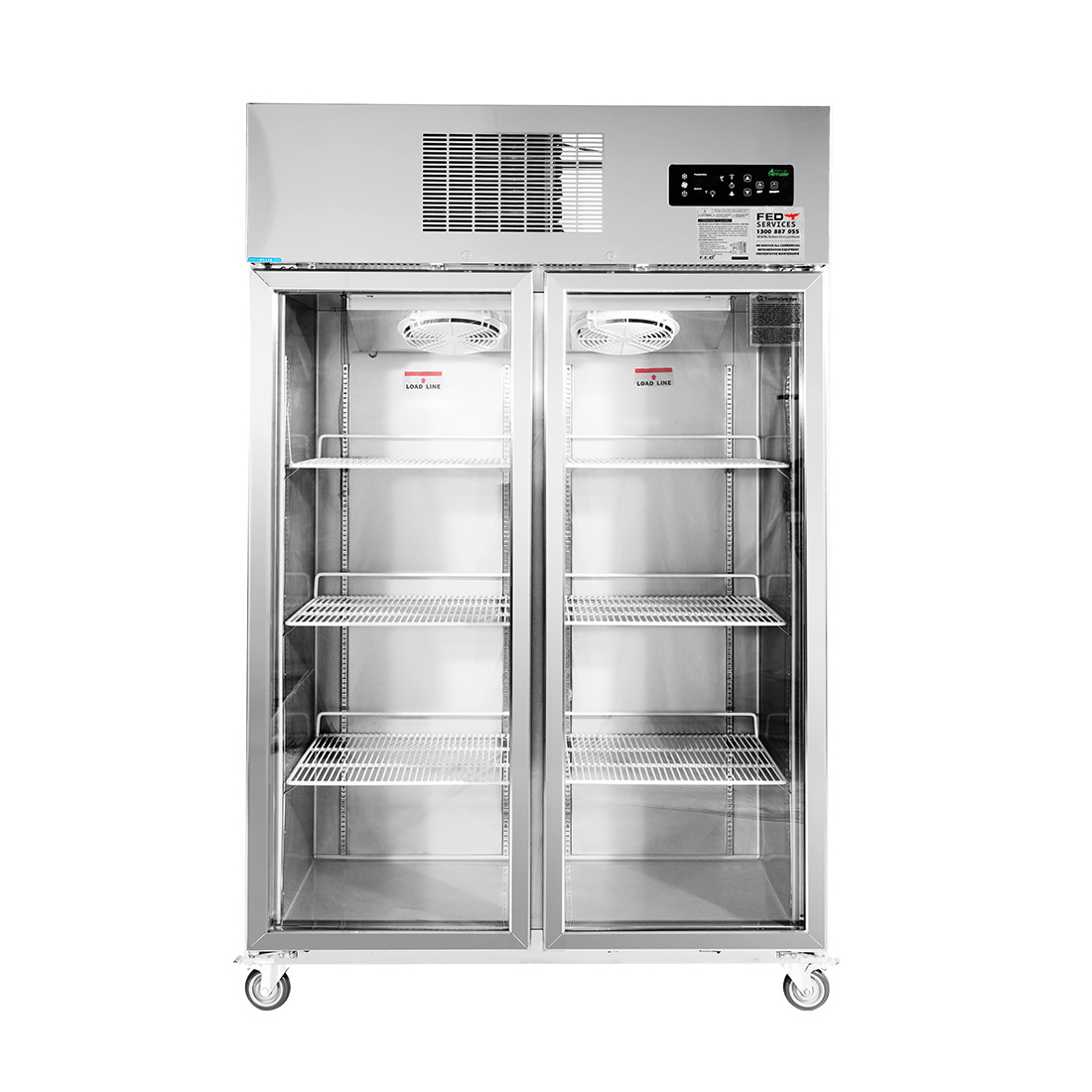
Thermaster SUCG1000 Double Door Upright Display Fridge
Model SUCG1000- Capacity (Litres)
- 1000
- Door Type
- Hinged Doors
- Temperature Range
- 2 to 8ºC (Refrigerated)
-
FED-X
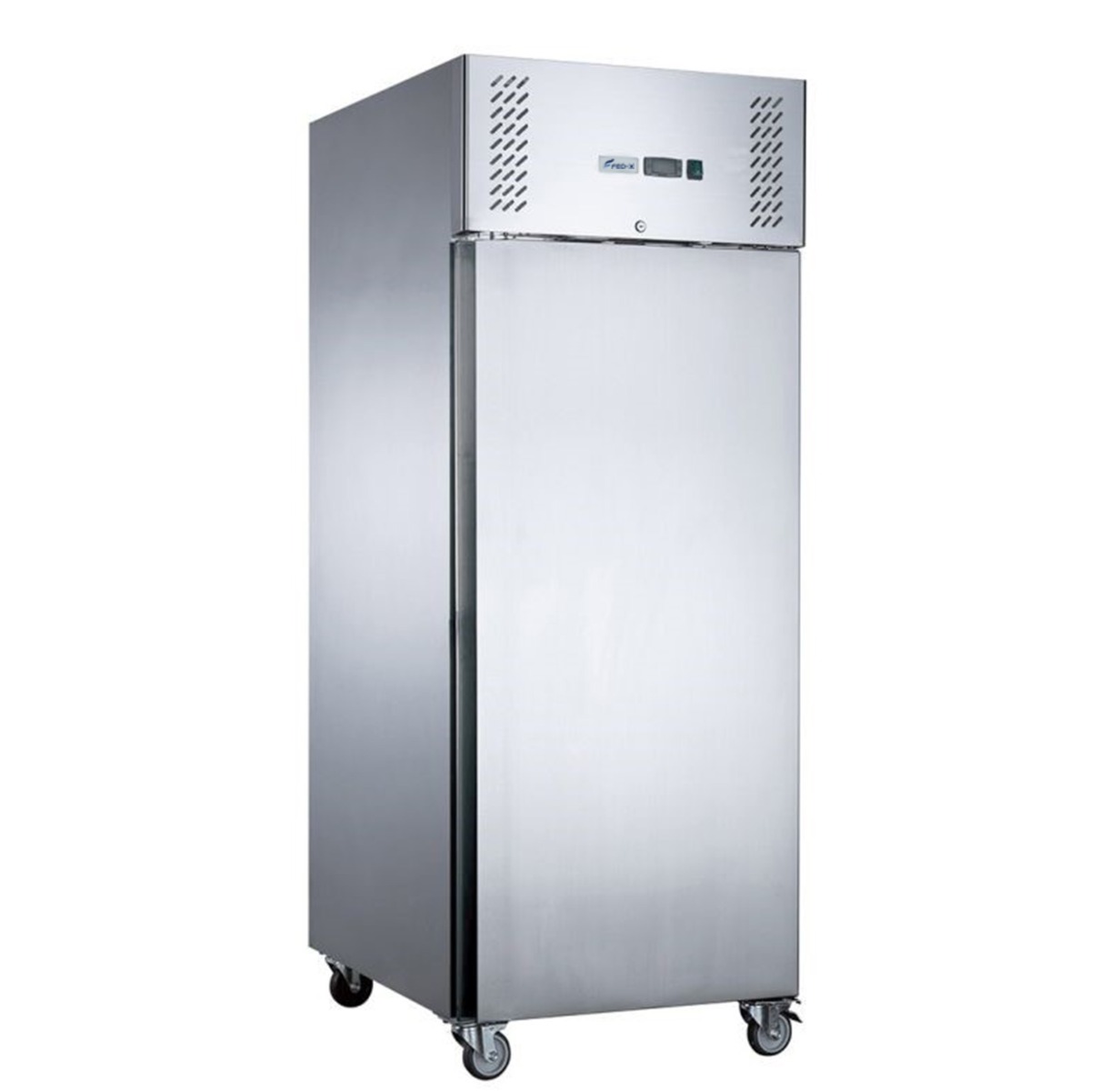
FED-X XURC600SFV S/S Single Full Door Upright Fridge
Model XURC600SFV- Capacity (Litres)
- 600
- Door Type
- Hinged Doors
Underbench
Service stock at the line, under a prep bench
-
Bromic
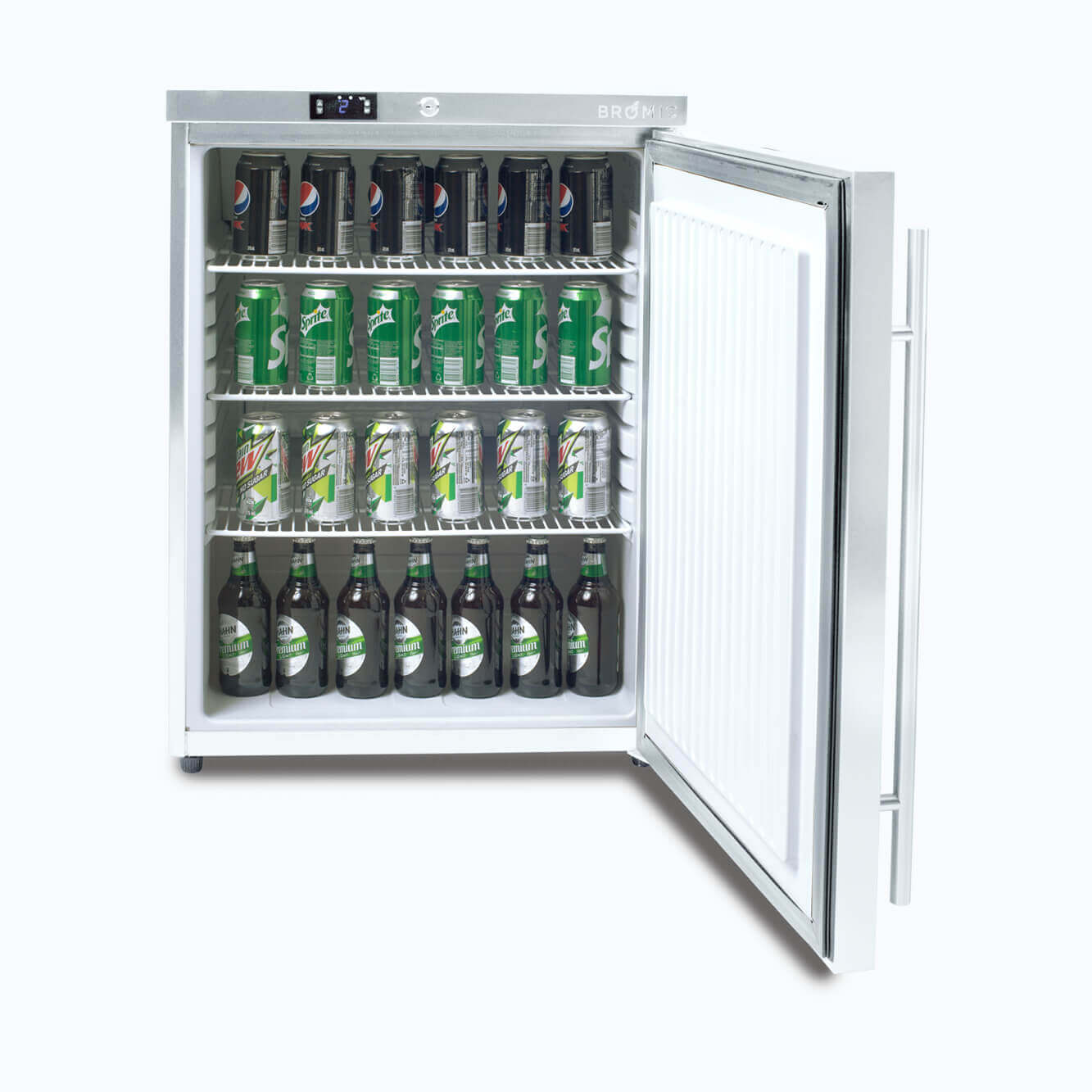
Bromic UBC0140SD-NR Under Bench Fridge - 138L - 1 Door - Stainless Steel
Model UBC0140SD- Capacity (Litres)
- 145
- Door Type
- Solid
- Temperature Range
- +1°C to +10°C
-
Atosa
Atosa YPF9020 Undercounter Fridge 1200 Mm
Model YPF9020- Capacity (Litres)
- 220
- Door Type
- Solid
- Temperature Range
- 0°C to 4°C

Bar and back-bar
Bottles and cans within reach of the pour
-
Thermaster
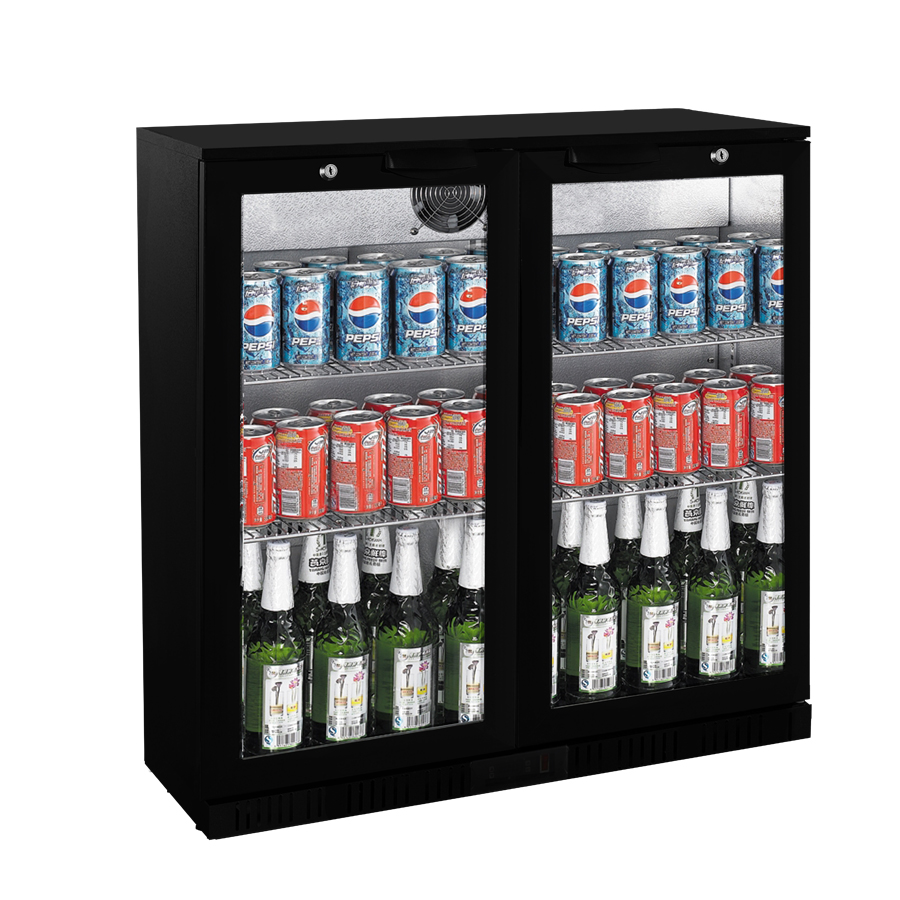
Thermaster LG-208HC Under Bench Two Door Bar Fridge/Cooler
Model LG-208HC- Capacity (Litres)
- 208
- Door Type
- Hinged Doors
-
Thermaster
Thermaster LG-208SC Under Bench Two Sliding Door Bar Fridge/Cooler
Model LG-208SC- Capacity (Litres)
- 208
- Door Type
- Sliding Doors
Drinks display
Front-of-house merchandising and self-serve
-
FED-X
FED-X XUB7C13G2V Two Glass Door Bench Fridge Stainless Steel
Model XUB7C13G2V- Capacity (Litres)
- 282
- Door Type
- Hinged Doors
-
FED-X
FED-X XUB7C18G3V Three Glass Door Bench Fridge Stainless Steel
Model XUB7C18G3V- Capacity (Litres)
- 417
- Door Type
- Hinged Doors
Salad prep
Chilled gastronorm wells over refrigerated storage
Drawer
Point-of-use chilled storage where a door cannot swing
-
Thermaster
Thermaster CBR1-3 Flexdrawer counter
Model CBR1-3- Capacity (Litres)
- 116
- Door Type
- Hinged Doors
Specifications shown are the values the exact model publishes in our catalogue; fields a listing does not record are left out rather than guessed. Confirm dimensions, electrical requirements and warranty against the manufacturer's data sheet for that exact model number before you order.