


Commercial Kitchen Equipment Maintenance: The Habits That Prevent Breakdowns
Daily, weekly and periodic maintenance habits for commercial kitchen equipment, plus why the service interval belongs in the model's manual, not a blog post.
In this article
- The quick answer
- Why maintenance is a scheduling problem, not a knowledge problem
- Build the asset list first
- Daily habits
- Weekly habits
- Periodic habits, and where the interval actually comes from
- Refrigeration: condensers, seals, drains and airflow
- Warewashing: scale, wash arms and chemicals
- Cooking equipment: grease, ventilation and gas
- Which jobs are staff jobs and which are licensed trades
- Before you call for a service
- Frequently asked questions
- Where to go next
There is no single number that tells you how often to service a combi oven, a dishwasher or a fridge. The interval that actually matters lives in the manufacturer's manual for the exact model you own, and it changes with how hard the machine works. What you can control, starting today, is whether the daily and weekly habits that prevent most avoidable failures actually happen — and whether you have the paperwork in front of you when something does go wrong.

The quick answer
Three habits prevent most of the avoidable breakdowns in a commercial kitchen: keep airflow clear around refrigeration condensers, keep water-heated equipment free of scale, and keep door and lid seals intact. None of them need a technician. All three are jobs that get skipped the moment nobody on the roster owns them.
Beyond those daily and weekly habits, the periodic work — gas servicing, refrigerant checks, electrical testing, deep descaling — follows the schedule in the manufacturer's manual for your model, not a generic quarter. This article sets out what to do, how often it's reasonable to check, which jobs are yours and which belong to a licensed trade, and what to have ready before you make a service call.
Why maintenance is a scheduling problem, not a knowledge problem
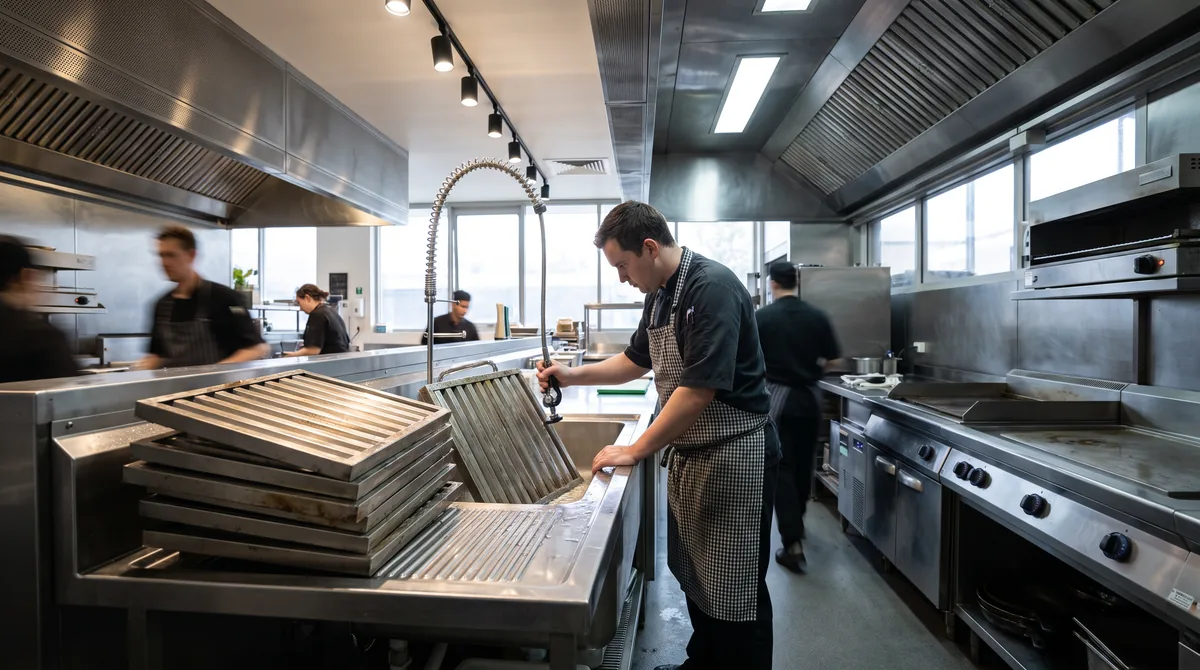
Almost every kitchen already knows that scale damages elements, that a blocked condenser makes a compressor work harder, and that a torn door seal wastes energy. The knowledge isn't the gap. The gap is that maintenance has no fixed slot on anyone's shift, so it competes with service, prep and close-down and loses every time something more urgent is happening — which in a working kitchen is always.
The fix is not a better checklist. It's putting the habit on the same roster as a prep task, with a name against it, at a time it will actually get done: condenser brushing on the same day as the stocktake, door seal checks folded into the close, oil filtration logged at the end of dinner service. A checklist nobody is rostered to complete is a wall decoration. A five-line habit with an owner and a time slot is maintenance.
This matters more than it sounds like it should, because the alternative isn't "nothing goes wrong" — it's the same failure paths recurring on their own schedule instead of yours. Scale builds regardless of whether anyone notices. A blocked condenser runs hot regardless of whether anyone brushes it. The machine doesn't wait for a quiet week to fail; it fails during service, on the night you can least afford it.
The venues that get this right tend to share one trait: someone senior treats the maintenance roster as seriously as the food safety log, checks it, and follows up when a box hasn't been ticked. It doesn't need to be elaborate. A clipboard by the walk-in door with a name and a date against each task beats a shared spreadsheet nobody opens during service.
Build the asset list first
Before any maintenance schedule is worth writing, build the record that makes every later service call faster: one page per significant machine, listing the brand, the exact model number, the serial number, the install or purchase date, the power or gas supply it's connected to, the warranty term and who to call for service. It takes an afternoon to compile across a kitchen and saves that afternoon back on the first breakdown, because the technician can bring the right part on the first visit instead of the second.
This detail matters more than most kitchens assume, because you cannot reliably get it from the online listing your equipment was bought from. Across the KitchenCompare catalogue, the share of active listings that actually publish key ownership fields is low and varies sharply by category:
| Field | Refrigeration (n=3,352) | Cooking equipment (n=5,071) | Dishwashing (n=912) | Commercial ovens (n=2,192) |
|---|---|---|---|---|
| Warranty | 51% | 44% | 14% | 31% |
| Country of origin | 39% | 47% | 13% | 37% |
| Power supply | 10% | 27% | 10% | 26% |
| Refrigerant | 30% | n/a | n/a | n/a |
| Width (mm) | 68% | 74% | 29% | 64% |
Share of active tracked KitchenCompare listings publishing each field, by department, as at 21 August 2026. Figures describe what retailer listings publish, not what manufacturers provide — a manufacturer commonly states a warranty term that the retailer's listing simply doesn't carry through. Some attribute fields also carry mismatched values (a small number of "Climate Class" fields hold warranty text instead, for example), so these percentages are an upper bound on what's actually usable, not a floor.
Across the whole active catalogue — 37,474 comparable SKUs tracked across 49 active Australian retailers as at 21 August 2026 — warranty terms are published on 18.7% of listings, country of origin on 15.0%, power supply on 5.8% and refrigerant type on 2.6%. Dishwashing is the weakest category for warranty coverage of the four shown here, at 14% against a sample of 912 listings.
The honest conclusion is that you cannot rely on a product listing to hand you the warranty term, the refrigerant charge or the electrical supply months or years after purchase. Capture it yourself when the machine is commissioned, while the paperwork and the installer are both still in front of you. Compare current specifications and prices for the exact model you're replacing, rather than trusting an old listing, on the refrigeration category page or the equivalent category for your equipment.
Daily habits
These take minutes and belong to whoever is closing or opening, not to a manager doing a weekly walk-through.
- Dishwashers and glasswashers. Drain, rinse and leave the machine open overnight so it dries out rather than sitting in stagnant water. Clear filters and wash arms of food debris — blocked jets are the single most common reason a warewasher stops cleaning properly.
- Fridges and ovens. Wipe door and lid seals as part of the close. Grease and food debris on a seal stop it sealing long before the rubber actually perishes.
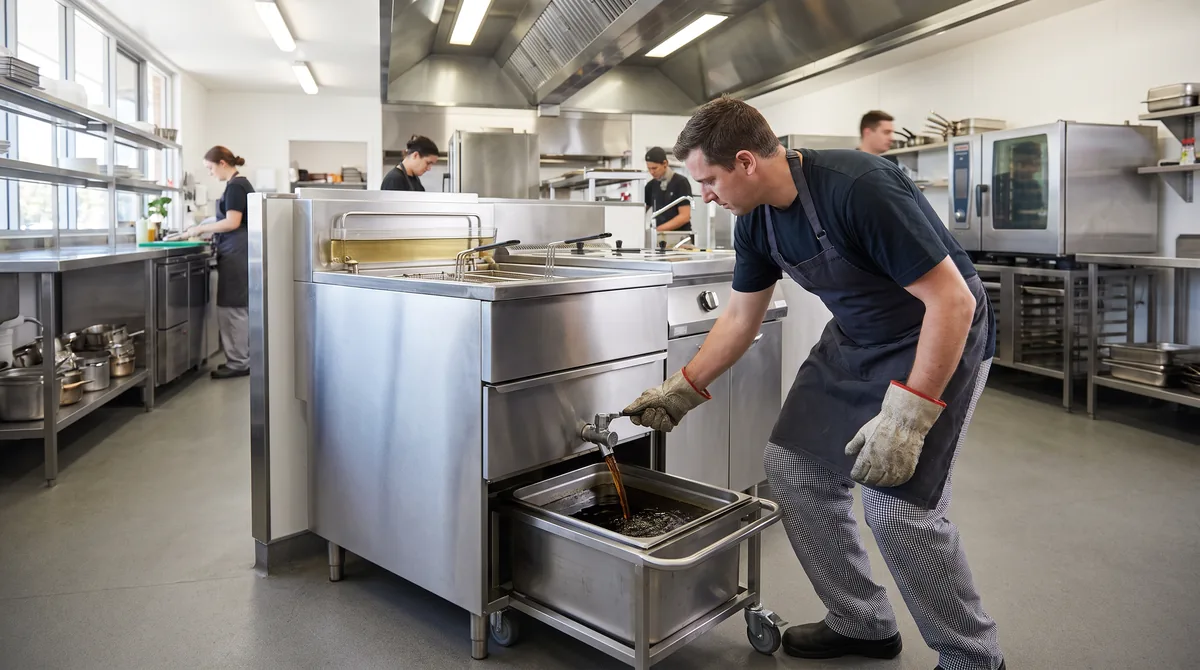
- Fryers. Filter or change oil on the schedule set for your fryer and the food being cooked in it. Degraded oil damages the food first and the fryer's heating element and thermostat second.
- Everything. Log any fridge running warmer than it should, any appliance tripping power, or any unusual noise or smell. A symptom caught on day one is a five-minute adjustment. The same symptom ignored for three weeks is a call-out, and often a spoiled delivery of stock alongside it.

Weekly habits
Weekly habits need a rostered slot rather than a daily one, because they take longer and are easier to defer under service pressure — which is exactly why they need to be scheduled instead of left to memory.
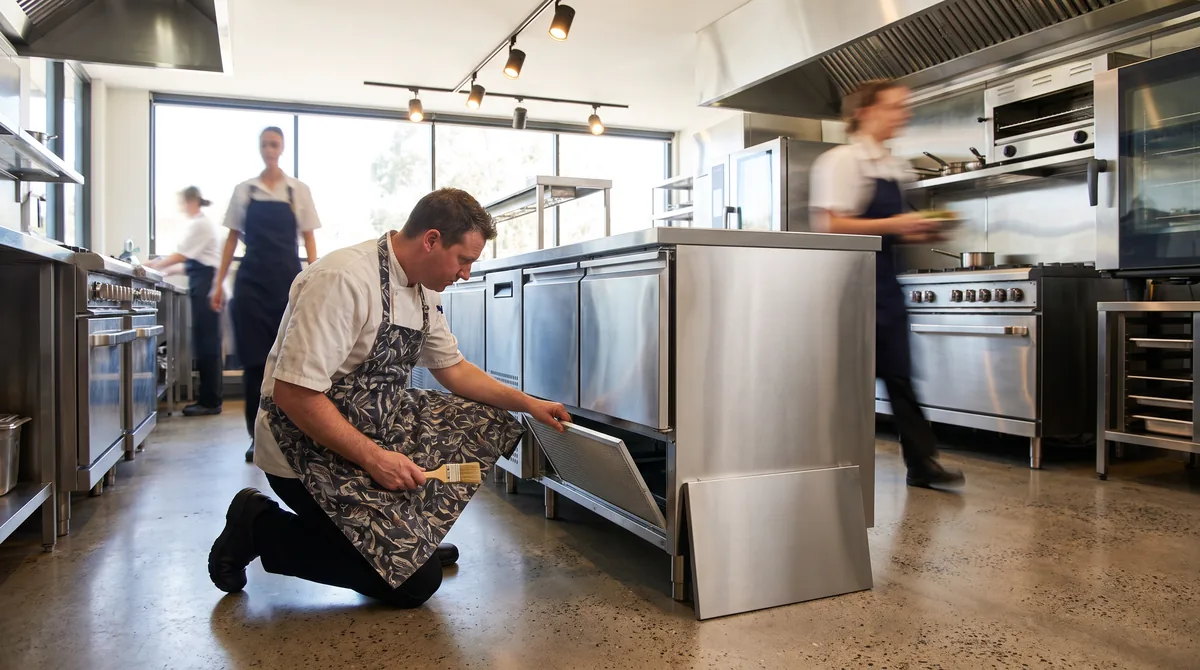
- Refrigeration condensers. Brush or vacuum condenser coils and check that airflow around the unit isn't blocked by boxes or stock. Flour-heavy bakeries and greasy kitchens need this more often than a café; dust and grease both restrict airflow the same way.
- Combi ovens and steam equipment. Run the manufacturer's cleaning or descale cycle on the schedule the machine's control panel and manual specify. Combi ovens fail differently to other cooking equipment because their boilers and injectors are the parts scale attacks first.
- Castors, feet and hardware. Check bench equipment feet, castors and brakes. Movement wears cable and gas connections that are supposed to stay still.
- Doors and closers. Test self-closers and hinges on fridge and cool-room doors. A door that doesn't fully latch runs the compressor the same way a torn seal does, and it's often the cheaper fix of the two.
Periodic habits, and where the interval actually comes from
This is the section that most maintenance advice gets wrong by publishing a fixed interval — quarterly, six-monthly, annual — as if every kitchen and every machine run the same load. They don't. A fryer in a high-volume QSR earns a service interval a fraction of the length of the same model running a handful of covers a night in a café. A dishwasher behind a busy bar sees more cycles in a week than one in a function room sees in a month.
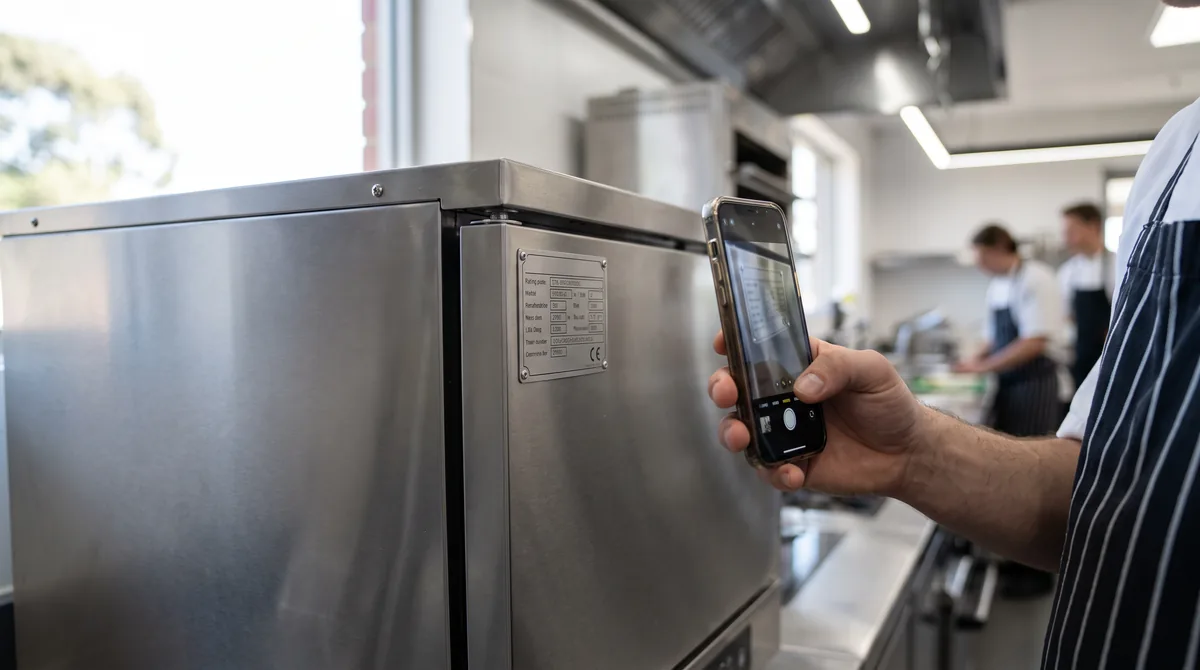
The interval that actually applies to your machine is set by the manufacturer's manual for that exact model, usually as a combination of a calendar interval and a usage or cycle count. Find the model number on the rating plate, locate the manual — the manufacturer's site or the installer who supplied it are the two reliable sources — and follow the service schedule it sets out, including which parts it specifies as consumable and which cleaning agents it approves. Using an unapproved chemical or a longer-than-specified interval is one of the more common ways an otherwise valid warranty claim gets refused.
If you've inherited equipment with no manual on hand, the model number is still the way back to one: how model numbers actually work covers how to read a rating plate and track down documentation for equipment you didn't buy new.
Refrigeration: condensers, seals, drains and airflow
Refrigeration fails in a small number of predictable ways, and all of them show up as the same symptom before they show up as a breakdown: the compressor running more than it should.
- Condensers. A blocked condenser can't reject heat efficiently, so the compressor runs longer to hold temperature and wears out sooner doing it. This is the weekly brush-or-vacuum job above, and it's the highest-value five minutes in refrigeration maintenance.
- Door seals. A torn or perished gasket lets warm, humid air into the cabinet continuously, which both runs the compressor harder and makes it harder to hold food at a safe temperature.
- Drains. Evaporator drains that block with debris cause water to pool inside the cabinet or freeze into ice at the coil. Check and clear the drain line as part of a periodic clean, not only when you notice standing water.
- Ambient and clearance. A cabinet installed hard against a wall or in direct sun works harder than the same cabinet given clearance and airflow. If a fridge runs constantly and still won't hold temperature, check clearance and condenser cleanliness before assuming the unit itself has failed — it's the more common cause of the two.
- Refrigerant. Refrigerant type and charge sit behind the panel and are a licensed job to check or top up, not a staff one. Coverage of refrigerant type on retailer listings is thin across the catalogue — 30% for refrigeration listings and 2.6% catalogue-wide as at 21 August 2026 — which is another reason to record it from the compliance plate or the installer's paperwork at commissioning rather than expect to find it later on a listing.
Whatever the symptom, verify actual food temperature with a calibrated probe thermometer rather than trusting the cabinet's dial or digital readout on its own — food safety authorities recommend probe verification for exactly this reason. Food Standards Australia New Zealand sets out how to keep food at the right temperature and how to use and calibrate food thermometers (both accessed 21 August 2026); read them directly for the current guidance rather than relying on a paraphrase, since the specifics can be updated.
For the fuller decision on which refrigeration format suits your kitchen in the first place, see the commercial fridge buying guide.
Warewashing: scale, wash arms and chemicals
Warewashing equipment has the worst documentation of any category we track — only 14% of active dishwashing listings in the KitchenCompare catalogue publish a warranty term, against a sample of 912 listings as at 21 August 2026, and that's a listing-coverage figure, not a statement that manufacturers don't offer a warranty. It's a strong argument for building your own asset record rather than relying on the listing to still be there when you need it.
The mechanical failure paths are narrower than refrigeration's, and mostly come down to two things:
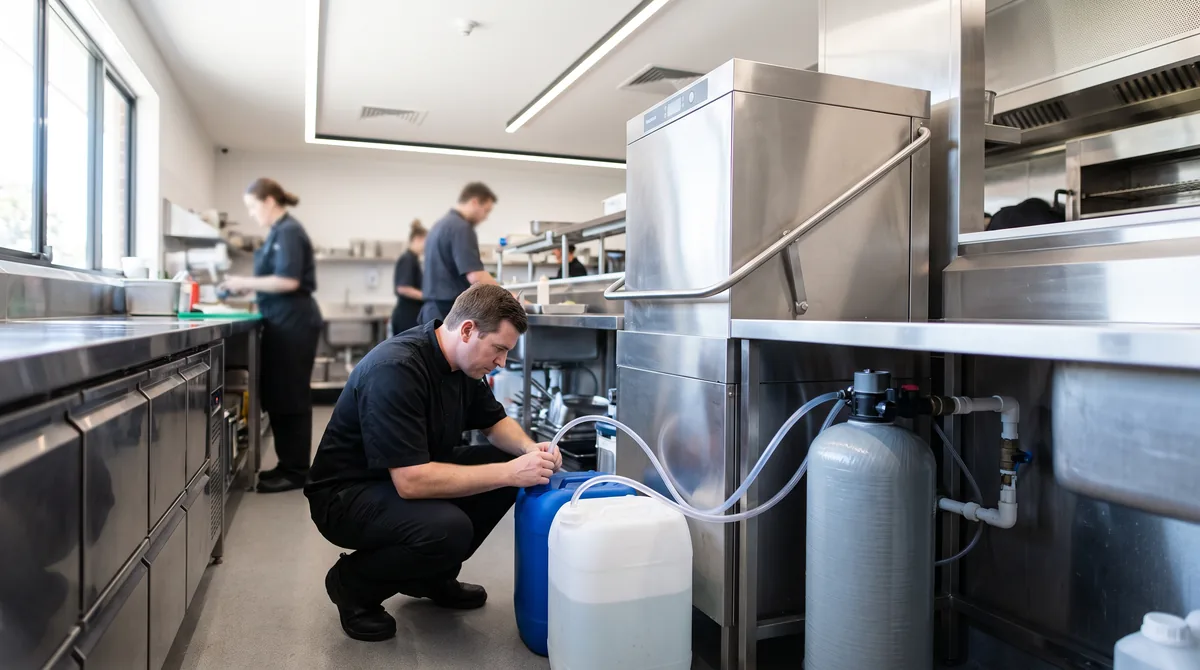
- Scale. Wherever water is heated inside the machine — wash tank, booster heater, rinse jets — dissolved minerals deposit as scale on contact with heat. Scale insulates elements so they work harder for the same result, and it blocks the small jets in wash and rinse arms first, which shows up as poor wash results before it shows up as a fault code. Whatever water treatment or dosing the manufacturer specifies for local water hardness needs to actually be fitted and its cartridges or salt replaced on schedule, not when someone happens to notice.
- Chemical dosing. Detergent and rinse-aid dosing set incorrectly — too little or too much — either leaves residue on glassware and crockery or wastes chemical and damages surfaces over time. Dosing pumps need periodic calibration against the machine's specification, which again sits in the manual for that model.
Wash arms, filters and door seals are the daily and weekly staff jobs described above; the detergent and rinse-aid dosing system, along with any internal descale beyond what the machine's own cleaning cycle handles, is where it becomes worth checking whether that's a staff job on your specific machine or one for the servicing technician — the manual will say. For sizing and format decisions before you buy, see the commercial dishwasher buying guide.
Cooking equipment: grease, ventilation and gas
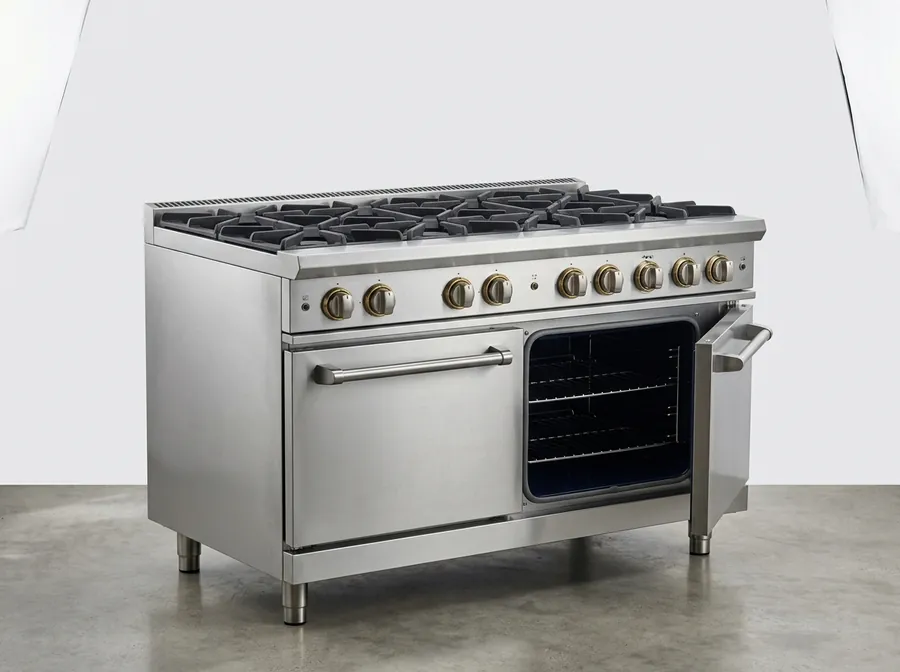
Cooking equipment carries the widest range of maintenance needs of any category, because it covers everything from a benchtop salamander to a floor-mounted combi oven, and because it's the category where a maintenance failure most often becomes a safety issue rather than just a cost.
- Grease. Canopy filters, extraction ductwork and cooking surfaces all accumulate grease through service. Grease-laden filters restrict extraction airflow, which pushes heat and smoke back into the kitchen and is also a fire-load issue building insurers and fire authorities take seriously. Clean or replace filters on a schedule that matches how greasy the cooking actually is, not a generic interval.
- Ventilation. Extraction capacity and make-up air both need to keep working as designed; a canopy that's technically running but starved of clean filters or blocked ductwork isn't actually protecting the kitchen the way it was specified to.
- Fryer oil. Covered above under daily habits — filtration is the daily job, oil quality monitoring is the ongoing one.
- Gas appliances. Burner cleanliness, flame colour and pilot behaviour are worth a visual check as part of routine cleaning, but gas pressure testing, combustion checks and any work on gas connections are licensed work in Australia. Don't attempt to adjust a gas appliance's regulation or combustion yourself, and don't keep using an appliance showing an irregular flame, soot, or a gas smell — isolate it and call a licensed gasfitter.
Combi ovens deserve a specific mention because scale is the failure path that defines them: their boiler and steam-injection system are exactly the parts water minerals attack first, and the manufacturer's descale schedule is the single most important periodic habit for that machine. See the combi oven buying guide for how scale and water treatment factor into choosing one in the first place.
Which jobs are staff jobs and which are licensed trades
Getting this boundary right is a safety decision, not just a maintenance one.
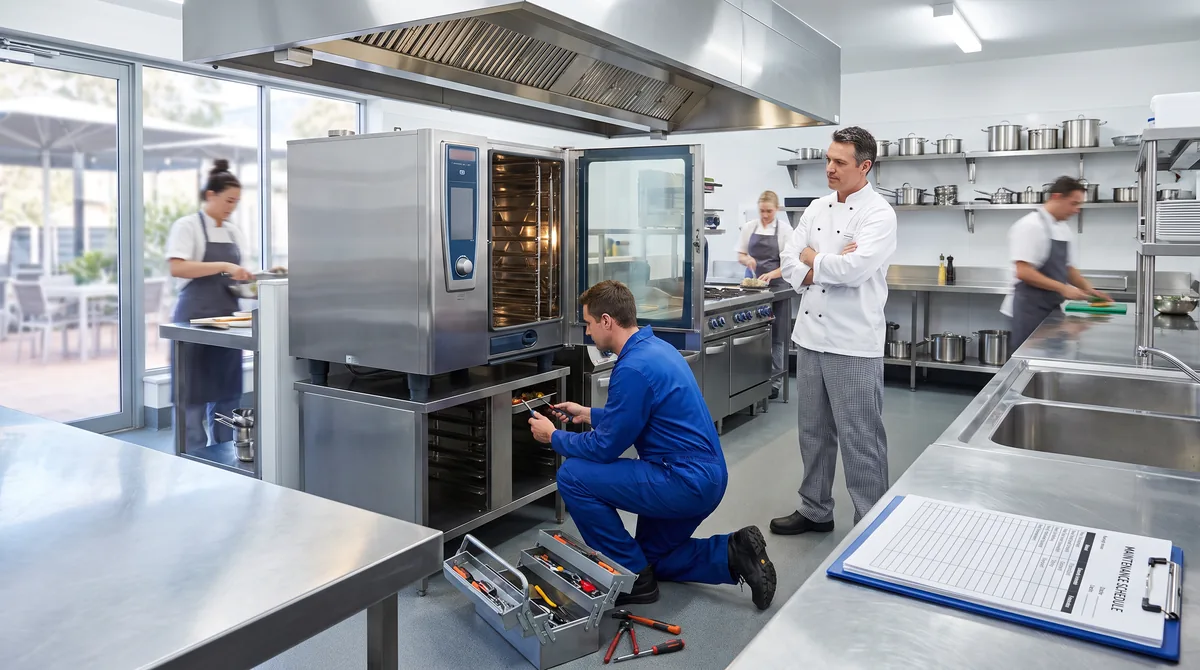
Staff jobs, once trained, include: cleaning and sanitising, checking and wiping seals, clearing filters and wash arms, brushing condenser coils, filtering fryer oil, checking castors and hardware, and logging anything unusual for follow-up. None of these require opening an electrical enclosure, working on a gas line, or handling refrigerant.
Licensed-trade jobs include anything behind an electrical or gas enclosure, any work on gas connections, pressure or combustion, any refrigerant handling, and any calibration or repair work the manufacturer's manual specifies as a technician task. Gas fitting and electrical work on commercial kitchen equipment are licensed activities in Australia; confirm the specific licensing and compliance requirements that apply with your installer, your gas or electrical contractor, or the relevant state or territory regulator, since the detail varies by jurisdiction and by the type of work.
Isolate equipment — power and gas — before any cleaning or inspection that goes near a panel or burner, and never defeat a safety cut-out or interlock to keep a machine running through a service period. A machine that's cutting out is telling you something; working around the cut-out doesn't fix what it's telling you.
Before you call for a service
Have the following ready before you pick up the phone. It turns a diagnostic first visit into a repair first visit far more often than not:
- The model and serial number from the rating plate, not from memory or an old invoice that might describe a different revision of the same model.
- What the fault actually looks like — an error code if there is one, when it started, and whether it's constant or intermittent.
- What's already been checked — seals, filters, condenser, power supply — so the technician isn't repeating the daily habit checklist on-site.
- The warranty status and purchase date, from your own asset record rather than the original listing, since the listing may no longer be live or may never have carried the warranty term in the first place.
- Site access details — power isolation point, gas isolation point, and anything blocking access to the machine.
This is the same one-page-per-machine record described earlier, used for the purpose it exists for. Keep it somewhere the whole team can find it, not on one manager's phone.
Frequently asked questions
How often should commercial kitchen equipment actually be serviced?
There's no single correct interval across all equipment. It's set by the manufacturer's manual for the exact model, combined with how hard the machine runs — a high-volume site earns a shorter interval than a low-volume one on the same model. Find the model number and check the manual rather than applying a generic quarterly or annual rule.
Which maintenance jobs can staff do, and which need a licensed technician?
Cleaning, seal checks, filter clearing, condenser brushing and oil filtration are staff jobs once trained. Anything behind an electrical or gas enclosure, gas pressure or combustion work, and refrigerant handling are licensed-trade work in Australia. Confirm the specific requirements for your job with your licensed contractor.
Why does my fridge run constantly and still not hold temperature?
The two most common causes are a blocked condenser restricting airflow and a torn or perished door seal letting warm air in continuously. Both are staff-checkable before assuming compressor failure. Clearance from walls and direct sun also affects how hard a unit has to work to hold its set point.
Is a maintenance or service contract worth it for a small venue?
That depends on your equipment mix, call-out costs in your area and how much downtime costs your business — figures this article can't state on your behalf. Weigh a contract's cost against the cost of an unscheduled peak-period call-out plus lost trade, and check what the contract actually covers against what your manual requires.
What should I have ready before I call for a service?
The model and serial number from the rating plate, a description of the fault including any error code, what's already been checked, the warranty status from your own records, and site access details for power and gas isolation. This turns most call-outs into a single visit.
Why doesn't a product listing show me the warranty or specifications I need?
Retailer listings frequently don't publish every field a manufacturer offers. Across the KitchenCompare catalogue, warranty terms appear on well under half of listings in most categories and as low as 14% in warewashing (n=912, as at 21 August 2026). Capture these details yourself at commissioning rather than relying on the listing later.
How do I stop maintenance being everyone's job and therefore nobody's?
Put each habit on the roster with a named owner and a specific time — the same way you roster prep, not as a separate checklist that competes with service. A job without an owner and a slot doesn't happen consistently, regardless of how clearly it's written down.
Where to go next
Build the one-page asset record for every significant machine first — it's the single change that makes every future service call faster. Then compare replacement or additional equipment on the exact specifications that matter for your site, rather than on a listing that may not carry the full picture, in the refrigeration category or the equivalent category for what you're replacing. If you're planning a fitout or a larger equipment refresh where service access and utility connections still need to be designed in, the kitchen fitout budget guide covers where servicing sits in that budget.