


Underbench Fridge Buying Guide: Measuring, Doors and Placement
The three measurements that kill an underbench fridge order, how many doors you actually need, and why the appliance next to it decides the spec.
In this article
An underbench fridge exists to put cold stock where the work happens. It is service storage: the things a chef reaches for during a shift, at arm's length, under the bench they are already standing at.
That makes it the partner to your upright, not a substitute for it. The upright holds the reserve — what you bought at the last delivery and will use over the week. The underbench holds what this service needs. Getting that split right is the beginning of a sensible refrigeration plan; for the whole picture across chillers, freezers and cold rooms, see how to choose commercial refrigeration.
Measuring before you shop
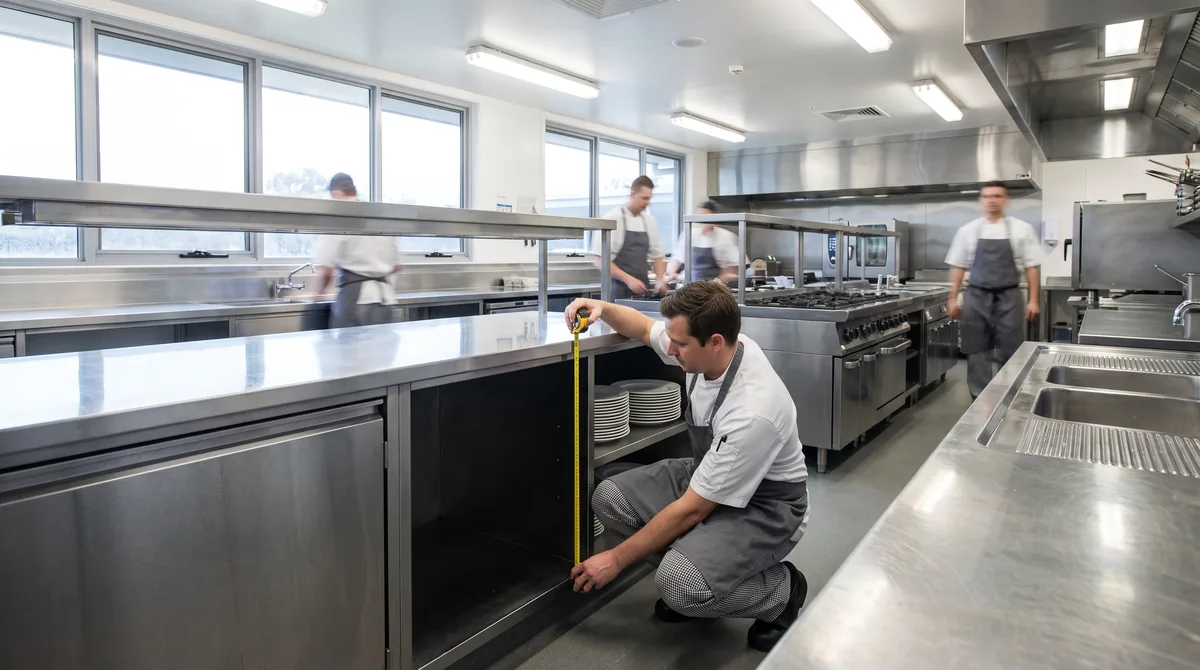
Three measurements kill more underbench orders than any specification issue. Take all three to the supplier before you look at a single model.
- Height under the bench
- Finished floor to the underside of the bench, measured in more than one place. Check whether the model's stated height includes castors or legs — some are supplied either way.
- Depth including the swing
- Cabinet depth plus door thickness, plus how far the door projects when open, plus anything protruding at the rear. The listed depth is the cabinet, never the footprint.
- Clearance to breathe
- The manufacturer's stated air path at the condenser — front, rear or side depending on the model.
The measurement people skip
Depth is quoted for the cabinet, so a unit can fit the void perfectly and still be unusable because the open door fouls the bench opposite. Measure the aisle as well as the hole, and check which side the door is hinged before you order.
Height under the bench. Measure from the finished floor to the underside of the bench at the exact position, and measure it in more than one place — floors are rarely level and benches are rarely straight. Then check what the cabinet's stated height includes. Castors and adjustable legs change it, and some units can be supplied either way.
Depth including the door swing and the compressor. The listed depth is the cabinet. It is not the footprint. Add the door thickness and how far the door projects when open, plus anything protruding at the rear. A unit that fits the void but whose door fouls the opposite bench is a unit that will be worked around badly for years.
Clearance to breathe. Every fridge rejects heat, and it needs the manufacturer's stated clearance at the condenser — front, rear or side, depending on the model — to do it. Building an underbench unit into a tight recess with no air path is the most reliable way to shorten its life. Check where the condenser draws and exhausts on the exact model before you plan the cabinetry around it.
Also worth measuring: the delivery path. Doorways, corners, a step at the back door, and the height of a lift are all cheaper to check than to discover.
How many doors
Door count follows what actually lives inside, not the length of bench you have spare.
One door suits a single section — a bar, a coffee station, a small prep area, a dessert station. It is also the right answer for a second cold point somewhere that currently has none.
Two doors is the workhorse for a prep or service section that holds several categories of stock for one service.
Three doors suits a long prep line or a section holding for multiple services, where staff are working along the run rather than at one point.
A related decision: a long underbench run is often better as several units than one long one. Separate units let you put cold exactly where each task is, keep one running if another fails, turn one off in a quiet season, and replace one at a time as they age. The counter-argument is cost per litre and more connections. In most kitchens the flexibility wins.
| Configuration | What it suits | Watch for |
|---|---|---|
| One door | A single station — bar, coffee, dessert, a small prep area | Easy to under-buy; a second cold point is often cheaper than a bigger one |
| Two doors | A prep or service section holding several stock categories for one service | The workhorse; check shelf spacing against gastronorm pans |
| Three doors | A long prep line, or a section holding for multiple services | One long cabinet fails as one unit — consider two smaller ones |
| Several units | A long run where each task has cold at hand | More connections and more cost per litre, but far more resilient |
Doors or drawers
Doors are cheaper, give you the full internal volume, and suit bulk items and anything on a shelf.
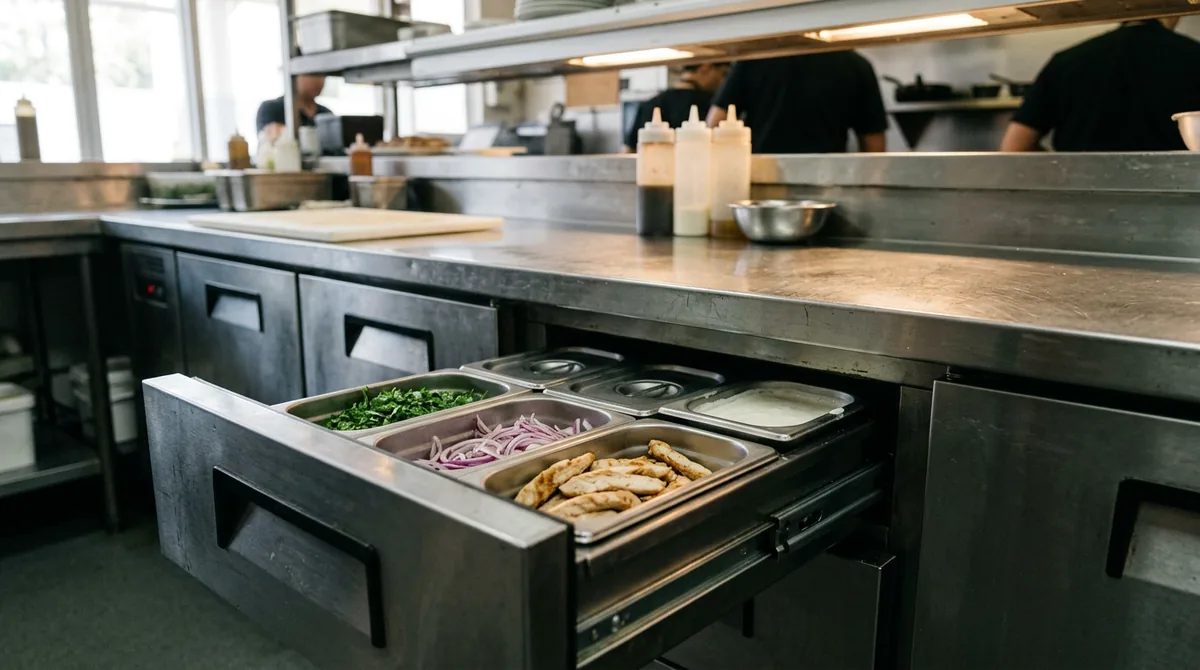
Drawers are faster to access, keep cold in better because you are not opening a whole cabinet, and suit a prep line where the same pans are opened repeatedly through a service. They cost more, the mechanism is a wear item, and the drawers themselves consume internal volume.
| Doors | Drawers | |
|---|---|---|
| Cost | Lower | Higher, and the mechanism is a wear item |
| Access speed | Slower — open, find, reach | Faster, and the pan you want is on top |
| Cold retention | A whole cabinet opens at once | Only one drawer's air is exposed |
| Internal volume | Full cabinet | Reduced by the drawer boxes |
| Best for | Bulk items and varied stock on shelves | The same pans opened repeatedly through service |
The practical test: if staff open it constantly during service and reach for the same few things, drawers pay for themselves in speed and in cold retention. If it holds varied stock accessed occasionally, doors are the better buy. See drawer fridges for the drawer options.
Where it sits, and why that decides the spec
This is the single most common failure, and it is a placement problem rather than a product problem.
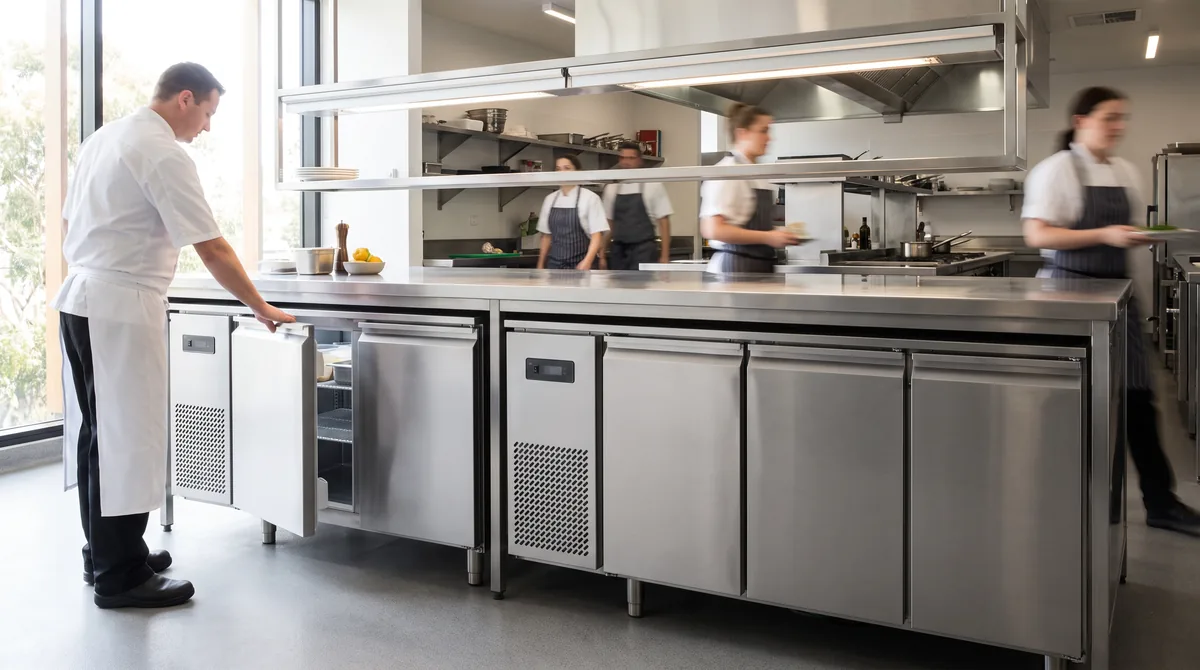
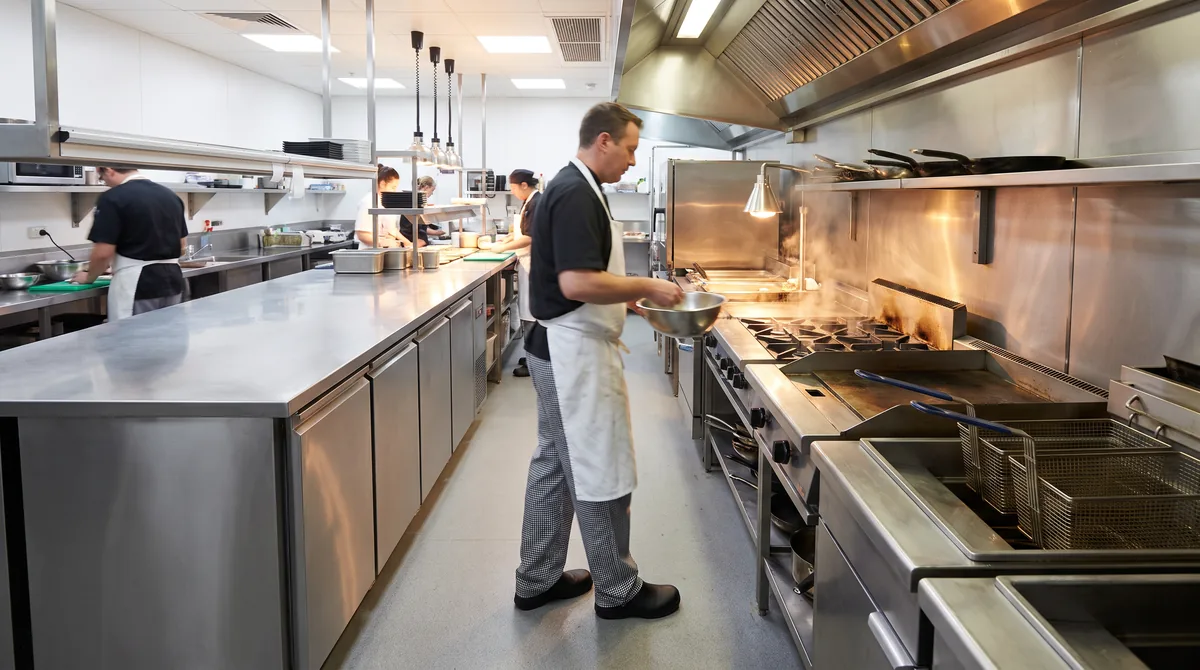
An underbench fridge installed beside a fryer, grill, oven or salamander is not living in your room's ambient temperature. It is living in a local pocket that is much warmer, all service, every service. The compressor runs longer, the cabinet struggles to hold, and the unit ages faster.
An underbench fridge beside a fryer is not living in your room's ambient temperature. It is living in a local pocket that is much warmer, all service, every service.
Commercial refrigeration carries a climate class, which states the ambient conditions the unit is designed to hold temperature in. It is on the rating plate and in the specification sheet, and it is one of the few numbers on that sheet that will actually predict whether the unit works for you. Many imported cabinets are rated for cooler ambient conditions than a working Australian kitchen sees in February.
Tell the supplier where it is going
Climate class is one of the few numbers on a specification sheet that predicts whether the cabinet will actually hold temperature for you. Give the supplier the position — next to the fryer, in a closed joinery run, under a window — and ask them to confirm the class of the exact model against it. A cabinet rated for a cooler ambient is not faulty when it struggles; it is mismatched.
Practical rules:
- Do not put refrigeration next to cooking equipment if there is any alternative.
- If you have no alternative, tell the supplier where the unit is going and check the climate class of the exact model against that reality.
- Leave the manufacturer's clearances even when the joinery would rather you did not.
- Give the condenser somewhere to exhaust that is not straight into another appliance.
Fridge, freezer or a combination
Underbench freezing suits a line that needs frozen product to hand — a fryer section, a dessert station, a bar that goes through ice cream. If your frozen stock is bulk reserve, a chest or upright freezer elsewhere is the better and cheaper answer.
Some ranges offer combination units with a fridge section and a freezer section under one bench. They suit a tight site with both needs, at the cost of less of each. See underbench freezers for the dedicated options.
Build details that matter over ten years
- Door seals. Gaskets are the most common wear item on any commercial fridge. Ask whether they are a user-replaceable magnetic gasket and whether they are stocked in Australia for that model. A cabinet you cannot re-seal is a cabinet you will replace.
- Hinges and self-closing. Self-closing doors save you from the door left ajar through a service, which is the most expensive small mistake in a kitchen. Check the hinge is serviceable.
- Castors or legs. Castors let you pull the unit out to clean behind and under it, which means it will actually be cleaned. Legs are more stable and easier to level. Castors with brakes are a good compromise.
- Shelving. Check whether the shelves suit gastronorm pans, whether they are adjustable, and whether they are coated or stainless.
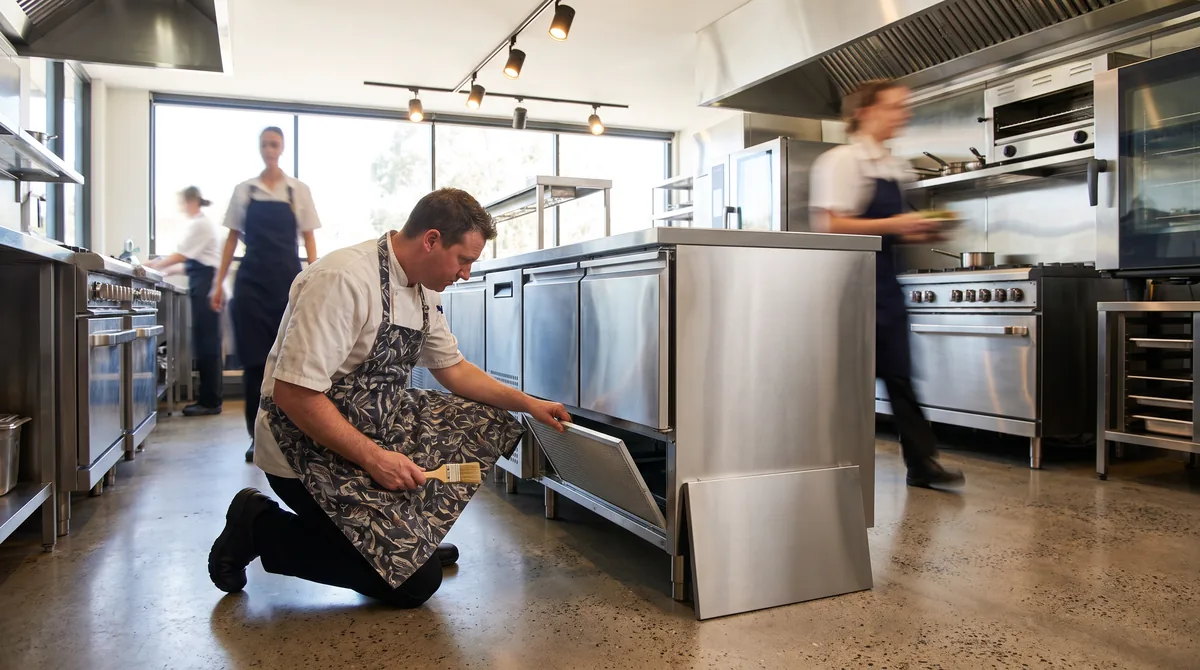
- Condenser access. If cleaning the condenser requires dismantling the cabinet, it will not happen. A front-accessible condenser is worth paying for.
Cleaning and the maintenance that prevents the callout
Three habits prevent most underbench fridge callouts:
- Seals. Wipe them weekly and check they still seal along the whole edge. A note left in the door should be gripped.
- Condenser. Clean it at the manufacturer's interval. A blocked condenser is the leading cause of a cabinet that will not hold temperature, and it looks exactly like a refrigerant fault.
- Drainage. Keep the condensate path clear. A blocked drain produces water in the cabinet and a puddle on the floor.
For the wider habits, see maintenance habits that extend commercial equipment life.
Measured up and know the door count? Compare underbench models on the exact supplier model number, with live retailer prices and price history — never matched on product names.
Compare underbench fridgesComparing specific models
Underbench refrigeration is a category where series names hide big differences. One series routinely spans two- and three-door versions, doors and drawers, solid and glass doors, different climate classes, different shelving, castors or legs, and different power connections — behind model numbers that differ by a single suffix.
That is why every comparison on this site is matched on the exact supplier model number rather than on product names; see why model numbers matter. Prices shown on the site include GST.
Compare like for like on: external dimensions including door projection, internal volume, door or drawer configuration, climate class, shelving supplied, gasket replaceability, condenser position and access, castors or legs, electrical requirement, warranty terms and local service coverage.