


Pass-Through Dishwasher Buying Guide: Line Layout, Hood Clearance and Site Checks
How a pass-through dishwasher turns wash-up into a two-person line, and the hood clearance, benching and power checks that rule machines out before spec sheets matter.
In this article
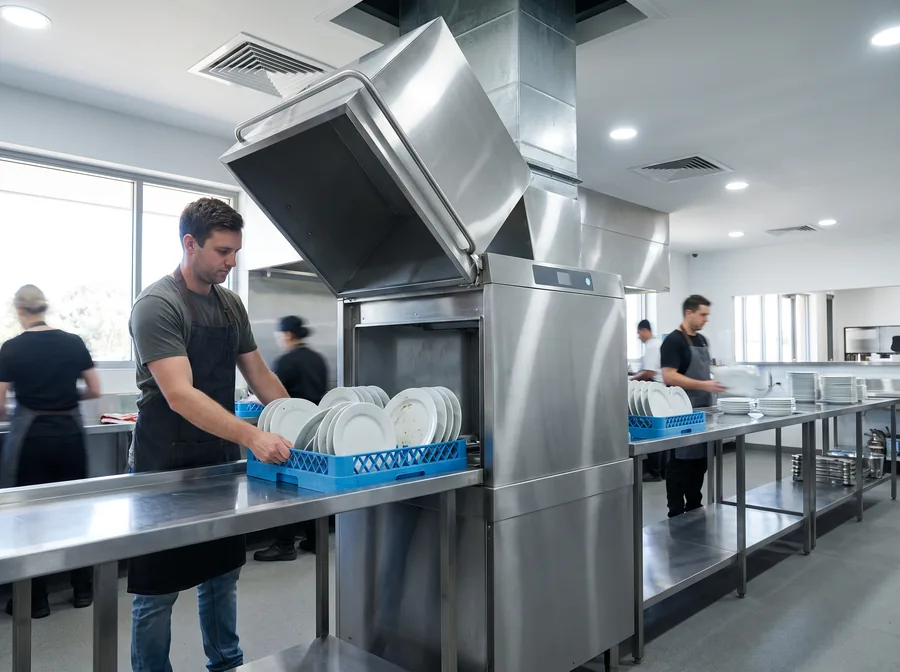
A pass-through dishwasher is a lifting hood over a rack that slides in dirty on one side and out clean on the other. It is the configuration that turns wash-up from a single station into a line, and it is the default choice for a restaurant, pub or function venue that can staff two people at it through service.
That last condition is the one buyers skip. A pass-through bought for a kitchen that only ever puts one person on it is not automatically an upgrade on an underbench machine — see the full commercial dishwasher buying guide for how it compares against underbench, glasswasher and conveyor configurations before you commit to this one.
How a pass-through line actually works
Dirty items land on the loading bench on one side. The operator scrapes, racks and slides the rack under the hood, which lowers and runs the cycle. On the clean side, a second operator lifts the finished rack off and unloads it while the next dirty rack is already loading. Done properly, the machine is never standing empty between racks.
Done with one operator, that overlap disappears. The same person has to walk around, unload, reload and start the next cycle, which turns a fast machine into a slow one. If you cannot commit two people to the wash-up during peak service, an underbench machine — see the underbench dishwasher guide — is often the better fit even at a lower rack-per-hour rating, because a single operator can actually run it at its rated speed.
Hood clearance and benching — the site checks specific to this machine
These are the checks that rule out an otherwise ideal machine, and they are specific to the hood format:
- Hood travel clearance. Measure the height available above the machine for the hood to lift fully. A range hood, low ceiling, shelving or ductwork above the wash-up bay is the most common reason a pass-through does not fit a space that looks big enough on the floor.
- Benching on both sides. A pass-through needs a loading bench on the dirty side and a landing bench on the clean side. A machine dropped into a space with benching on one side only forces someone to carry clean racks across the kitchen, which defeats the point of the layout.
- Loading direction. Dirty-in, clean-out has to match which way your kitchen actually flows. Confirm the direction with the supplier before ordering — it is a factory configuration on most models, not something you can reverse on site after delivery.
- Drain pump. Many pass-through installations sit on a plinth or stand, which can put the drain above the machine's gravity outlet. Check whether a drain pump is fitted as standard on the exact model or needs to be specified.
- Electrical supply. Rinse boosters on pass-through machines draw more power than an underbench unit's, which is the main reason three-phase supply is common on this configuration. Of the pass-through models in the KitchenCompare catalogue that publish a power-supply attribute, 29 of 35 are three phase (as at 21 August 2026) — a strong pattern, not a certainty for the exact model you are looking at. Confirm the actual requirement and the circuit capacity available at that location with a licensed electrician.
- Steam. A hood releases a burst of steam when it lifts. Canopy or condensate-hood provision above the wash-up bay is part of the fit-out, not an afterthought; see canopies and ventilation.

Sizing a pass-through to your service
The brochure's rated racks-per-hour figure is a laboratory maximum: continuous perfect loading, no scraping, no handling, no tank recovery between cycles. Real service throughput is lower, and on a pass-through it depends heavily on whether two people are actually on the line together.
Work it out from your own numbers, not the spec sheet: take your busiest hour, convert covers into racks at the rack size you will buy, then add handling time on both sides and the tank and booster recovery time between consecutive cycles. The full worked method, including a bistro-sized example, is in the buying guide's throughput section. Specify above your calculated peak, not at it — a machine running at its limit during service has nothing left for a bus group or a dropped rack.
Specifications that matter on a pass-through
| Specification | Why it matters here specifically |
|---|---|
| Hood lift height | Rules the machine out on ceiling and canopy clearance before anything else does |
| Rack size and chamber width | Sets how many items go through per cycle and what replacement racks cost |
| Cycle time and litres per rack | The manufacturer's stated figures are the honest input to your throughput calculation |
| Rinse booster capacity | Determines final rinse temperature under sustained, consecutive-cycle load |
| Drain pump | Standard on some models, optional on others; needed on most benched or plinth installs |
| Water softener | Protects glassware and elements in hard-water areas; check whether it is built in |
| Electrical supply | Single or three phase, and the amperage — see the site-check section above |
| Warranty and local parts | A pass-through is the wash-up bottleneck for the whole floor; a machine with no local technician is a long outage |
Comparing exact models
Series names on pass-through ranges routinely span different chamber widths, hood heights, drain pumps fitted as standard or optional, and different rinse booster capacities behind model numbers that differ by a single suffix. Compare the exact supplier model number rather than the series name; see why model numbers matter. When you get a quote, check it is like for like on booster, softener, drain pump, racks included, GST treatment and warranty exclusions.
The KitchenCompare catalogue tracks 89 pass-through dishwasher models across 41 Australian retailers, as at 21 August 2026 — the deepest of the five warewashing configurations by model count, which fits the restaurant and pub trade being the volume buyer of this format. Full current listings, retailer counts per model and price history are on the pass-through dishwashers category.
Keeping it running
Daily scraping, filter and wash-arm clearing, and overnight drying prevent most call-outs on any warewasher. The scheduled descale and service interval is set by the manufacturer for the exact model and your water hardness, not by a generic calendar rule. See the commercial dishwasher maintenance checklist for the daily, weekly and scheduled tasks that keep a pass-through line running through service.
Current verified market prices for pass-through machines are not published on this page — they move too often for an evergreen guide to state reliably. Get written quotes for the exact model with racks, stand, softener and installation itemised separately, and compare current listings on the category page below.
Know your line and your site checks? Compare pass-through dishwashers on the exact supplier model number, with live retailer prices and price history — never matched on product names.
Compare pass-through dishwashers