


Commercial Underbench Dishwasher Guide: Sizing, Bench Fit and Site Checks
The bench void, drain and power checks that decide whether an underbench dishwasher fits — and when a single-operator machine stops being enough.
In this article
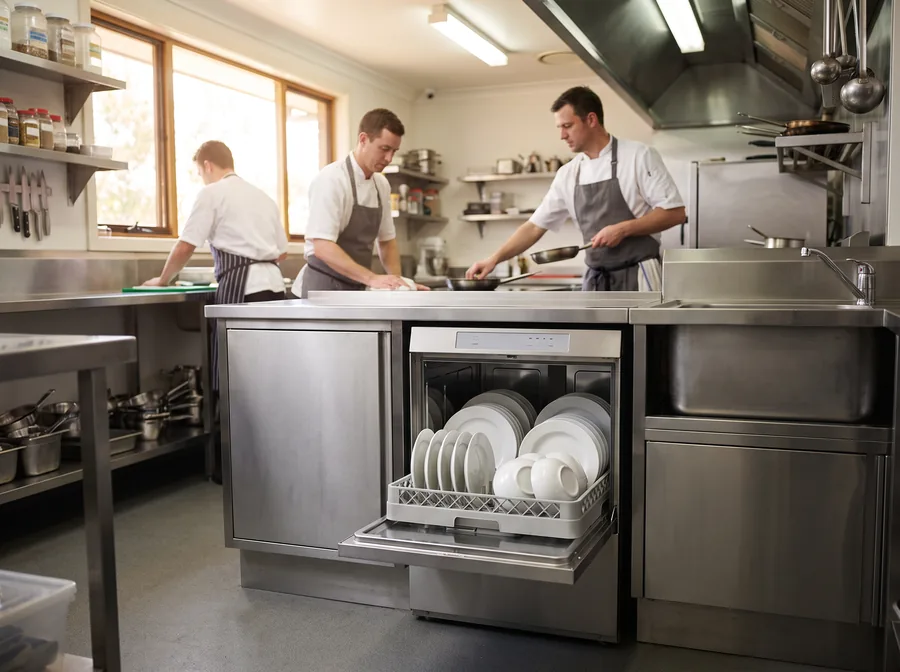
An underbench dishwasher is the default machine for a café, small bistro or bar kitchen: it sits in a standard bench void, takes one rack at a time, and is loaded and unloaded by whoever is on wash-up. It is the smallest commitment of floor space and site services of any commercial warewashing format, which is exactly why it is also the easiest one to under-size.
This guide covers the checks specific to fitting and running an underbench machine. For how it compares against glasswashers, pass-through and conveyor formats before you commit to this one, see the commercial dishwasher buying guide.
Measuring the bench void before you shop
Three measurements rule machines out before a single specification does.
Height and width of the void. Measure the opening, not the machine you are replacing — benches and floors are rarely perfectly level, so measure in more than one place.
Depth including the door swing. The listed cabinet depth is not the footprint. A front-opening door needs clearance to swing fully open, and a unit that fits the void but whose open door fouls the aisle in front of it will be worked around badly for the life of the machine.
Drain height and distance. Underbench units usually drain by gravity to a floor waste below the bench. If the drain point sits above the machine's outlet, or the run is long, a drain pump is needed — check whether one is fitted as standard or is an option on the exact model.
Usable clearance height inside the chamber. This is the number that decides whether your tallest plates, bowls or stacked items actually fit — it is not the same as the external cabinet height, and it is the single most commonly overlooked figure on a spec sheet.
Sizing it to a single-operator workflow
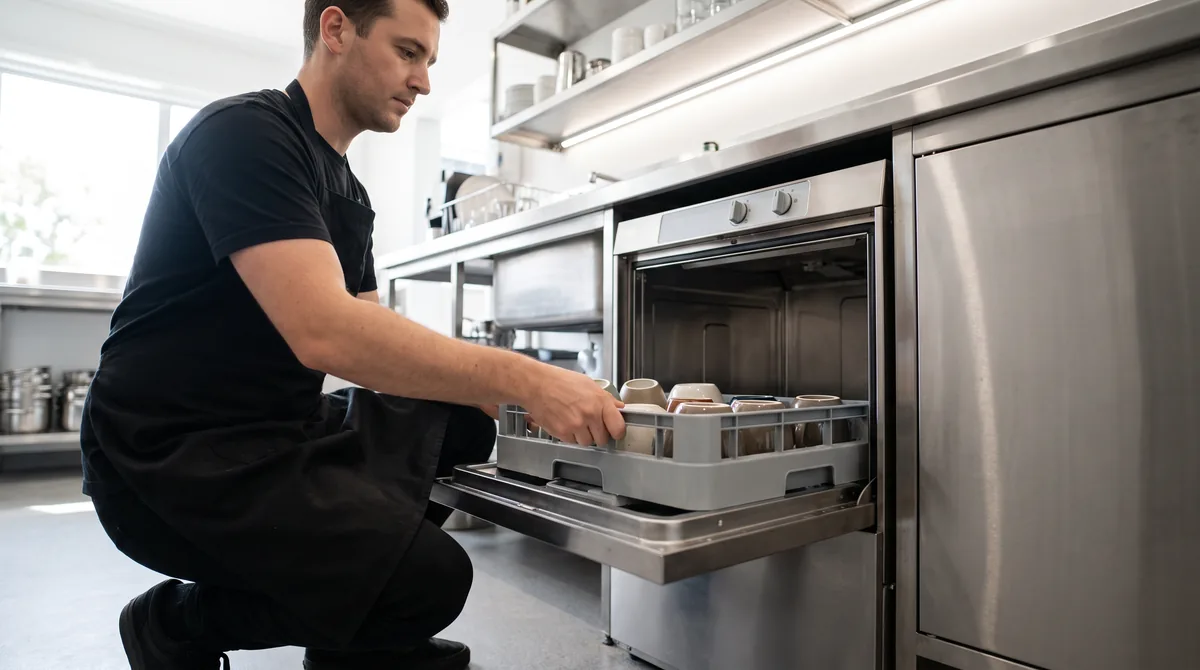
An underbench machine is a single-operator format by design: one person scrapes, loads, unloads and reloads. That handling time is the constraint, not the cycle time printed on the door.
If loading, unloading and stacking take roughly a minute on top of a two-minute cycle, the machine is really delivering a rack every three minutes at best — and only while someone stands at it continuously through service. Work this out against your own busiest hour before you shortlist a model; the full method, with a worked example, is in the buying guide's peak throughput section.
If that arithmetic does not clear your peak with reasonable headroom, the honest options are a second underbench machine, or a pass-through dishwasher staffed by two people, which is designed to keep loading and unloading happening at the same time rather than in sequence.
Underbench or glasswasher — or both
An underbench dishwasher will physically wash a glass, and a glasswasher will physically wash a plate. Neither does the other job well. Glasswasher cycles are shorter and gentler, built around soft water and stemware racks; a crockery cycle is longer and harder, built to shift baked-on food.
A café or small bar doing food and drinks together usually needs both — an underbench machine for crockery and cutlery, and a dedicated glasswasher for glass — rather than one machine compromised for both jobs. Whether that is worth the extra bench space and plumbing point depends on your glass volume: a bar with a handful of wine glasses an hour probably does not need it; a bar doing brunch service on top of drinks usually does.
Specifications that matter on an underbench machine
| Specification | Why it matters here specifically |
|---|---|
| External width and depth including door swing | Rules the machine in or out of your bench void before anything else |
| Usable clearance height | Decides whether your tallest items actually fit |
| Cycle time and litres per rack | The honest input to your single-operator throughput calculation |
| Drain pump | Needed on many sites; standard on some models, optional on others |
| Electrical supply | Single phase is common on this format — see the catalogue note below — but confirm the exact model |
| Water softener | A purchase decision in hard-water areas, not an upgrade |
| Warranty and local parts | A single machine handling all your wash-up has no redundancy if it goes down |
What the catalogue shows for underbench machines
The KitchenCompare catalogue tracks 57 underbench dishwasher models across 42 Australian retailers, as at 21 August 2026 — the second-deepest configuration by retailer coverage in warewashing, which means most models here have more than one dealer to compare a quote against. Of the underbench models that publish a power-supply attribute, 12 of 20 are single phase, which is generally why this format suits sites with limited electrical capacity — though the exact model's requirement still needs confirming against the manufacturer's documentation and a licensed electrician's assessment of your circuit. Full current listings and price history are on the underbench dishwashers category.
Comparing exact models
One underbench series can span single- and multi-rack chamber sizes, drain pump fitted or optional, different water treatment and different rack inclusions behind model numbers that differ by a single suffix. Compare the exact supplier model number, never the series name; see why model numbers matter. When comparing quotes, check they are like for like on booster, softener, drain pump, racks included, GST treatment and warranty exclusions.
Keeping it running
Daily scraping, clearing wash arms and filters, and leaving the machine open overnight to dry prevent most avoidable call-outs. See the commercial dishwasher maintenance checklist for the full daily, weekly and scheduled routine.
Current market prices are not published on this page because they move too often for an evergreen guide to state reliably. Get written quotes for the exact model with racks, softener and installation itemised, and compare current listings on the category page below.
Measured the void and know your peak? Compare underbench dishwashers on the exact supplier model number, with live retailer prices and price history — never matched on product names.
Compare underbench dishwashers