


Salamander Grill Buying Guide: Gas, Electric and Sizing
What a salamander actually does, whether your kitchen needs one, and how to choose between gas and electric, fixed and rise-and-fall, bench and wall mount.
In this article
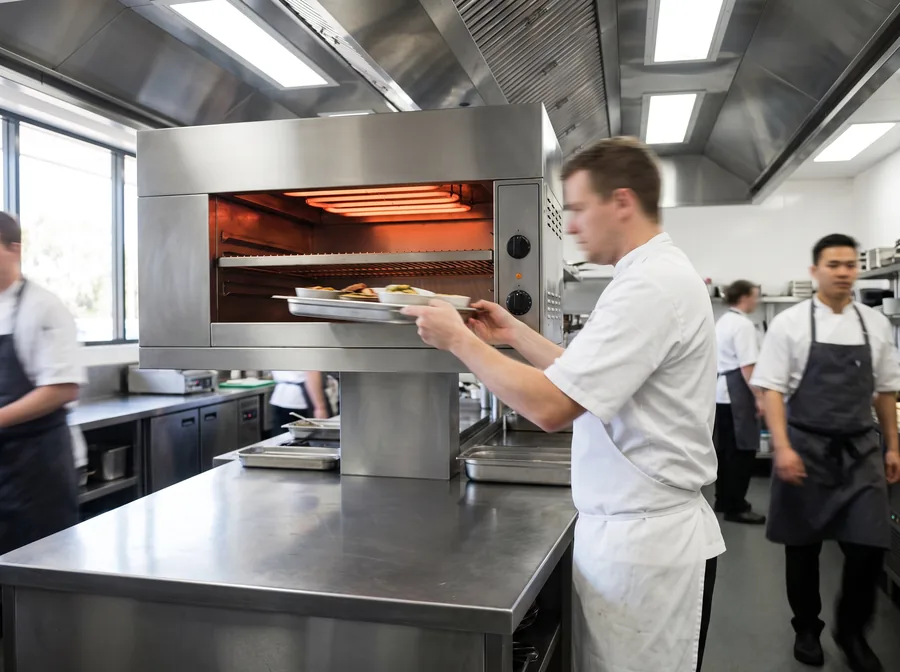
A salamander grill applies intense radiant heat from above. It finishes, melts, glazes and browns food that is already cooked or nearly cooked, and it does that job faster and more controllably than an oven can.
It is worth being clear about what it is not, because the three machines get confused constantly. A char grill heats from below and cooks food through. A conveyor toaster does one job at high throughput and does not adapt. A salamander sits above the food, is adjustable, and is used for short, attentive bursts through a service.
Do you need one? The service test
A salamander earns its bench space when your service repeatedly needs one of these:
- Melting cheese to order — parmigiana, burgers, gratins, nachos.
- Glazing and browning — crème brûlée, meringue, a crust on a fish fillet, a finished sauce.
- Finishing protein that came off a grill or out of a water bath and needs colour.
- Toasting or crisping to order where a conveyor toaster is too rigid.
- Holding a plate under gentle heat for a moment while the rest of the dish is plated.
It will sit cold in a kitchen whose menu is assembled cold, or fried, or cooked entirely in an oven and served straight from it. The right question is not "how big is my kitchen" but "how many dishes per service need a finish". If the answer is a handful, the oven will cope; if it is most of the menu, the salamander becomes a bottleneck the moment it is undersized.
A pub bistro with a parmigiana on the menu, a brunch café doing anything with melted cheese, or a restaurant with a grill section will almost always want one. A sandwich bar or a pizza kitchen usually will not.
Gas or electric
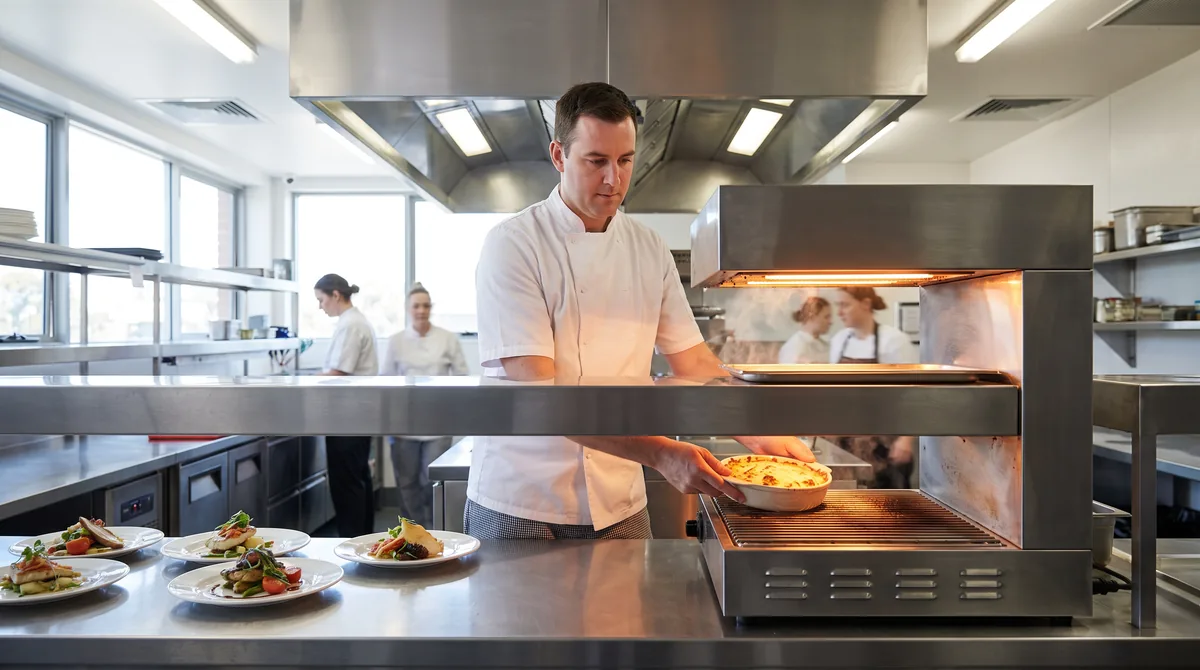
This is the real decision, and it is decided by your site rather than by cooking quality.
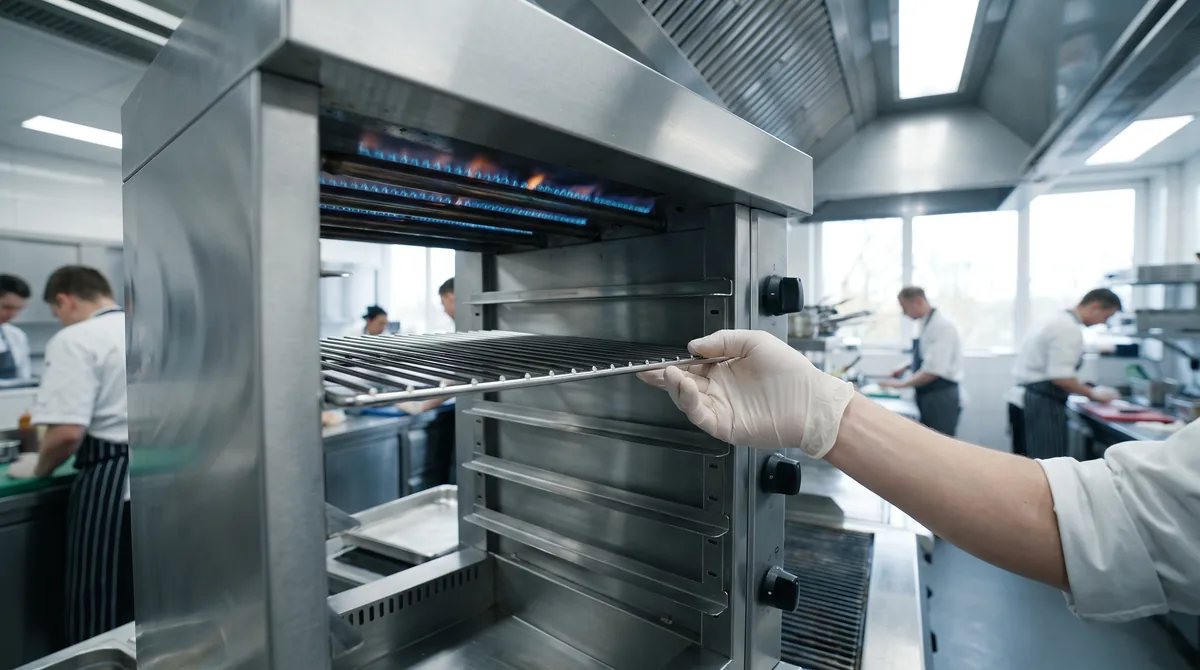
Gas salamanders need a gas connection sized for the appliance, and the flue and ventilation arrangements that go with it. They tend to reach working heat quickly and give a very direct, responsive radiant heat that many chefs prefer for browning. Installation has to be done by a licensed gas fitter.
Electric salamanders need adequate circuit capacity at the location. They are usually simpler to install where the power is available, they suit sites with no gas connection, and controllability varies with the element and control type rather than being inherently better or worse. Installation and any circuit work has to be done by a licensed electrician.
Do not choose on a warm-up claim or a rating figure quoted in a listing. Read the rating plate and the specification sheet for the exact model, and give those figures to your gas fitter or electrician before you buy. What usually decides it in a real fit-out is simple: what is already available at the position where the machine has to go, and what it would cost to change that.
| Format | What it suits | Trade-off |
|---|---|---|
| Cheese melter | One repeated job — melting, light gratinating | Lighter duty; will not keep up as a general finishing station |
| Fixed-height salamander | A settled menu finishing at one intensity | Simplest and cheapest; no control over browning speed |
| Rise-and-fall | A menu ranging from delicate glazing to hard browning | The adjustment is the main lever you have; worth paying for |
| Bench, wall or stand mounted | Whatever your pass and services allow | Brackets and stands are usually model-specific — decide before ordering |
Sizing and configuration
Width. Measure against your pass. A salamander that is narrower than your plating run forces staff to work in sequence at one point; one that is too wide takes bench you need for something else. Think about how many plates or trays have to be under it at once during your peak.
Fixed height or rise-and-fall. A fixed-height unit is simpler and cheaper. A rise-and-fall (or adjustable-shelf) unit lets you change the distance between the element and the food, which is the main lever you have over how fast and how aggressively it browns. If your menu ranges from delicate glazing to hard browning, adjustability is worth paying for.
Salamander, cheese melter or rise-and-fall. These names are used loosely across the market. A cheese melter is generally a lighter-duty unit built for the single job of melting; a full salamander is a heavier unit intended for continuous service; a rise-and-fall grill is a salamander with an adjustable cooking height. Read what the specification actually describes rather than trusting the product name.
Mounting. Bench-mounted is the simplest. Wall-mounted frees the bench underneath but commits you to a position and needs a wall that can carry it. Stand-mounted suits a run where nothing else fits. Decide this before you order, because brackets and stands are often model-specific.
Check what is above and behind it first
A salamander throws heat upward and forward. Shelving, a cupboard or a services run directly above one is a problem that is far cheaper to find before the unit is mounted than after. Clearances to combustible surfaces come from the manufacturer's manual for the exact model, not from a general rule.
Installation and ventilation
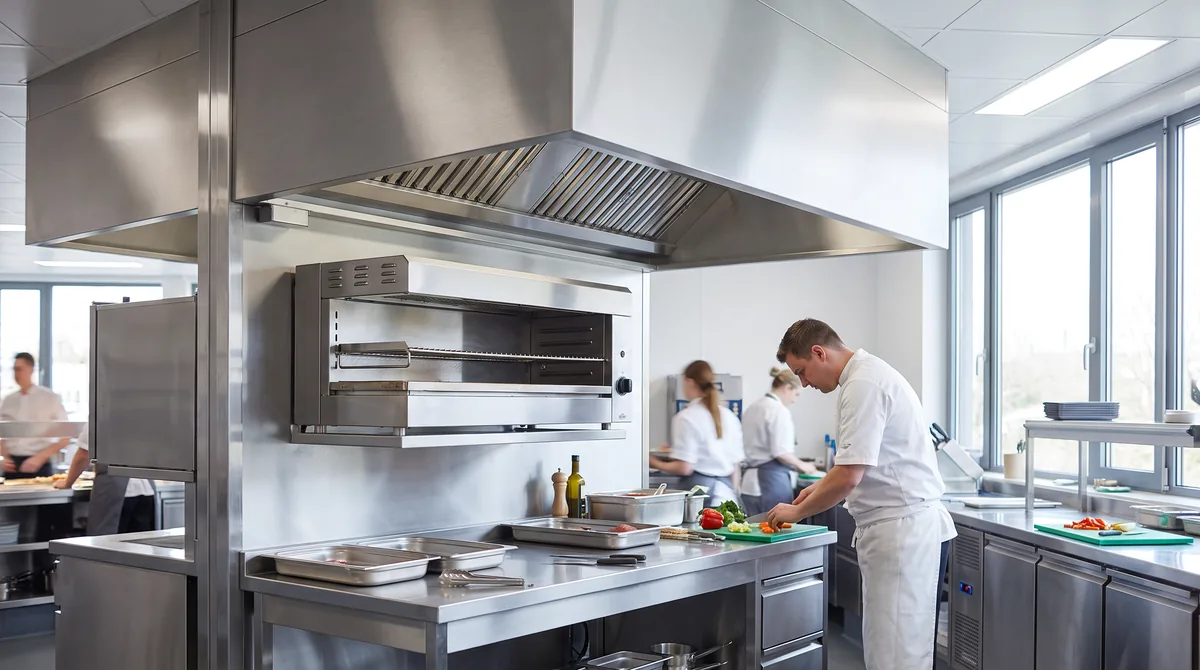
A salamander concentrates heat upward and forward. That has consequences for what surrounds it.
- Clearances to combustible surfaces, and clearances at the sides and rear, are stated in the manufacturer's manual for the exact model. Follow those, not a general rule.
- What sits above it matters. Shelving, a cupboard or a services run directly above a salamander is a problem, and it is much cheaper to discover that before the unit is mounted.
- Ventilation. A salamander is commercial cooking equipment and normally sits under mechanical exhaust ventilation. Whether your canopy covers the new position, and whether the canopy has capacity for another appliance, is part of the purchase decision. See canopies and ventilation.
- Licensed trades. Gas connection is work for a licensed gas fitter; electrical connection and any circuit work is for a licensed electrician. Get the exact model's requirements from the manufacturer's documentation and hand them over before you commit.
Controls, elements and build
- Zoned or single control. Independent control of left and right halves lets you run a hot side and a gentle side at once. On a busy pass that is genuinely useful; on a low-volume machine it is a cost you may not need.
- Element type and coverage. What matters is even coverage across the cooking area. A unit with hot spots produces uneven results and staff learn to compensate, which slows service.
- The parts that wear. Elements or burners, the shelf runners or lift mechanism on a rise-and-fall unit, and the grease trays. Ask whether each is a replaceable part and whether it is stocked in Australia.
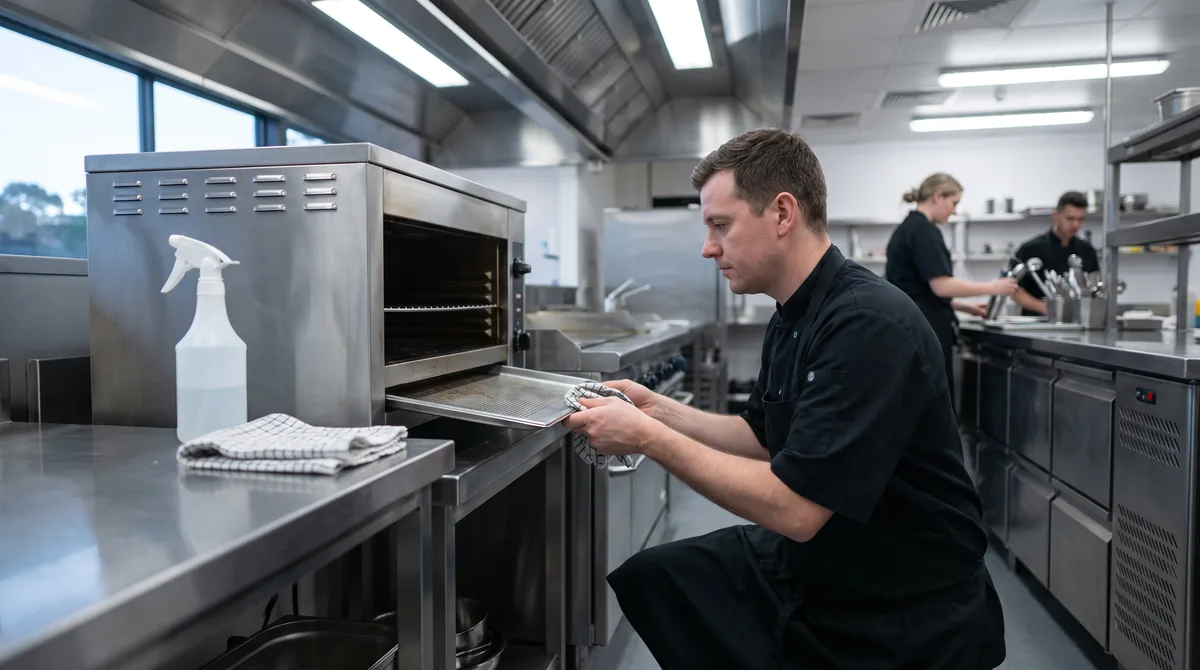
- Cleanability. This decides whether the machine is looked after. Removable grease trays and runners, accessible surfaces and a design that does not trap fat where nobody can reach it are the difference between a five-minute close-down and a job that gets skipped.
Running costs and cleaning
A salamander is often switched on at the start of service and left on, because the whole point is that it is ready when a plate needs it. That makes it a continuous load rather than an occasional one, which is worth knowing when you size the circuit or gas supply and when you think about the heat it adds to the kitchen.
The cleaning routine is simple and needs to be done every service:
- Empty and wash the grease trays. Fat that stays in the tray is a fire risk and a smell.
- Wipe the runners and the shelf while the unit is warm but off, so residue lifts.
- Clean the underside of the element guard where splatter collects.
- Check the trays and runners are seated correctly before the next service.
For the wider habits that keep cooking equipment alive, see maintenance habits that extend commercial equipment life.
Settled on gas or electric, and the width? Compare salamanders on the exact supplier model number, with live retailer prices and price history — never matched on product names.
Compare salamander grills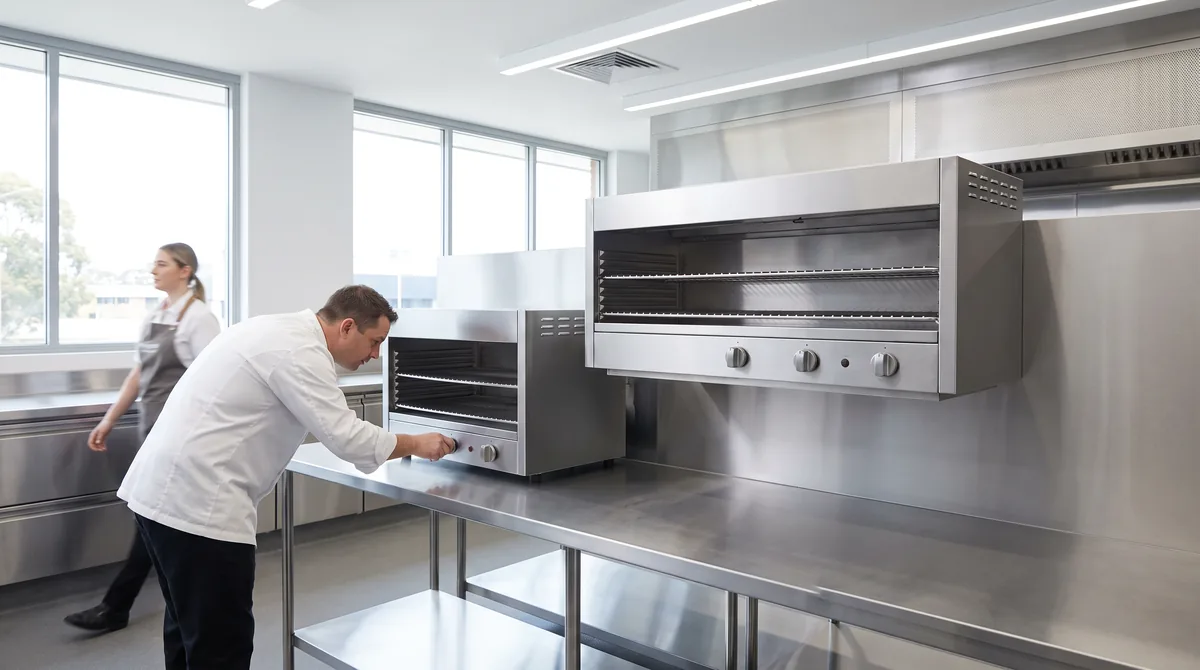
How to compare specific models
Once you know gas or electric, the width, and whether you need rise-and-fall, the comparison gets concrete — and this is where product names stop helping.
One salamander series routinely spans different widths, gas and electric variants, fixed and adjustable shelves, and bench and wall mounting, behind model numbers that differ by a suffix. Two listings with almost the same name can be different machines, and two listings that look different can be the same machine at different prices.
That is why every comparison on this site is matched on the exact supplier model number rather than on the product name; see why model numbers matter. Prices shown on the site include GST.
Compare like for like on: width and cooking area, gas or electric and the exact supply required, fixed or adjustable shelf height, zoned or single control, mounting method and whether the bracket or stand is included, replaceable parts availability, warranty terms and local service coverage.