


Commercial Conveyor Dishwasher Guide: Sizing, Fit-Out and Site Requirements
A rack conveyor is a fit-out decision as much as a machine purchase — the floor run, services and staffing it needs before you shortlist a model.
In this article
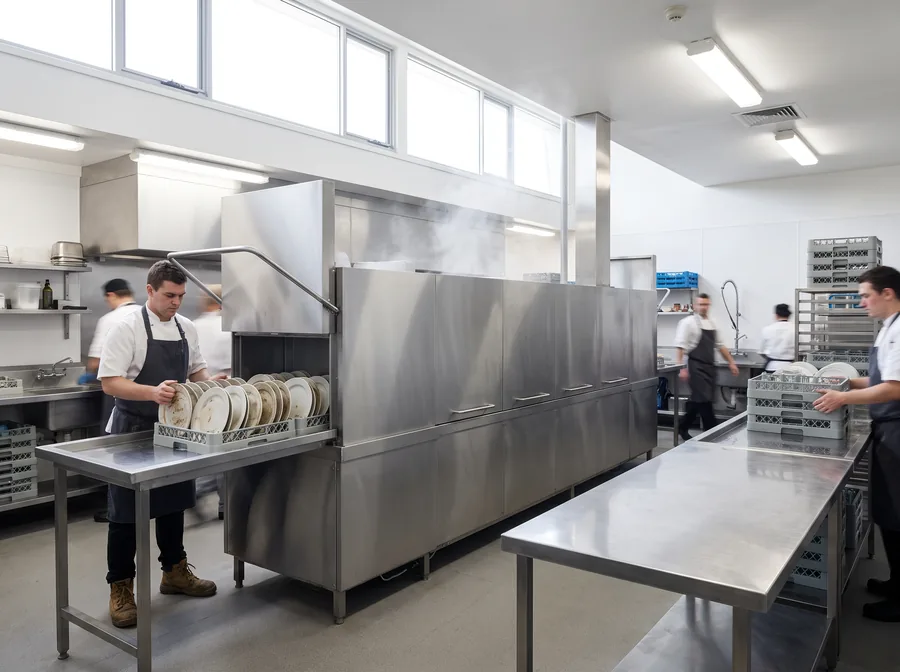
A rack conveyor dishwasher feeds racks continuously through wash and rinse zones rather than running one rack at a time. It is built for institutions, hospitals, large function venues and high-volume kitchens with dedicated warewashing staff, where the flow of dirty items never really stops during a service period.
It is also the configuration where the fit-out — not the machine — is usually the harder part of the decision. For how a conveyor compares against pass-through, underbench and glasswasher formats, see the commercial dishwasher buying guide.
The fit-out drives this decision as much as the machine does
A rack conveyor needs a substantial floor run for the machine itself, plus infeed tabling long enough to stage dirty racks and outfeed tabling long enough to land clean ones without a bottleneck at either end. Before you get to comparing models, work through:
- Floor run. Machine length plus infeed and outfeed tabling, in a straight run with room for staff to work both ends.
- Services. Heavy water, drainage and electrical services, sized for continuous operation rather than intermittent cycles.
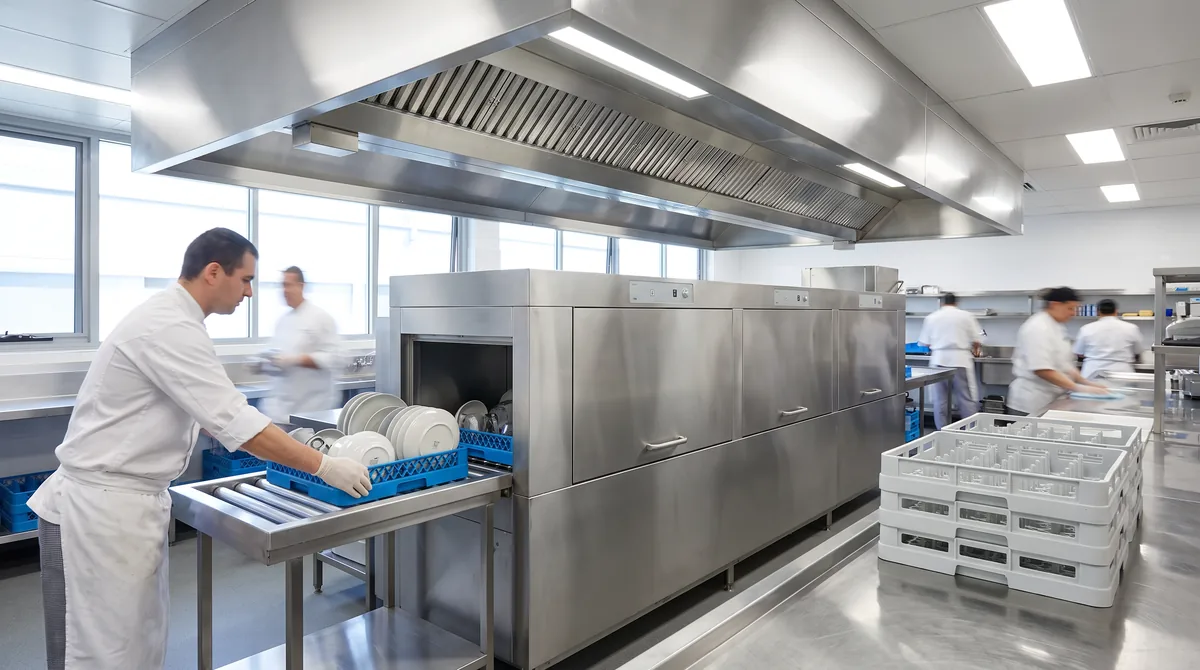
- Ventilation. Sustained steam release over a long service period needs proper extraction; see canopies and ventilation.
- Trade waste. Continuous high-volume discharge is more likely to involve your local water authority's trade-waste requirements than an intermittent underbench or pass-through installation. Requirements are set locally, so confirm with your water authority rather than assuming another site's approval applies to yours.
- Staffing. A conveyor is designed around dedicated warewashing staff feeding and unloading continuously, not a single person splitting attention between the machine and other tasks.
Sustained throughput, not brochure maximums
Every warewasher's rated racks-per-hour figure is a laboratory maximum, but the gap between that figure and reality matters most on a conveyor, because it is meant to run continuously rather than in short bursts. Ask for the manufacturer's stated sustained throughput for the exact model, not just the peak figure, and check what tank recovery and reheat time it assumes under continuous feed. The general method for calculating your own peak demand — covers to racks, handling time, recovery, headroom — is in the buying guide's throughput section; on a conveyor, apply it to your sustained service-period volume, not just your single busiest hour.
When a pass-through line stops being enough
The crossover between a two-person pass-through dishwasher and a conveyor is about sustained volume over a long service period, not peak covers alone. A pass-through line staffed by two people can move a genuinely high rack rate for a defined lunch or dinner service. Where it struggles is continuous, all-day or multi-sitting volume — a hospital, a school, or a function venue running back-to-back events — where the line would need to run at its rated pace for hours without a break for tank recovery or crew rotation. That sustained-volume pattern, more than any single peak hour, is the practical signal that a conveyor's continuous-feed design is worth the extra floor space and services it demands.
Specifications that matter on a conveyor
| Specification | Why it matters here specifically |
|---|---|
| Sustained throughput | The figure that predicts actual continuous-service performance, not the peak rating |
| Machine length and tabling required | Sets the floor run — often the binding constraint before specifications do |
| Water and drainage capacity | Sized for continuous operation, not intermittent cycles |
| Heat recovery | Affects running cost and how much steam enters the room over a long service |
| Electrical supply | Heavy three-phase load is typical; confirm the exact circuit capacity with a licensed electrician |
| Local parts and service coverage | A conveyor down mid-service in an institution has no fallback machine |
| Warranty | Scale and chemical-damage exclusions matter more on a machine running near-continuously |
What the catalogue shows for conveyors
The KitchenCompare catalogue tracks 7 rack conveyor models across 4 Australian retailers, as at 21 August 2026 — the shallowest of the five warewashing configurations by a wide margin. If you are buying one, expect a much thinner comparison set than the other formats and a more project-based sales process, with quotes shaped around your specific fit-out rather than a simple like-for-like price check. Current listings are on the conveyor dishwashers category.
Comparing exact models
Even within a small segment, model numbers within one series can differ on tank configuration, drive system, heat recovery and electrical connection. Compare the exact supplier model number rather than the series or family name; see why model numbers matter. Given how few retailers list any single conveyor model, confirm inclusions — tabling, heat recovery, drain pump, commissioning — in writing rather than assuming two quotes for "the same machine" are actually comparable.
Keeping it running
A conveyor's near-continuous duty cycle makes scheduled descaling and dosing calibration more consequential than on an intermittently run machine, because scale and dosing errors accumulate over a longer daily run time. See the commercial dishwasher maintenance checklist for the daily, weekly and scheduled tasks.
Current market prices are not published on this page because they move too often for an evergreen guide to state reliably, and because conveyor pricing is typically project-specific. Get a written, itemised quote for the exact model with tabling, installation, commissioning and staff training included, and compare current listings on the category page below.
Confirmed your floor run and services? Compare conveyor dishwashers on the exact supplier model number, with live retailer prices and price history — never matched on product names.
Compare conveyor dishwashers