


Why Model Numbers Matter More Than Product Names
Series names hide 8,952 distinct machines behind 2,315 stems, and one exact model still swings 38.6% in price between dealers — here's what to check on a quote.
In this article
Ask two dealers to quote "the RF7 series fridge" and you can get two different machines, both correctly quoted, both technically "the RF7". The series name was never the identity. The model number is. Across the KitchenCompare catalogue, 2,315 series stems cover 8,952 distinct model numbers — about a quarter of every comparable SKU we track — and the same exact model number still prices a median 38.6% apart between dealers (as at 21 August 2026, 21,568 SKUs with four or more dealer prices). Neither number moves until you get to the exact model.
The quick answer
A model number is the manufacturer's identity for one specific configuration of a machine: one capacity, one door type, one gas or power connection, one temperature range. A product name or series name is marketing copy layered on top, and it is shared across every configuration in that range. When you compare on name alone, you are comparing a description, not a machine. Get the exact model number before you compare price.
What a model number actually is
A model number is usually built from three parts: a stem, which identifies the series or platform; a capacity or size code; and a suffix, which encodes the specific configuration — door type, gas or electric, voltage, left or right hinge. Manufacturers use it because it is unambiguous in a way a name never is. "Two-door upright fridge" describes hundreds of machines. A model number describes one.
The stem is what a retailer usually puts in a product title, because it is what a customer searches for. It's also the least useful part of the number for comparison, because it is the part every configuration in the range shares.
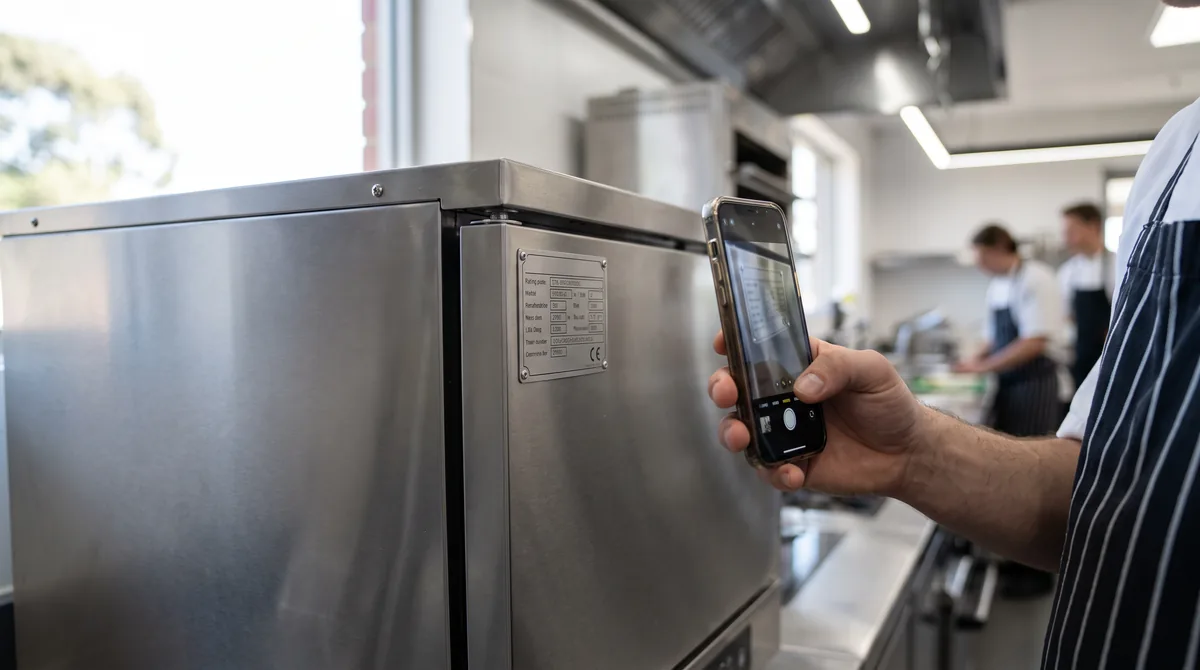
Retailers then build product titles from that stem plus whatever keywords help the listing get found — capacity, brand, sometimes a marketing descriptor that isn't on the spec sheet at all. None of that is dishonest. It's just not the identity. The identity is the string on the rating plate and the invoice line, and it's usually longer and less readable than the title above it.
There's no single Australian convention for how manufacturers build a model number, and that's part of the problem for a buyer trying to compare across brands. Some encode capacity directly in the number; some encode it in a separate size code; some put the gas or electric flag at the start of the suffix, others at the end. What's consistent is the principle, not the format: everything before the suffix usually describes the platform, and everything in the suffix describes the one configuration you're actually being quoted. Read a model number the way you'd read a part number, not a product name — every character is doing a job.
The real problem is the series, not the name
The instinct is to worry that two listings with an identical product name might secretly be different machines. In our data, that's rare: only 2 product-name families across 37,474 comparable SKUs share an exact identical name (as at 21 August 2026). Retailers mostly don't duplicate names by accident.
The real exposure is one level up. A series stem — the leading part of a model number, shared across a manufacturer's range — covers far more ground than a buyer expects. We found 2,315 series stems across the catalogue, and between them those stems cover 8,952 distinct model numbers: about 24% of every comparable SKU we track (as at 21 August 2026). One stem detection method groups models by their leading alphanumeric run, which is a practical heuristic rather than a manufacturer's own definition of a series — it will lump in configurations a brand would call separate ranges, and occasionally miss ones it would group. Even allowing for that, the shape of the finding holds: a series name is a family, not a product, and the number of configurations hiding inside a typical family is large enough that treating a stem as a single "product" is the actual mistake buyers make, not confusing two identical names.

Practically, this means a quote that says "the [series name] fridge" hasn't told you which configuration you're getting. You need the full model number — stem, size code and suffix — before a second quote is genuinely comparable to the first.
What a suffix changes
The suffix is where the real specification differences live, and they're not cosmetic. A single character can mean a different door, a different temperature range or a different power connection on an otherwise identical cabinet.
Cookrite's AT80 range is a workable illustration of the pattern, not a recommendation of the brand
or a specific model. Within that stem, model numbers such as AT80G12G-C-LPG, AT80G12G-C-NG,
AT80G12G-F-LPG and AT80G12G-F-NG share the same core designation but carry two suffix elements:
a configuration letter and a gas-type code. The LPG and NG variants are built for different gas
supplies. Order the LPG unit for a site plumbed for natural gas, and the machine that arrives will
not connect to what's on the wall — that's a site visit and a delay, not a five-minute fix.
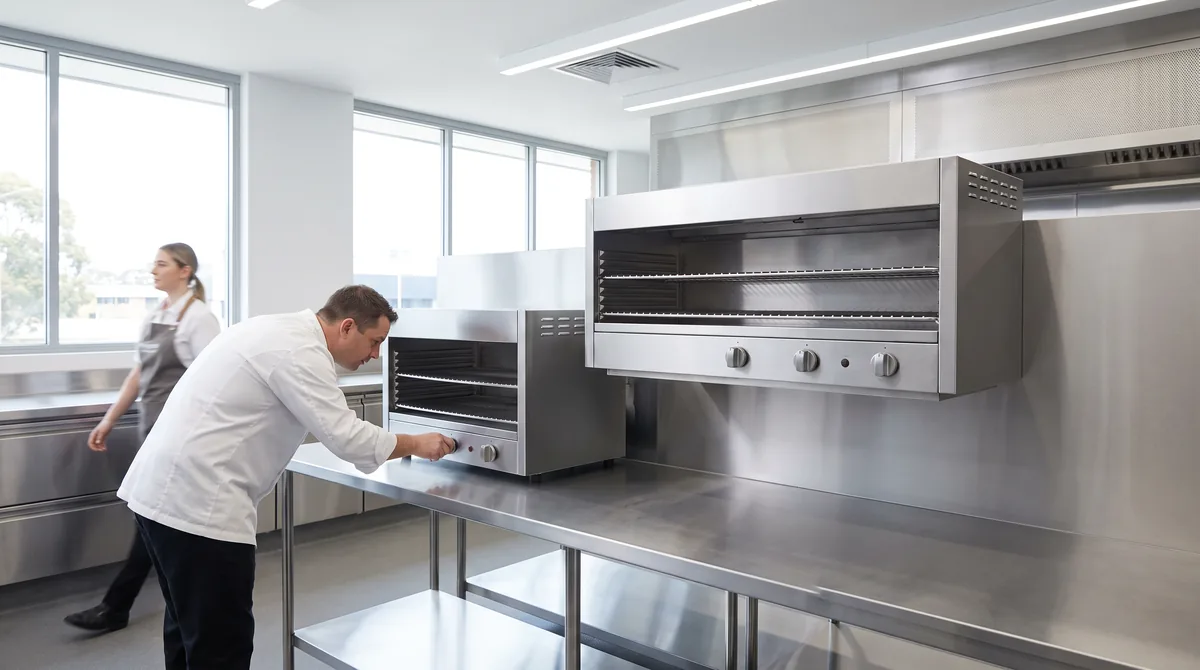
The pattern repeats across refrigeration, cooking and warewashing ranges: a suffix carrying door handing, voltage, drain configuration or climate rating. None of it shows up in a shortened product title. All of it shows up in the full model number, and it's exactly what an installer needs confirmed before delivery, not after.
What the same model costs at different dealers
Even once you've locked the exact model number, price is not settled — dealers price the identical machine very differently. Across 21,568 SKUs with at least four dealer prices, the median spread between the dearest and cheapest listing of one exact model is 38.6%, with the middle half of models spread between 26.0% and 62.0% (as at 21 August 2026). Spread here is calculated as (highest price minus lowest price) divided by the lowest price, so a 38.6% spread means the dearest dealer is charging 38.6% more than the cheapest for the identical model.
That spread is common, not exceptional: 96.7% of models with sufficient price coverage show more than a 10% spread, and 77.8% show more than 25% (as at 21 August 2026). Commercial fridges track close to the overall pattern — a 37.4% median spread across 1,139 SKUs, with 84.9% of those models spread more than 25% (as at 21 August 2026). We don't publish a "widest spread" example: the extreme tail is dominated by pack-quantity errors in smallwares listings rather than genuine price gaps, and naming a single outlier would misrepresent what's actually a broad, unremarkable pattern across the market.
The practical read: on any equipment model with real dealer coverage, the difference between picking the first quote and checking three is worth checking. See the commercial fridge buying guide for the refrigeration-specific figures, and how to choose commercial refrigeration for the category picture beyond fridges alone.
Why we never fuzzy-match
KitchenCompare's comparison pages only ever show listings matched on the exact supplier model number. The rule lives in the code that builds every comparison: a listing is only treated as comparable once its match status is confirmed exact, never inferred from a similar name or a close description.
In plain terms, that means our retailer counts are sometimes lower than a name-matching tool would show. If two listings can't be confirmed as the same model number, we don't merge them, even when everything else about the listing looks identical. It also means the opposite error doesn't happen here: we won't show you three "similar" machines dressed up as one product with three prices. When you see a comparison on this site, every price on it is for the model number in the header, not a sibling configuration.
The alternative — matching on product name similarity — is the easier engineering problem and the worse outcome for a buyer. A name-matching system will happily group a 400-litre chiller with its 370-litre sibling because the listing titles are ninety percent identical, and it will just as happily miss a genuine match because two retailers described the same machine differently. Both failures look fine in a spreadsheet and both cost the buyer money: the first inflates the apparent saving on a "cheaper" listing that's actually a smaller unit, the second hides a lower price that does exist. An exact-match rule produces a shorter list. It's the list you can actually trust.
Have a model number in hand? Search it directly and see every Australian retailer listing that exact model.
Search by model numberPrice callouts on KitchenCompare come from verified price data only. They are never influenced by a retailer's subscription tier or any other commercial relationship.
How to check a quote in five minutes
- Find the full model number, not the series name. It's on the specification sheet the supplier sent, or on the rating plate on the machine itself — never trust a shortened product title alone.
- Read the suffix character by character. Compare it against the second quote the same way. A one-character difference is a different machine, not a typo.
- Ask what the suffix encodes. Gas type, door hinge, voltage and climate rating are the ones that most commonly hide in a suffix. Ask the supplier to confirm each one against your site.
- Check the model number against your comparison, not the price alone. A cheaper quote on a different suffix isn't a discount — it's a different specification, and possibly a machine that won't run on your site as delivered.
- Keep the model number on the paperwork. Put it on the purchase order and the invoice. It's the identity your warranty claims and service calls will run against, long after the series name on the box is forgotten.
Questions to ask a supplier
- What is the full model number, including every suffix character — not the series or range name?
- Does this suffix change the gas type, voltage, door handing or climate rating from the unit I was shown?
- Is this the exact configuration on the specification sheet you sent me, or a substitution?
- If a cheaper quote arrives for "the same model", ask the other supplier for their full model number in writing before you compare the two on price.
- Does the quoted price match what's confirmed on the model's comparison page, or is it for a different variant?
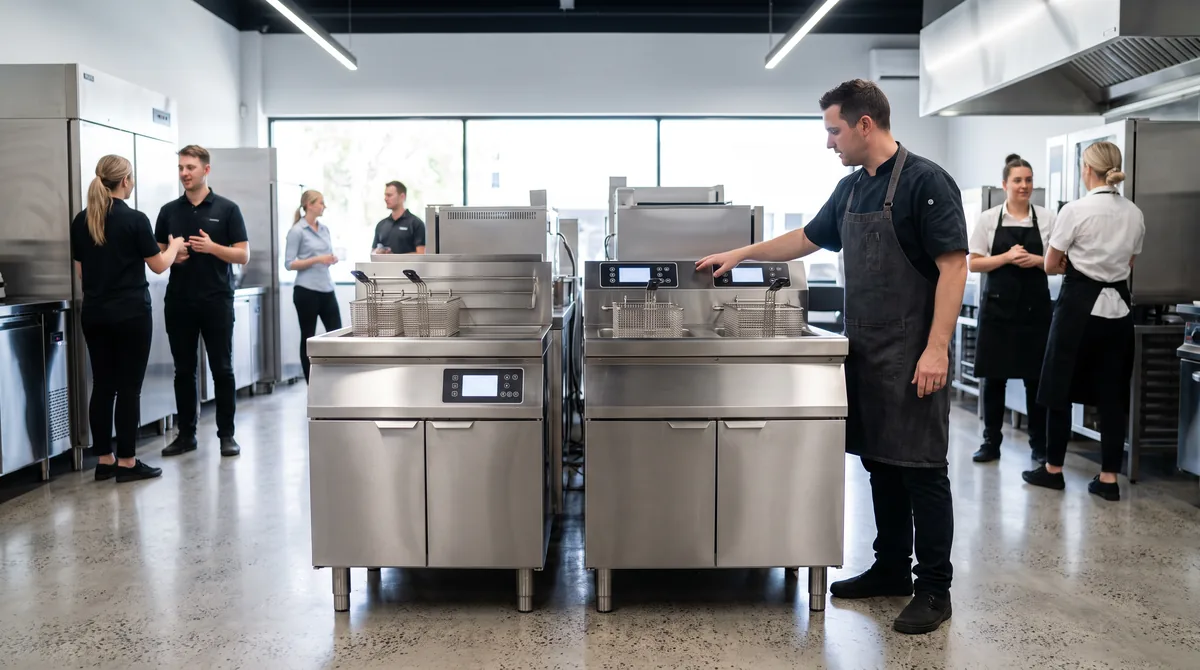
For equipment beyond refrigeration and cooking, the same model-number discipline applies to warewashing. See the commercial dishwasher buying guide for how inclusions change what a dishwasher quote actually covers, and the kitchen fitout budget guide for comparing quotes across an entire fit-out rather than one machine at a time.
Frequently asked questions
Is a product name ever enough to compare two quotes?
Rarely. A product name usually names the series, not the configuration. Two quotes for "the same" product name can be different capacities, door types or power connections. Ask for the full model number from each supplier and compare that instead — it's the only field guaranteed to identify one specific machine.
Where do I find the model number on a quote or spec sheet?
Look for a field labelled "model" or "model number" on the specification sheet, usually near the capacity and dimensions. On the physical machine, it's on the manufacturer's rating plate, normally inside the door or on a rear or side panel. If a quote only lists a series name, ask the supplier to provide the exact model number in writing.
Does a one-letter suffix really change anything, or is it just a warehouse code?
It can change real specifications. In documented examples like Cookrite's AT80 range, a suffix encodes gas type — LPG versus natural gas — alongside a configuration letter. Ordering the wrong suffix can mean a machine that won't connect to your site's gas supply. Always ask what a specific suffix means before assuming it's cosmetic.
Two dealers quoted me the same model at different prices — is one of them wrong?
Not necessarily. Price varies genuinely between dealers on the identical model number: our data shows a median 38.6% spread between the dearest and cheapest listing of one exact model, across 21,568 SKUs with at least four dealer prices (as at 21 August 2026). Confirm the model numbers match exactly, then treat the price difference as a real comparison to shop, not an error.
How does KitchenCompare match listings between retailers?
Only on the exact supplier model number. If two listings can't be confirmed to share the same model number, they are never merged into one comparison, regardless of how similar the names or descriptions look. That's a deliberate trade-off: it can mean fewer retailers shown against a product than a name-matching tool would claim, but every price shown is for the same machine.
What should I write on the purchase order — the series name or the model number?
The full model number. It's what a warranty claim, a spare-parts order or a service call will be matched against later, and the series name printed on packaging or a listing title is not always kept as a searchable reference once the box is gone.
Is it true that most listings with the same product name are actually different machines?
No, and this is worth being precise about. In our catalogue, only 2 product-name families out of 37,474 comparable SKUs share an identical name across listings (as at 21 August 2026). Identical names are rare. The real risk sits one level up, in the series: a shared series name commonly covers many distinct model numbers, and that's where the confusion actually happens.
Does a series name tell me anything useful at all?
Yes, as a starting point. A series name tells you the platform — the general cabinet, build and feature set a manufacturer sells under one range. What it doesn't tell you is the configuration: which capacity, which door type, which power connection. Use the series name to find the right family of machines, then use the full model number to confirm which one you're actually being quoted.
If I'm not sure which suffix I need, who should I ask?
Your supplier or installer, with the specifics of your site in hand: gas type available, available voltage, door swing clearance and the site's climate conditions if the unit carries a climate rating. Confirming these against the exact suffix before ordering is faster and cheaper than resolving a mismatch after delivery.
Where to go next
Get the model number before you get a second quote. Then use it: search it directly, or start from the category and filter down to the exact configuration your site needs.
Compare equipment by model number or browse the cooking equipment category if it's a cooking-line machine you're quoting.