


Commercial Dishwasher Buying Guide: Types, Throughput, Brands and Site Checks
Underbench, glasswasher, pass-through or conveyor? How to match a commercial dishwasher to your peak rack demand, your workflow and what your site can actually supply — with verified brand and retailer coverage from the KitchenCompare catalogue.
In this article
- The quick answer: which machine does my venue need?
- What is a commercial dishwasher?
- Why a commercial machine earns its place
- How a commercial dishwasher works
- Which commercial dishwasher type do you need?
- Commercial versus industrial dishwasher
- Calculate peak throughput before you choose a machine
- Specifications that materially change the choice
- What the KitchenCompare catalogue actually shows
- Commercial dishwasher brands available in Australia
- Comparing actual products
- Compare exact models, not series names
- What does ownership actually cost?
- Site checks before you shortlist
- Hygiene and Australian requirements
- Water quality, chemicals and wash results
- Maintenance and expected lifespan
- Common concerns before buying
- Questions to ask a supplier
- Final buying checklist
- Frequently asked questions
- Where to go next
Choose a commercial dishwasher by peak rack demand, workflow, site utilities and what you are actually washing. Those four things decide the configuration; everything else is specification. The cheapest machine is the wrong starting point, because a machine your site cannot supply with water, drainage or power is not cheap at any price.
This guide routes you to the right configuration, shows you how to work out realistic throughput, names the brands that are actually sold here, and lists the site checks worth doing before you shortlist anything.
The quick answer: which machine does my venue need?
A café with a single wash-up operator wants an underbench machine. A bar wants a dedicated glasswasher. A restaurant or pub that can staff a dirty-in, clean-out line wants a pass-through. A hospital, school or function centre washing continuously through a service period wants a rack conveyor. A bakery or production kitchen washing trays, pots and gastronorm pans wants a utensil or pot washer, usually as well as a crockery machine rather than instead of one.
| Venue | Usual machine | Why |
|---|---|---|
| Café, small bistro | Underbench | One operator, bench-height loading, modest rack demand |
| Bar, club, live venue | Glasswasher | Glass needs a short, gentle, soft-water cycle |
| Restaurant, pub, function venue | Pass-through (hood) | Two-person line, dirty in one side and clean out the other |
| Hotel, hospital, school, aged care | Rack conveyor | Continuous feed with dedicated warewashing staff |
| Bakery, production kitchen | Utensil / pot washer | Trays, pots and pans do not fit a crockery chamber |
Start from that row, then work through throughput and site checks below before you compare models on the dishwashing equipment category.
What is a commercial dishwasher?
A commercial dishwasher is a professional warewashing machine built to run repeated short cycles all day, loaded by rack rather than by shelf, and connected to a building's water, drainage and power as fixed equipment. A domestic machine runs a long cycle a couple of times a day and dries by residual heat. A commercial machine runs a wash and a hot final rinse in minutes, then relies on that rinse plus air drying rather than a drying element.
Can a restaurant use a domestic dishwasher? For a service kitchen, no. Not because a rule bans the appliance itself, but because the throughput, the duty cycle and the sanitation program are not designed for commercial service. Your local food authority regulates the outcome rather than the appliance, so the practical answer is that a domestic machine will not keep up and will not survive the workload. Check your own state or council requirements rather than assuming another state's rule.
Why a commercial machine earns its place
The benefit is not "cleaner dishes". It is that the wash-up stops being the thing that decides how many covers you can turn.
- Cycle speed. A short glass cycle can return a rack in a couple of minutes. That is the difference between a bar running out of glassware at 8pm and not running out.
- Labour. Rack workflow means one person loads, runs and unloads without hand-washing. In a small venue this is often the largest recurring saving, but only if the machine is sized above peak. A machine at its limit creates queueing, not savings.
- Consistency. A machine running a validated wash and rinse program does the same thing every cycle, which is far easier to monitor and record than a hand-wash sink.
- Workflow. Pass-through and conveyor machines are laid out around a dirty-to-clean direction of travel, which reduces cross-handling in the wash-up.
- Presentation. Correct rinse-aid dosing and appropriate water treatment are what stop glassware going cloudy. Both are purchase decisions, not afterthoughts.
- Durability. Commercial chassis, pumps and elements are built for repeated duty cycles and carry supported spare parts. That is the difference between a two-hour repair and a replacement.
None of that arrives automatically. Every benefit above depends on correct sizing, correct water treatment and correct chemicals, which is what the rest of this guide is about.
How a commercial dishwasher works
The process is short, and much the same across machine types:
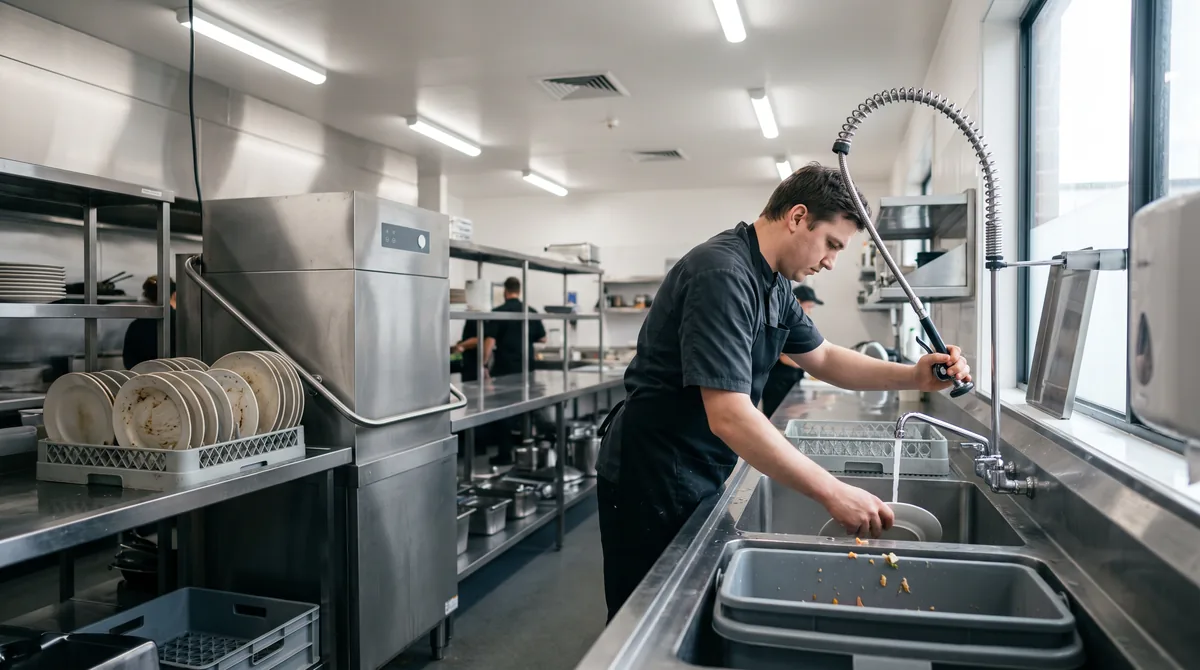
- Scrape. Solids go in the bin, not the machine. Food residue is the main cause of poor results and blocked wash arms.
- Pre-rinse. A spray hose or pre-rinse sink knocks off remaining residue.
- Load the rack. Items are racked in a fixed pattern so water reaches every surface.
- Wash. Heated, detergent-dosed water from the wash tank is pumped through rotating wash arms. The tank recirculates, so the same water washes several racks.
- Rinse. Fresh water from the rinse booster — a small dedicated heater — delivers the hot final rinse with rinse aid dosed in. This stage sanitises, and it decides whether items dry spot-free.
- Drain. Waste leaves by gravity, or through a drain pump where the drain sits above the machine outlet.
- Air dry. Items dry from their own retained heat on the rack. There is no drying element, so final rinse temperature matters more than it does at home.
- Clean down. Tank drained, filters and arms cleaned, machine left open.
Two components buyers routinely overlook: the rinse-aid dispenser, which lowers water surface tension so items sheet dry instead of spotting, and the water softener, which removes the hardness minerals that scale elements and etch glass.
Which commercial dishwasher type do you need?
Warewashing splits into a small number of configurations. Each solves a different problem, and the right one is usually obvious once the workload is described honestly.
| Configuration | Best fit | Workflow | Space | Site check | Throughput measure | Compare |
|---|---|---|---|---|---|---|
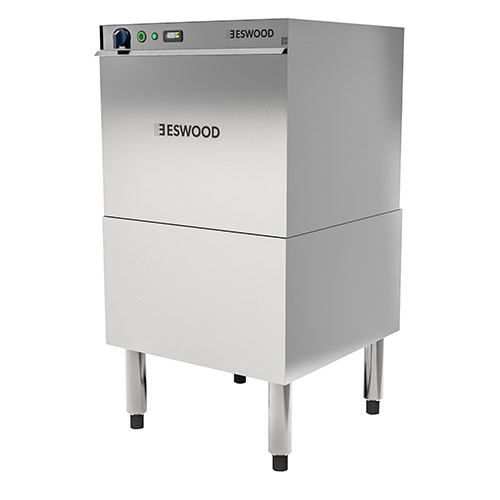
| Underbench | Cafés, small bistros, bars with food | Load at the bench, single operator | Fits a standard bench void | Inlet, drain height, single or three phase | Racks per hour at your cycle | Underbench dishwashers |
| Glasswasher | Bars, clubs, venues with high glass volume | Dedicated glass line, short cycles | Compact, often under the bar | Water hardness matters more here than anywhere else | Glass racks per hour | Glasswashers |
| Pass-through (hood) | Restaurants, pubs, function venues | Dirty in one side, clean out the other | Needs benching both sides | Hood clearance, drain pump, three phase common | Racks per hour with a two-person line | Pass-through dishwashers |
| Rack conveyor | High-volume kitchens, institutions, large functions | Continuous feed, dedicated staff | Substantial run plus tabling | Heavy services, ventilation, trade waste | Racks per hour sustained | Conveyor dishwashers |
| Utensil and pot washers | Production kitchens, bakeries, large prep | Separate from the crockery line | Large chamber footprint | Drain and power sized for the chamber | Items or baskets per cycle | Utensil and pot washers |
Underbench dishwashers
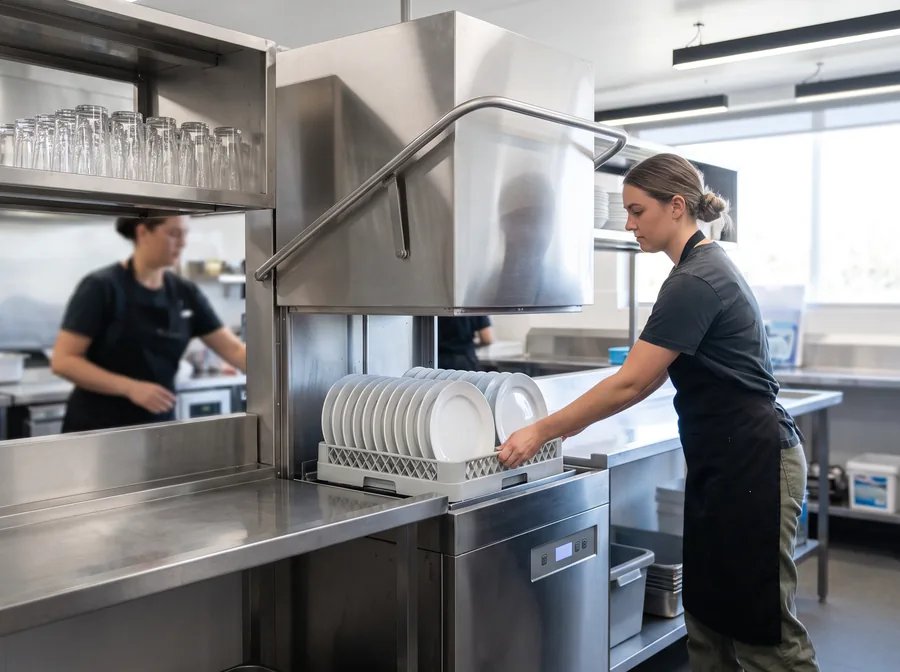
The default small-venue machine. It sits in a standard bench void, takes a single rack, and is loaded and unloaded by whoever is on wash-up. Strengths: compact, often single phase, no benching changes. Limits: one rack at a time, and a single operator's handling time frequently exceeds the cycle time, so the brochure rate is unreachable in practice. Check the usable clearance height inside the chamber against your tallest item before anything else. Full guide: commercial underbench dishwasher guide.
Glasswashers
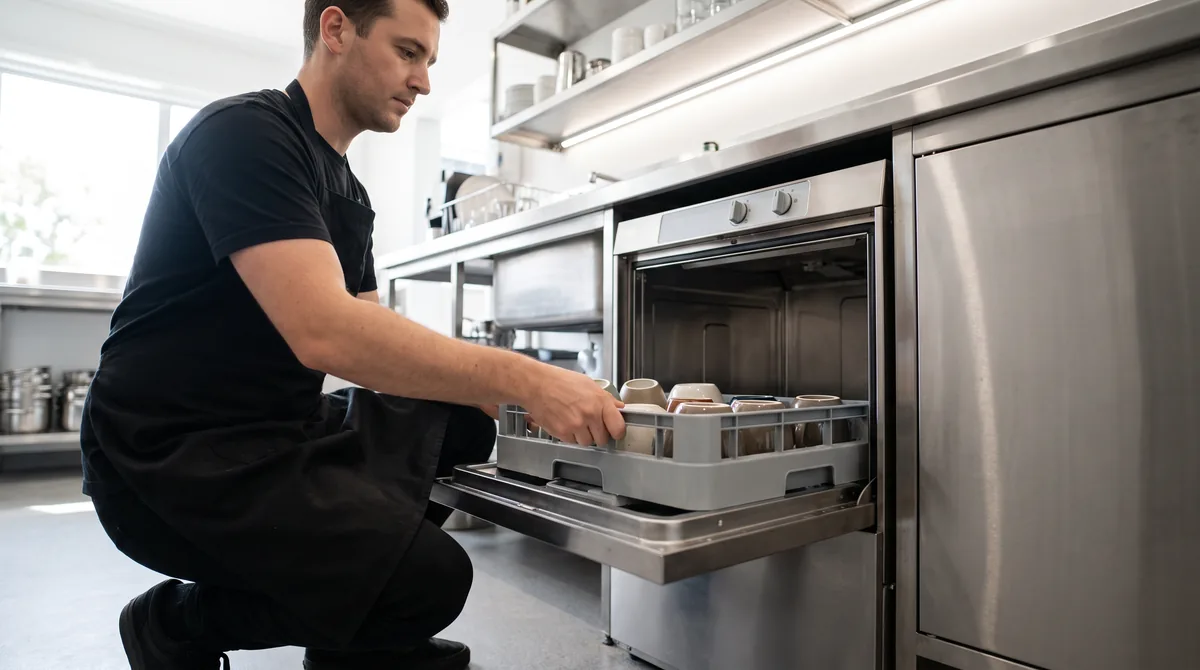
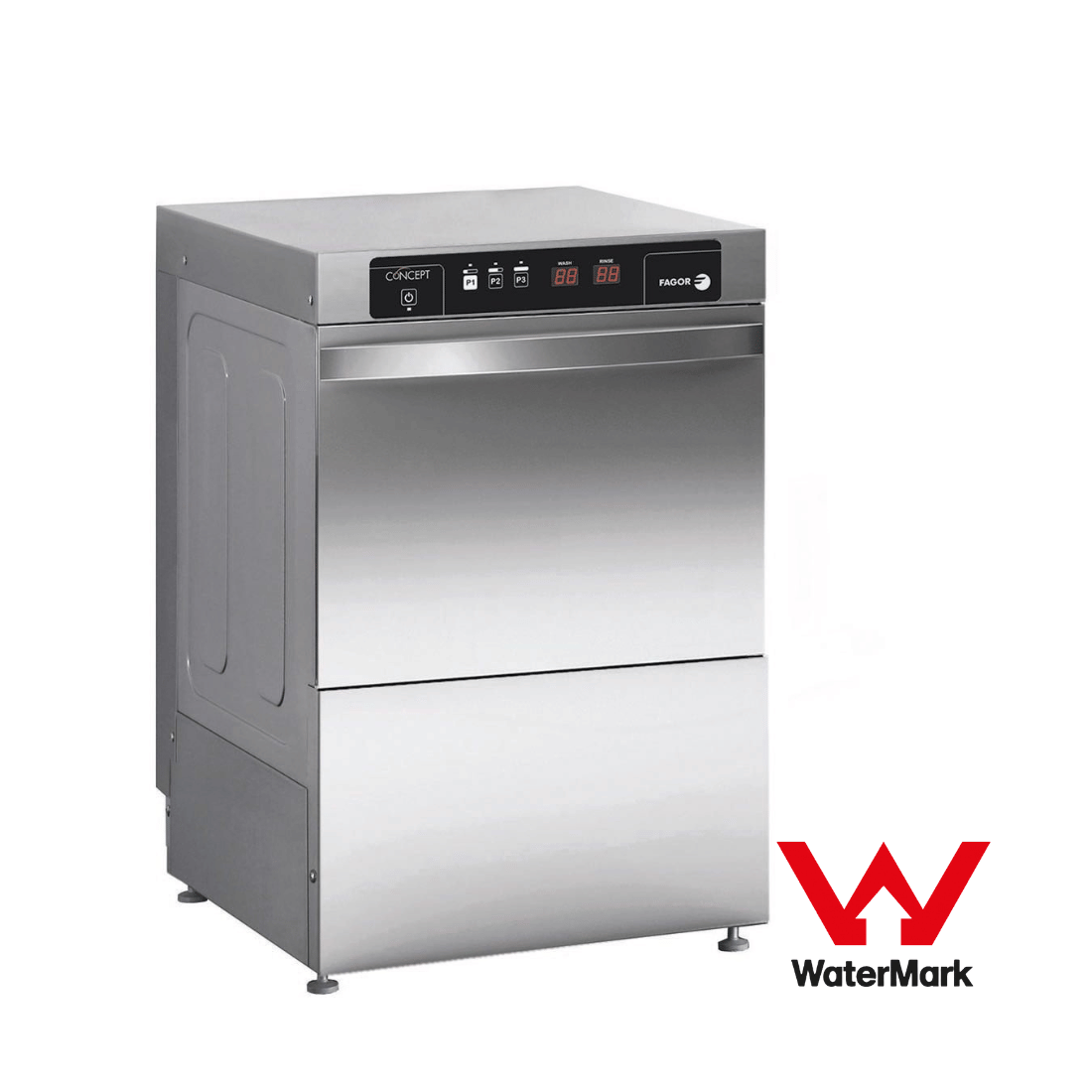
Purpose-built for glass: shorter cycles, gentler wash pressure, and a strong dependence on soft water and correct rinse aid. A glasswasher will physically wash a plate, but the cycle is not designed for baked-on food and the racks are not designed for crockery, so results and rack life both suffer. A café doing brunch usually needs a dishwasher and a glasswasher rather than one machine doing both jobs badly. Full guide: commercial glasswasher guide.

Pass-through (hood) dishwashers
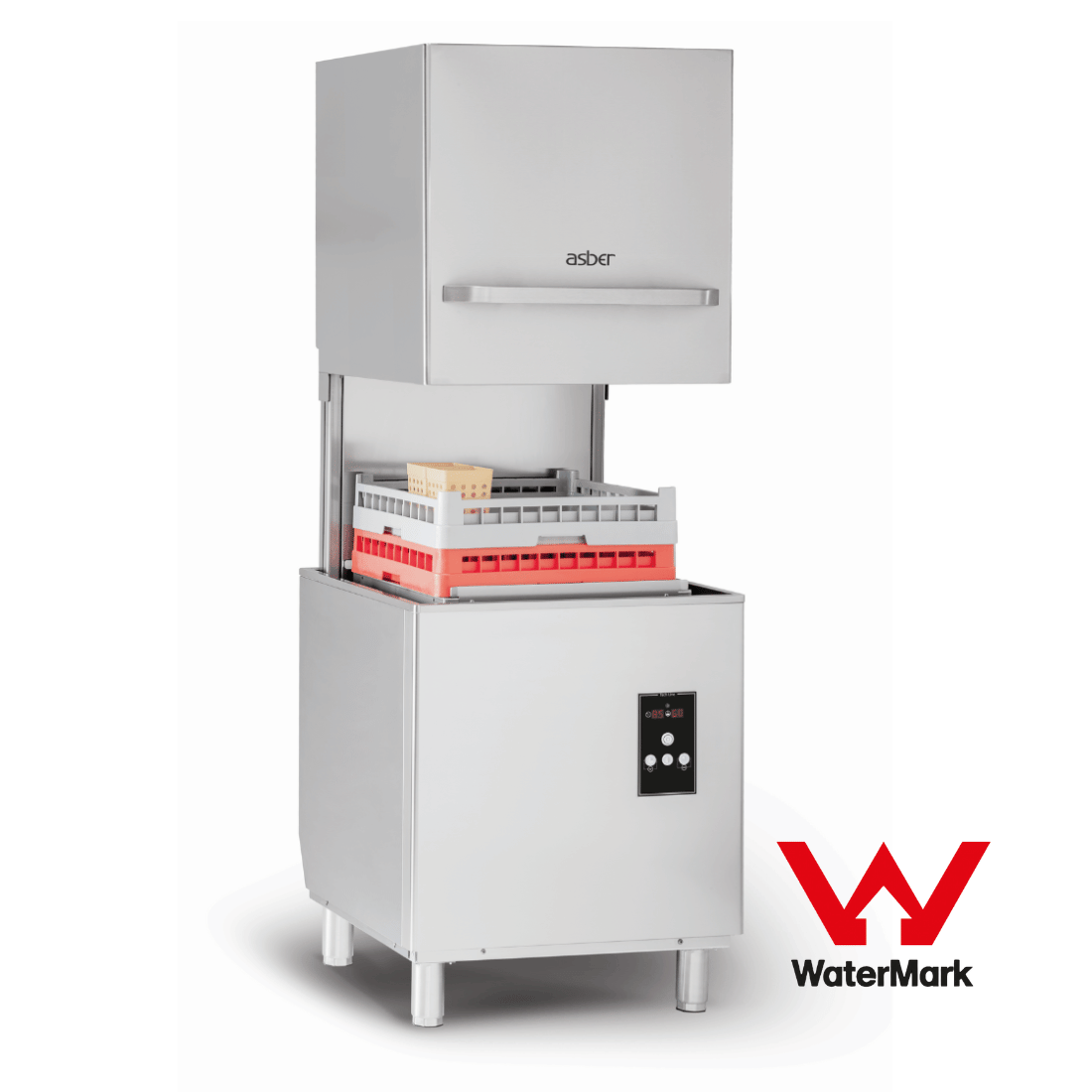
A lifting hood over a rack that slides in one side and out the other. This is the configuration that turns the wash-up from a station into a line. Strengths: high sustained throughput with two people, and clean separation of dirty and clean. Limits: it needs benching on both sides, hood travel clearance above the machine, and commonly a three-phase supply. Measure the hood lift height against your ceiling, range hood and any shelving before you shortlist. Full guide: pass-through dishwasher buying guide.
Rack conveyor dishwashers
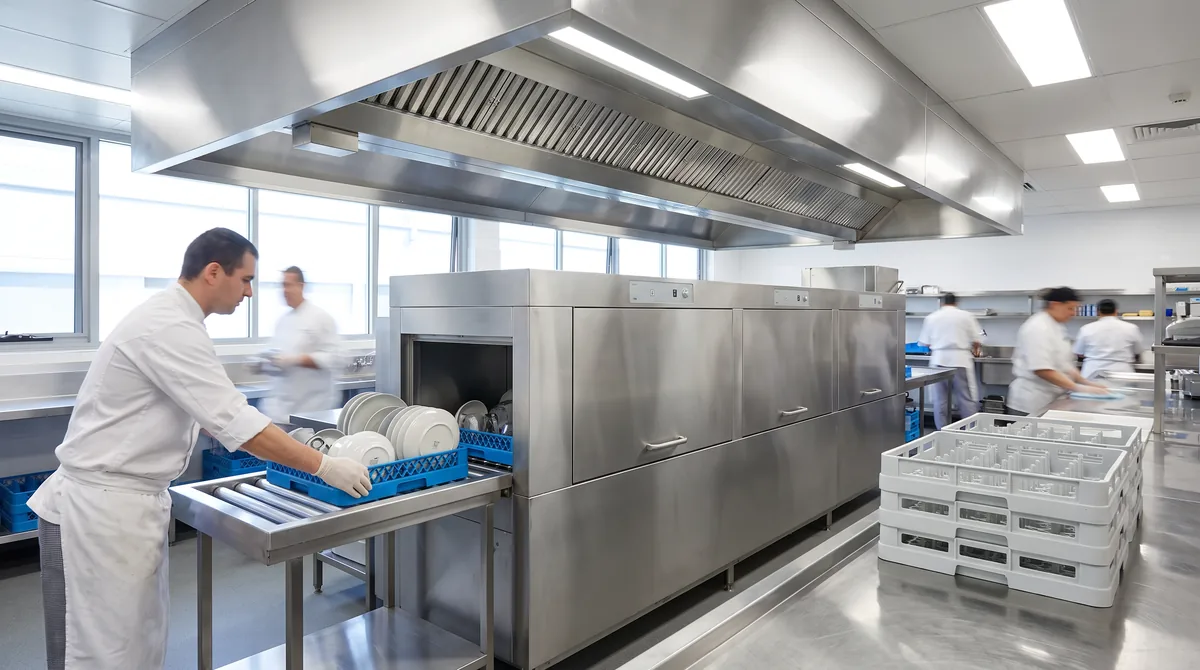
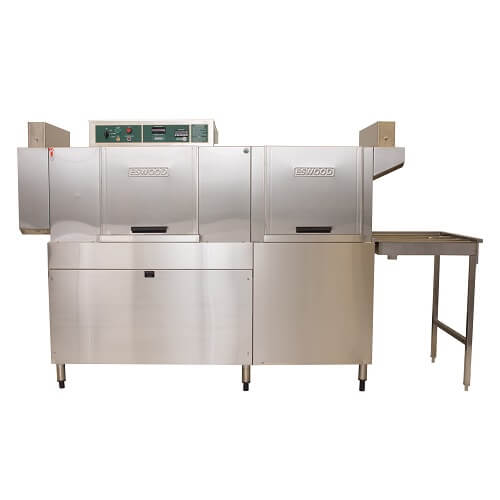
Racks are fed continuously through wash and rinse zones. Suited to institutions and large function venues with dedicated warewashing staff. Limits: substantial floor run plus infeed and outfeed tabling, heavy services, ventilation, and often trade-waste involvement. This is the configuration where the fit-out drives the decision as much as the machine does. Full guide: commercial conveyor dishwasher guide.
Utensil and pot washers
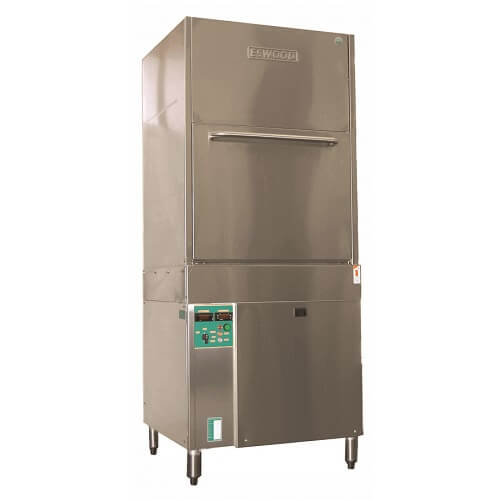
Large-chamber machines for trays, pots, pans and gastronorm inserts. They usually sit alongside the crockery machine rather than replacing it, because the chamber and the cycle are built for different items. Drain and power are sized for the chamber, so treat these as a separate services conversation.
A note on terminology
Suppliers use "warewasher", "dishwasher" and "dishwashing machine" interchangeably. "Hood" and "pass-through" are the same machine. "Rack conveyor" and "conveyor dishwasher" are the same machine. None of those words changes what you are buying. The configuration, throughput and site requirements do.
Commercial versus industrial dishwasher
Australian search results use "commercial" and "industrial" for the same class of professional warewashing equipment, and suppliers use both words loosely. There is no separate industrial product class in this catalogue, and treating one as real will send you looking for a machine that does not exist.
The useful distinctions are configuration, sustained rack throughput and what the site has to supply. A rack conveyor in a hospital kitchen and an underbench unit in a café are both commercial machines; they differ by those three things, not by a marketing label.
Calculate peak throughput before you choose a machine
Throughput is where most purchases go wrong, because the number on the brochure is a laboratory maximum and the number you live with is not.
Work through it in this order:
- Peak covers or items. Take your busiest hour, not your average day. Count plates, cutlery, glassware and service items separately — they rack differently.
- Racks required. Convert those items into racks using the rack size you will actually buy. A part-full rack still costs a full cycle.
- Handling time. Add scraping, pre-rinsing, loading, unloading and stacking. On a single-operator underbench machine, handling often exceeds cycle time.
- Recovery between cycles. A machine running consecutive cycles has to reheat the wash tank and the rinse booster. Sustained output is lower than the first-cycle figure.
- Headroom. Specify above your peak, not at it. A machine running at the limit of its capability during service has nothing left for a bus group or a broken rack.
A worked example
A 60-seat bistro turns its room roughly one and a half times over a two-hour dinner service, so call it 90 covers, with the pressure concentrated in about 45 minutes. Each cover produces an entrée plate, a main plate, cutlery and two glasses. Racked properly — crockery in one rack type, cutlery in a basket, glassware in glass racks — that peak realistically produces somewhere between 14 and 18 mixed racks, not the neat number the arithmetic suggests, because racks go through part full when service demands it.
Now add handling. If loading, unloading and stacking take a minute per rack on top of the cycle, an underbench machine with a two-minute cycle is really delivering a rack every three minutes at best, and only while someone stands at it continuously. Against 18 racks in 45 minutes, that is already tight. This is the arithmetic that pushes a venue of this size towards a pass-through with two people on the line, or towards a second machine.
Do this calculation with your own numbers before you look at a single specification sheet.
Rated racks per hour is a laboratory figure
It assumes continuous perfect loading with no scraping, no handling and no tank recovery between cycles. Treat it as a comparison figure between machines, never as a promise about your service. Ask instead for the manufacturer's stated cycle time and litres per rack for the exact model.
Specifications that materially change the choice
Once configuration is settled, these are the specifications that change what you own.
| Specification | What it means | Why it changes your decision |
|---|---|---|
| Rack size | The standard rack the machine takes | Decides how many items go through per cycle, and what replacement racks cost |
| Usable clearance height | Height available inside the chamber | The number that decides whether your stockpots and tall glasses fit |
| Cycle options | Short glass, standard, heavy crockery | A machine set for one item type serves the other badly |
| Cycle time | Manufacturer's stated time per program | The honest input to your throughput calculation |
| Litres per rack | Fresh water used per cycle | The best water-cost comparison between two models, and manufacturers publish it |
| Rinse booster | Dedicated final-rinse heater capacity | Determines final rinse temperature under sustained load |
| Heat recovery | Captures rinse heat | Affects running cost and how much steam enters the room |
| Drain pump | Pumps waste to a higher drain | Standard on some models, an option on others, required by many sites |
| Water softener | Integrated or external treatment | Decides glass clarity and element life in hard-water areas |
| Chemical dosing | Built-in dispensers or external pumps | Changes both install scope and ongoing chemical arrangements |
| Electrical supply | Single or three phase, and amperage | Rules machines out entirely; see the phase data below |
| External dimensions | Footprint plus door or hood travel | Rules machines out before specifications matter |
| Warranty | Term, and what it excludes | Scale and chemical damage are commonly excluded |
| Parts and service coverage | Local technician and stock | A machine with no local technician is a machine with long outages |
Where a specification is published as a filter on our category pages, you can narrow the catalogue by it directly rather than reading specification sheets one at a time.
What the KitchenCompare catalogue actually shows
These figures come from the KitchenCompare database, as at 21 August 2026. They cover commercial warewashing machines only — racks, chemicals, benches and accessories are excluded — and count only listings that pass the platform's price-validity contract: matched on the exact supplier model number, from an active Australian retailer, new condition, seen within the freshness window, with one price per retailer.
| Machine type | Models tracked | Australian retailers listing them |
|---|---|---|
| Pass-through | 89 | 41 |
| Underbench | 57 | 42 |
| Utensil / pot washer | 46 | 25 |
| Glasswasher | 26 | 41 |
| Rack conveyor | 7 | 4 |
| All warewashing machines | 225 | 44 |
Two things worth drawing out of that table. Pass-through is the deepest segment in the Australian market by model count, which fits the restaurant and pub trade being the volume buyer. Rack conveyors are the shallowest — 7 models across 4 retailers — so if you are buying one, expect a much thinner comparison set and a more project-based sales process.
Retailer coverage per model. Across those 225 machines, the median model is listed by 5 Australian retailers and the average is 6.9. About 79% are listed by three or more retailers, which is enough to compare. But 22 models are listed by a single retailer. For those there is no second price to check, and that is worth knowing before you treat a quote as a market rate.
Power supply. Of the 72 machines whose listings publish a supply attribute, 46 are three phase and 26 are single phase. The split by type is the useful part: 29 of 35 pass-through models with a published supply are three phase, while 12 of 20 underbench models and every glasswasher with a published value are single phase. Every utensil and pot washer with a published value is three phase. Only 72 of 225 machines publish this attribute, so treat it as a directional signal about the category and confirm the exact model against the manufacturer's documentation.
Commercial dishwasher brands available in Australia
Sixteen warewashing brands meet our publication floor — at least two models, listed by at least three active Australian retailers — as at 21 August 2026. The table is ordered by how many models we track, which measures catalogue depth. It is not a ranking, not a quality judgment, and not influenced by any commercial relationship.
| Brand | Models tracked | Retailers listing them |
|---|---|---|
| Meiko | 63 | 19 |
| Hobart | 19 | 15 |
| Winterhalter | 18 | 10 |
| Eswood | 16 | 27 |
| Comenda | 15 | 3 |
| Fagor | 12 | 28 |
| DIHR | 12 | 6 |
| Aristarco | 12 | 10 |
| Wexiodisk | 10 | 8 |
| Washtech | 9 | 18 |
| Smeg | 8 | 10 |
| Adler | 8 | 19 |
| Zanussi Professional | 5 | 3 |
| Sammic | 5 | 11 |
| Classeq | 4 | 21 |
| Asber | 3 | 25 |
Read the two columns against each other, because they say different things. A brand with many models and few retailers — Comenda at 15 models across 3 retailers — is distributed narrowly: you will find the range, but not much price competition on any one model. A brand with few models and many retailers — Asber at 3 models across 25, Classeq at 4 across 21 — is widely stocked, so the same model is easy to price-check between dealers. Neither pattern is better. They are different buying situations, and knowing which one you are in tells you how hard to shop a quote.
There is no best commercial dishwasher brand, and we will not name one. What matters for your venue is whether the brand's range includes a machine in your configuration, whether the exact model's requirements suit your site, and whether there is a technician who services it in your area. That last point is worth more than brand reputation on a day your machine stops during service.
Comparing actual products
Product-level comparison belongs on the catalogue rather than in an evergreen guide, because specifications, availability and prices change and a hard-coded table in an article goes stale silently. The dishwashing equipment category shows each model with its current listings, how many retailers carry it, and the price history behind the number.
When you get there, compare like this:
- Filter to your configuration first — underbench, glasswasher, pass-through, conveyor or utensil and pot washer.
- Rule out on external dimensions and usable clearance height before you read anything else.
- Check the retailer count on each model. A model listed by one retailer has no comparison price.
- Compare exact model numbers, never series names.
Compare exact models, not series names
A series name tells you very little. Within one series you will find different chamber sizes, different power connections, optional drain pumps, optional softeners and different rack inclusions — often behind model numbers that differ by a single suffix. That is why every comparison on this site is matched on the exact supplier model number rather than on product names; see why model numbers matter.
When you compare two quotes, make them like for like on: booster fitted, softener fitted, drain pump fitted, racks included, GST treatment, delivery, and warranty terms including exclusions.
What does ownership actually cost?
Current market prices belong in a dated price report, not in an evergreen guide, because they move. What does not move is the shape of the cost:
| Cost | Timing | Frequently underestimated because |
|---|---|---|
| The machine | Purchase | The headline price often excludes racks and dosing equipment |
| Racks and baskets | Purchase | You need enough racks to keep a line moving, not one per rack slot |
| Stand, bench or tabling | Purchase | Pass-through machines need benching on both sides |
| Water treatment | Purchase, then ongoing | A softener is a purchase decision in hard-water areas, not an upgrade |
| Electrical and plumbing work | Install | Three-phase supply and drain-pump requirements are found late |
| Delivery and positioning | Install | Larger machines need access, not just a delivery date |
| Chemicals | Ongoing | Becomes a contract-scale cost in a busy venue |
| Water and energy per rack | Ongoing | Where the litres-per-rack figure earns its keep |
| Planned servicing and descaling | Ongoing | Often excluded from warranty cover if skipped |
| Consumables — seals, wash arms, filters | Ongoing | Wear parts, not faults |
| Downtime | On failure | A venue that cannot wash cannot trade |
When the dated commercial dishwasher price report is published it will carry verified current figures from live dealer listings with a stated as-at date. Until then, get written quotes for the exact model with every one of the items above itemised.
Site checks before you shortlist
Do these before you fall in love with a specification. Each one has ruled out otherwise ideal machines.
- Footprint and clearance. Measure the void, the door swing, and — for a pass-through — the hood travel above the machine. Check the usable clearance height inside the chamber against your tallest item.
- Loading direction. A pass-through has a dirty side and a clean side. Confirm the direction matches your bench layout before ordering, because it is not always reversible.
- Water inlet. Confirm hot or cold fill, the inlet temperature the model expects, and the flow and pressure available at that point. Undersupplied pressure produces poor results that look like a machine fault.
- Water hardness. Hard water scales elements and etches glassware. Whether you need a softener, and whether it is built in or separate, is a purchase decision rather than an afterthought.
- Drainage. Check drain height and distance. Many installations need a drain pump; on some models it is an option rather than standard.
- Electrical supply. Single or three phase, and the actual circuit capacity at that location. Rinse boosters are the usual reason a machine needs more power than expected. The catalogue data above shows how strongly this varies by configuration.
- Steam and ventilation. Pass-through and conveyor machines release steam on opening. Canopy or condensate-hood requirements are part of the fit-out; see canopies and ventilation.
- Chemical storage. Detergent and rinse-aid containers need a safe, accessible location within reach of the dosing lines.
- Service access. Leave room to pull the machine out. A machine boxed in by joinery costs more to service for its whole life.
- Trade waste. Discharge requirements are set by your local water authority and differ between states and even councils. Check yours; do not assume another city's rule applies to your site.
This is a buyer's preflight, not an installation procedure. Verify the exact model's requirements against the manufacturer's documentation and with licensed trades before you commit. Commercial warewashing installation involves regulated plumbing and electrical work, so it is not a self-install job.
Hygiene and Australian requirements
Australian food businesses must keep eating and drinking utensils clean and sanitary under the Food Standards Code, and that requirement is written as an outcome rather than as one machine setting. Cleaning and sanitising are separate steps: cleaning removes visible soil and grease, sanitising reduces micro-organisms to a safe level. A commercial dishwasher does both, in that order, in one cycle.
There is no single temperature that applies to every machine. Different machines sanitise by different validated means — a hot final rinse on one model, a chemical sanitiser at lower temperature on another — and the correct figures are the ones in that model's documentation, not a number from another manufacturer's manual. Ask the supplier for the model's validated program and how to verify it.
Practical monitoring in a venue usually means: check the machine reaches its stated wash and rinse conditions, confirm the chemical dispensers are drawing, keep a record where your local authority expects one, let items air dry rather than towel drying, and train staff on scraping, racking and clean-down. Requirements are enforced by state and territory authorities, so confirm what your jurisdiction expects — see Food Standards Australia New Zealand and your state food authority.
Water quality, chemicals and wash results
Most "the machine is broken" calls are water, chemical or loading problems. Work through this before you book a technician.
| Symptom | Common causes |
|---|---|
| Cloudy or filmy glassware | Hard water and no softener; softener out of salt; rinse aid not dosing |
| White spots on drying | Rinse aid under-dosed; final rinse temperature low |
| Permanent etching on glass | Long-term hard-water or over-dosed detergent damage — this does not wash off |
| Food left on plates | Inadequate scraping; blocked wash arms or filters; overloaded racks |
| Greasy film | Detergent under-dosed; wash tank temperature low; tank water overdue for a change |
| Poor drying | Low final rinse temperature; rinse aid empty; items racked so water pools |
| Scale inside the machine | Hard water without treatment; descaling overdue |
| Odour | Filters and tank not cleaned down; machine closed up wet overnight |
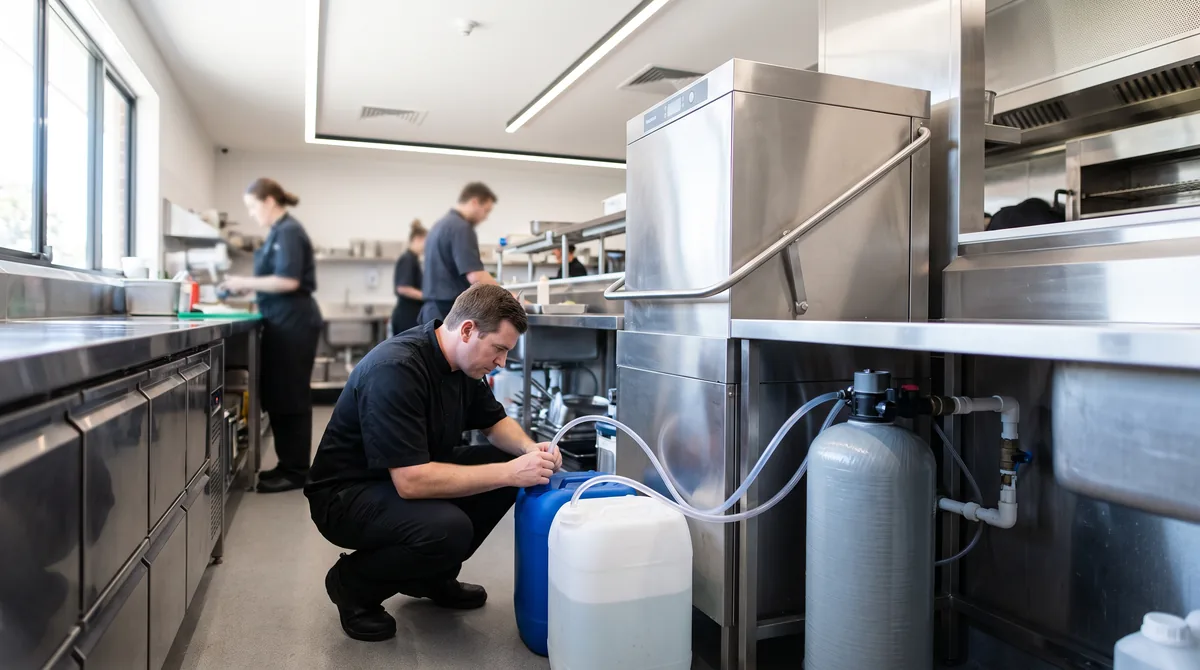
Water hardness varies substantially across Australia, and even between suburbs on different supply zones, so the honest answer to "do I need a softener?" is that it depends on your supply. Ask your water authority for the hardness at your address, and ask the machine supplier what the model requires. Use only chemicals the manufacturer approves — the wrong detergent damages machines and voids warranties, and that damage is commonly excluded from cover.
Maintenance and expected lifespan
Daily: scrape properly, clean the filters, check the wash arms spin freely and are not blocked, drain and rinse the tank, wipe the door seals, and leave the machine open overnight to dry.
Weekly and monthly: check chemical levels and that dispensers are drawing, check softener salt where fitted, descale on the interval the manufacturer specifies for your water hardness, and inspect seals and arms for wear.
Scheduled service: on the manufacturer's stated interval. Skipping it is a common way to lose warranty cover on a failure the service would have caught.
How long does a machine last? It depends on workload, water hardness, whether it was descaled, and whether parts remain available. A lightly used underbench machine in soft water on a maintenance schedule and a hard-driven conveyor in hard water without one are not the same asset, so a single number would mislead. The more useful question at purchase is parts and service availability in your area, because that decides whether the machine gets repaired or replaced. The full daily, weekly and scheduled routine, plus a troubleshooting table and the staff-versus-licensed-trade boundary, is in the commercial dishwasher maintenance checklist. General running habits that extend equipment life across every kitchen category are covered in maintenance habits that extend commercial equipment life.
Common concerns before buying
"What if I size it too small?" This is the most common and most expensive mistake. Do the peak calculation above with real numbers and specify above it. Under-sizing shows up as queues at the wash-up during your busiest service, and the fix is a second machine.
"Will it fit?" Measure before shortlisting: void, door swing or hood travel, and usable clearance height inside the chamber. Measure the delivery path too.
"Do I need three phase?" Frequently yes for pass-through and conveyor machines, less often for underbench and glasswashers — the catalogue split above shows the pattern. Confirm the exact model and the actual circuit capacity at that location with a licensed electrician.
"What if it breaks down mid-service?" Ask, before you buy, where spare parts are held and what the response time is in your postcode. Ask what the warranty excludes. For a venue that cannot trade without washing, a slightly dearer machine with local service is the cheaper machine.
"Is a cheaper unfamiliar brand worth it?" Sometimes. Judge it on the same criteria as anything else: does the exact model meet your throughput and site requirements, is there a local technician, are parts stocked here, and what does the warranty exclude? A brand being unfamiliar to you is not evidence either way. A brand with no Australian parts support is a real risk.
"Is the quote complete?" Check it against the ownership-cost table above. Racks, stand, dosing equipment, softener, delivery, installation and commissioning are the items most often missing.
Questions to ask a supplier
- What is the installation and commissioning scope, and which licensed trades do I need to arrange?
- What is the manufacturer's stated cycle time and litres per rack for this exact model?
- Is a drain pump fitted, and is the softener integrated or separate?
- What is the usable clearance height inside the chamber?
- Which supply does this exact model need, and what circuit capacity?
- What staff training is included, and is it delivered on site?
- Where are spare parts held, and what is the typical response time in my area?
- What does the warranty exclude — scale damage, chemical damage, consumables?
- Which chemicals are approved for this machine, and is the dosing equipment included?
- What is not in the headline price?
Final buying checklist
Before you request quotes, have these written down:
- Venue type and peak covers in your busiest hour.
- Items washed, by category — crockery, cutlery, glassware, trays, pots.
- Racks required at peak, and the rack size you will buy.
- Configuration chosen, and why.
- Available footprint, door swing or hood travel, and delivery access.
- Tallest item to be washed, against usable clearance height.
- Loading direction for a pass-through.
- Water inlet type, temperature, pressure and hardness at your address.
- Drain height and distance, and whether a drain pump is needed.
- Electrical supply available at that location.
- Ventilation and trade-waste requirements confirmed locally.
- Accessories required: racks, stand or bench, softener, dosing equipment.
- Installed budget, not machine budget.
- Warranty terms, exclusions and local service coverage.
Know the configuration your service needs? Compare dishwashing equipment on the exact supplier model number, with live retailer prices and price history — never matched on product names.
Compare dishwashersFrequently asked questions
How much does a commercial dishwasher cost?
Prices vary widely by configuration, chamber size and inclusions, and they move often enough that a fixed figure in an evergreen guide would be wrong within months. Current verified figures belong in dated price reports drawn from live dealer listings. For your own budget, get written quotes for the exact model with site work, accessories and chemicals itemised separately.
What is the best commercial dishwasher?
There is no single best machine, and any guide that names one is guessing about your venue. The best machine for you is the one whose configuration matches your workflow, whose sustained throughput covers your peak with headroom, and whose water, drainage and power requirements your site can actually meet. Rule out on site constraints first, then compare specifications within whatever shortlist survives.
What type of commercial dishwasher do I need?
Underbench suits cafés and small kitchens with a single operator. A glasswasher suits bars and any venue with high glass volume, because glass needs a shorter, softer cycle. Pass-through suits restaurants and pubs that can staff a dirty-in, clean-out line. Rack conveyors suit high-volume and institutional kitchens with dedicated warewashing staff.
What is the difference between a commercial and industrial dishwasher?
In Australian usage they mean the same thing: professional warewashing equipment, as distinct from a domestic machine. Suppliers use both words for the same products. The distinctions that matter are configuration, sustained rack throughput, and the water, drainage and electrical supply the machine requires.
Which commercial dishwasher brands are sold in Australia?
Sixteen warewashing brands meet our publication floor as at 21 August 2026: Meiko, Hobart, Winterhalter, Eswood, Comenda, Fagor, DIHR, Aristarco, Wexiodisk, Washtech, Smeg, Adler, Zanussi Professional, Sammic, Classeq and Asber. Model depth and retailer coverage differ sharply between them, which affects how easily you can price-check a given model. See the brand table above.
Does a commercial dishwasher need three-phase power?
It depends on the configuration. Among the machines in our catalogue that publish a supply attribute, 29 of 35 pass-through models are three phase, while most underbench models and all glasswashers with a published value are single phase. Confirm the exact model's requirement in the manufacturer's documentation, and check the actual circuit capacity at that location with a licensed electrician.
Can I install a commercial dishwasher myself?
No. Commercial warewashing installation involves regulated plumbing and electrical work, and often drainage, ventilation and trade-waste considerations as well. Use licensed trades, and have the supplier confirm the commissioning scope in writing so you know which parts are yours to arrange.
Do I need a drain pump?
You need one when the drain point sits above the machine's gravity outlet, or too far from it. Check your drain height and distance before ordering, because a drain pump is standard on some models and an option on others — and retrofitting costs more than specifying it.
Do I need a water softener?
It depends on the hardness of the water at your address, which varies between states and even between suburbs. Hard water scales elements and permanently etches glassware, so ask your water authority for the hardness at your site and ask the supplier what the model requires. A venue with high glass volume should treat this as a purchase decision, not an upgrade.
How much water does a commercial dishwasher use?
Manufacturers publish litres per rack for each model, and that is the figure to compare. It varies by chamber size, cycle selected and whether heat recovery is fitted, so there is no useful universal average. Ask for the litres-per-rack figure on the exact model number and multiply it by your realistic daily rack count.
How long does a commercial dishwasher take?
Cycle time and throughput are different questions. A short glass cycle may run in a couple of minutes while a heavy crockery cycle takes considerably longer, and the manufacturer publishes both for the exact model. Real service throughput is lower than cycle time implies, because scraping, loading, unloading and tank recovery all take time the cycle figure ignores.
What temperature should a commercial dishwasher reach?
There is no single figure that applies to every machine. Machines sanitise by different validated means — a hot final rinse on some models, a chemical sanitiser at lower temperature on others — so the correct wash and rinse conditions are the ones in that model's documentation. Your obligation under the Food Standards Code is the sanitary outcome; the machine's validated program is how you achieve it.
Do commercial dishwashers sanitise dishes?
Yes, when they run their validated program with the correct chemicals and are maintained. Cleaning removes soil and sanitising reduces micro-organisms, and a commercial cycle does both. Results depend on scraping, correct racking, working dispensers and the machine reaching its stated conditions, which is why monitoring matters more than the brochure.
Can a glasswasher wash plates?
It will physically wash a plate, but it is not designed to. Glasswasher cycles are short and gentle for glass, and the racks are built for stemware and tumblers rather than crockery. A venue washing both usually needs a glasswasher and a dishwasher rather than one machine compromised for both jobs.
How often should a commercial dishwasher be serviced?
On the interval stated by the manufacturer for that model and your duty cycle, with descaling frequency adjusted to your water hardness. Daily filter and wash-arm cleaning plus overnight drying are the operator's job and prevent most call-outs. Skipping scheduled service is a common reason a warranty claim is refused.
Should I buy a used commercial dishwasher?
It can work, but check the same things you would on a new machine and a few more: whether parts are still supported for that model, whether it has been descaled, the condition of seals, wash arms and the tank, and what the electrical and plumbing connections require at your site. Our price statistics exclude used, ex-demo and refurbished listings, so a used machine sits outside the comparison set.
How many racks per hour do I need?
Take your busiest hour, convert the items washed into racks at the rack size you will buy, then add handling and recovery time and specify above the result. Rated racks per hour on a brochure assumes continuous perfect loading with no handling, so it is a comparison figure between machines rather than a throughput you will achieve.
Where to go next
You know the configuration, the throughput you need and the site constraints that rule machines out. Now compare the machines that actually fit, on the exact supplier model number, across every Australian retailer listing them.
Commercial dishwashers worth comparing
Live listings from the KitchenCompare catalogue, one or two machines per configuration, so you can see what each format actually costs before you filter the full category. Specifications are the values the exact model publishes; anything a listing does not record is left out rather than guessed.
Selected from the KitchenCompare catalogue by how many Australian retailers hold a current listing for the exact supplier model number — the models you can genuinely price-check. Not a ranking, not a quality judgement, and never influenced by any commercial relationship. Prices and retailer counts last checked .
Underbench
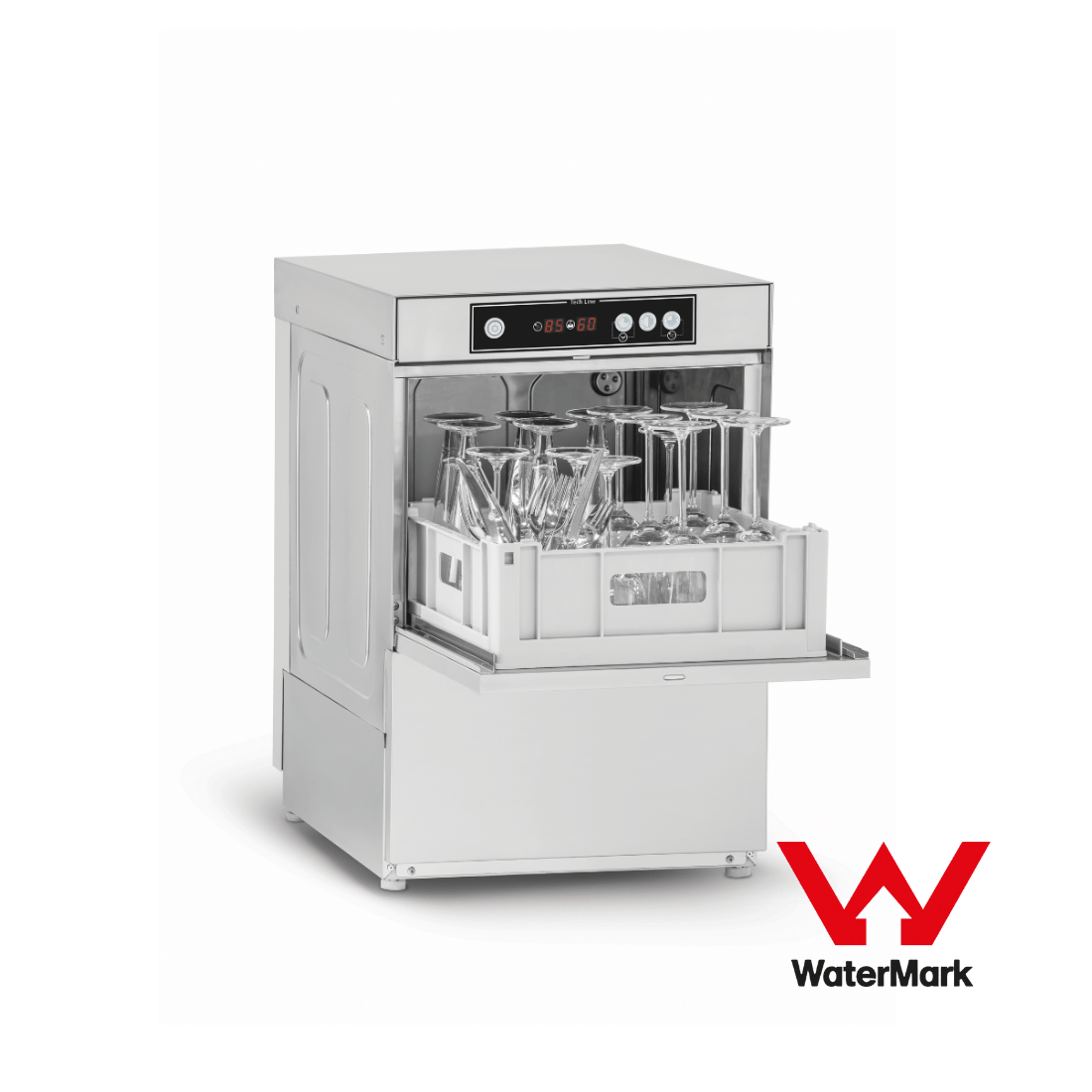
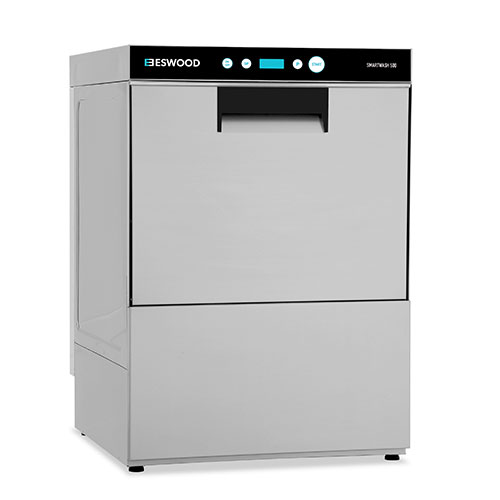
A single wash-up point in a small kitchen or bar
Pass-through
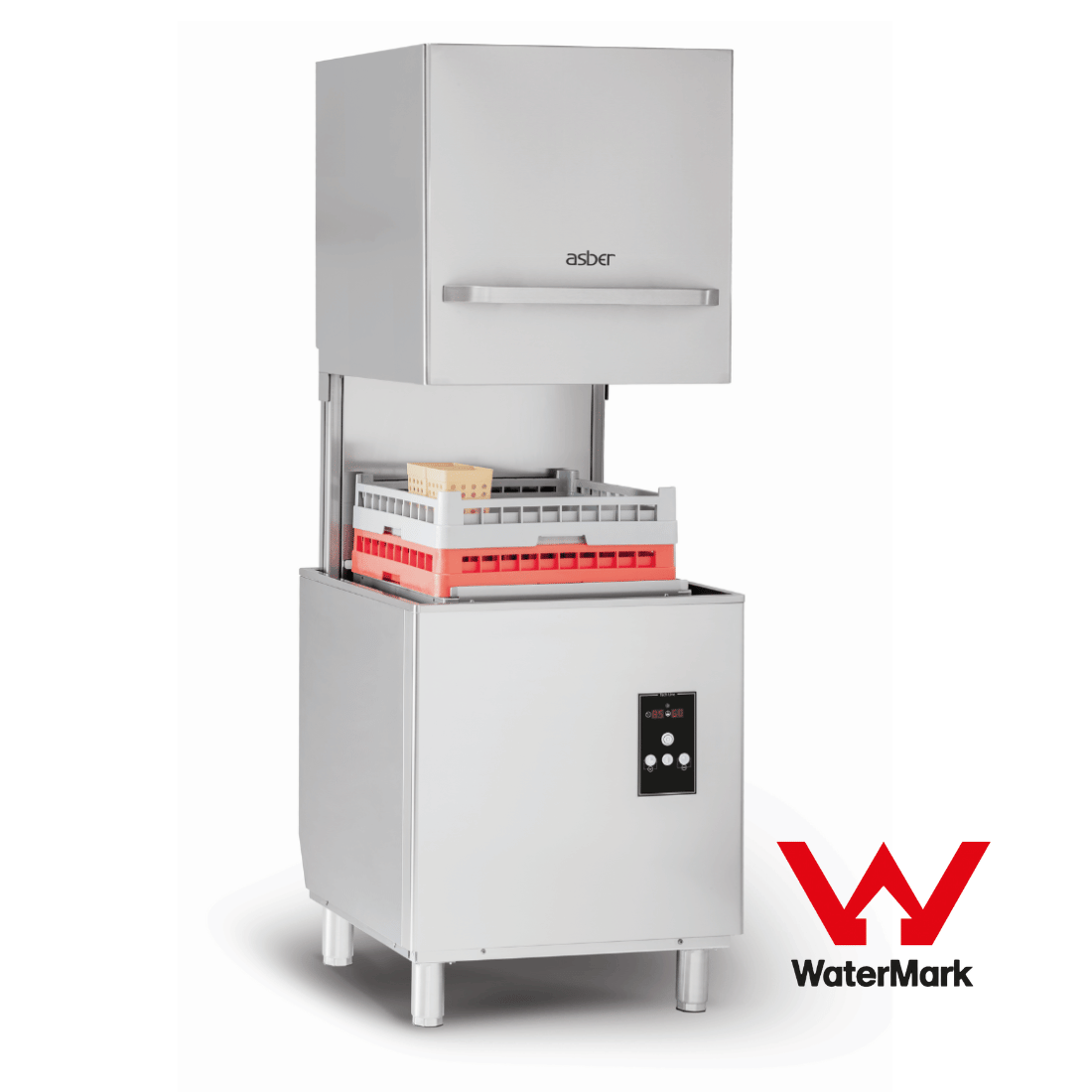
A dedicated wash-up bay with dirty-in, clean-out flow
Glasswashers
Glassware behind a bar, on a short cycle
-
Fagor
Fagor CO-402BDD EVO-CONCEPT glass washer with drain pump and detergent & rinse dispenser cold rinse
Model CO-402BDD- Width (mm)
- 470
Conveyor
Continuous high-volume warewashing
Utensil and pot washers
Pots, pans, trays and bulky kitchenware
Specifications shown are the values the exact model publishes in our catalogue; fields a listing does not record are left out rather than guessed. Confirm dimensions, electrical requirements and warranty against the manufacturer's data sheet for that exact model number before you order.