


Commercial Dishwasher Maintenance Checklist: Daily, Weekly and Scheduled Tasks
The daily, weekly and scheduled maintenance tasks that keep a commercial dishwasher running, and which jobs are staff work versus licensed-trade work.

In this article
Most "the dishwasher is broken" calls are actually water, chemical or housekeeping problems that a daily and weekly routine would have caught. This checklist sets out what to do, how often, and which jobs are staff work versus licensed-trade work — for whichever configuration you run, underbench, glasswasher, pass-through or conveyor.
For sizing and configuration decisions before you buy, start with the commercial dishwasher buying guide. This page assumes you already own a machine and want to keep it running.
Daily checklist
These take minutes and belong to whoever is on wash-up, not to a weekly walk-through.
- Scrape before racking. Food residue is the leading cause of poor wash results and blocked wash arms. Solids go in the bin, not the machine.
- Clear filters and wash arms of food debris at the end of service. Blocked jets are the single most common reason a warewasher stops cleaning properly.
- Drain, rinse and leave the machine open overnight. A machine closed up wet is a machine sitting in stagnant water and growing odour. Air drying open is the standard close-down for every configuration.
- Wipe door seals. Grease and residue on a seal stop it sealing long before the rubber actually perishes.
- Check dispensers are drawing. A quick visual check that detergent and rinse aid are actually being pulled through the lines catches an empty container before it costs a service's worth of cloudy glassware or greasy plates.
- Log anything unusual — a machine not reaching temperature, an unusual noise, a cycle running longer than normal. A symptom caught on day one is a five-minute check. The same symptom ignored for a fortnight is a call-out.
Weekly checklist
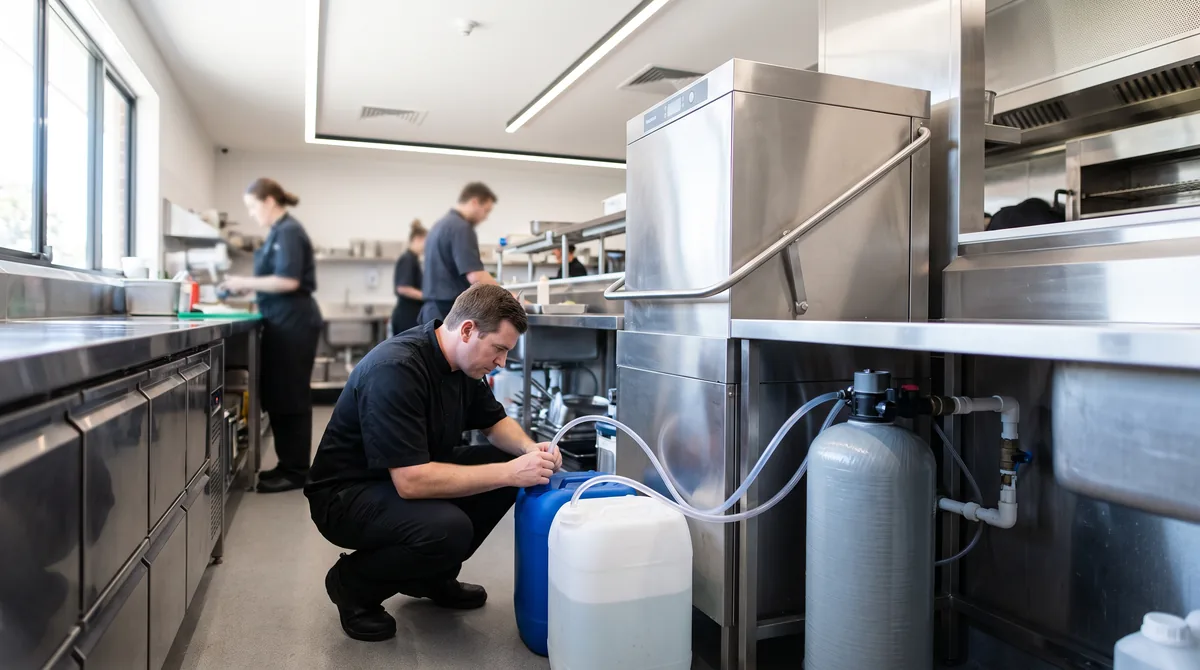
- Check softener salt where a softener is fitted, and top up before it runs out rather than after glassware starts clouding.
- Inspect seals and gaskets for wear along their whole length, not just where you can see from the front.
- Check castors, feet and hardware if the machine is on castors — movement wears the water and drain connections that are supposed to stay still.
- Clean the exterior and surrounding bench area, including under and behind the machine where access allows, so grease and debris are not being drawn back in through door seals or air gaps.
Scheduled tasks, and where the interval actually comes from
This is the point where generic advice usually gets it wrong by publishing a fixed interval — quarterly, six-monthly, annual — as if every machine and every venue run the same load. They don't. A glasswasher behind a busy bar sees more cycles in a week than the same model in a quiet function room sees in a month, and hard water accelerates scale build-up regardless of usage.
The interval that actually applies to your machine is set by the manufacturer's manual for that exact model, usually combining a calendar interval with a usage or cycle count, and adjusted for your local water hardness. Find the model number on the rating plate and locate the manual — the manufacturer's site or the installer who supplied the machine are the two reliable sources. Using an unapproved chemical or running past the specified interval is one of the more common ways an otherwise valid warranty claim gets refused.
Scale: warewashing's defining failure path
Wherever water is heated inside a dishwasher — the wash tank, the rinse booster, the rinse jets — dissolved minerals deposit as scale on contact with heat. Scale insulates elements so they work harder for the same result, and it blocks the small jets in wash and rinse arms first, which shows up as poor wash results before it shows up as a fault code or a breakdown.
Whatever water treatment or dosing the manufacturer specifies for your local water hardness needs to actually be fitted, and its cartridges or salt replaced on schedule — not only when someone happens to notice cloudy glassware. This matters more on a glasswasher than on any other configuration; see the glasswasher guide for why water hardness shows up there first.
Chemical dosing
Detergent and rinse-aid dosing set incorrectly — too little or too much — either leaves residue on glassware and crockery or wastes chemical and damages surfaces over time. Dosing pumps need periodic calibration against the machine's specification, and on many models that calibration is a technician task rather than a staff one — check the manual for your exact model rather than assuming.
Troubleshooting before you book a technician
| Symptom | Common causes to check first |
|---|---|
| Cloudy or filmy glassware | Hard water and no softener; softener out of salt; rinse aid not dosing |
| White spots on drying | Rinse aid under-dosed; final rinse temperature low |
| Food left on plates | Inadequate scraping; blocked wash arms or filters; overloaded racks |
| Greasy film | Detergent under-dosed; wash tank temperature low; tank water overdue for a change |
| Scale build-up inside the machine | Hard water without treatment; descaling overdue |
| Odour | Filters and tank not cleaned down; machine closed up wet overnight |
| Cycle taking longer than usual | Tank or booster reheating from cold after a break; check nothing is blocking the heating element |
Staff jobs versus licensed-trade jobs
Getting this boundary right is a safety decision as much as a maintenance one.
Staff jobs, once trained: scraping, clearing filters and wash arms, wiping seals, checking dispensers are drawing, topping up softener salt, and logging anything unusual for follow-up. None of these require opening an electrical enclosure or working on plumbing connections.
Licensed-trade jobs: anything behind an electrical enclosure, work on water supply or drainage connections, and any calibration or internal descale the manufacturer's manual specifies as a technician task. Gas is generally not relevant to dishwashers themselves, but plumbing and electrical work on commercial kitchen equipment is licensed work in Australia — confirm the specific requirements with your installer or contractor, since detail varies by jurisdiction.
Isolate power and water before any cleaning or inspection that goes near a panel or connection, and never defeat a safety interlock to keep a machine running through service. A machine cutting out is telling you something; working around the cut-out does not fix what it is telling you.
Before you call for a service
Having this ready turns a diagnostic first visit into a repair first visit far more often than not:
- The model and serial number from the rating plate — not from memory or an old invoice that might describe a different revision of the same model. See why model numbers matter for how to read a rating plate.
- What the fault looks like — an error code if there is one, when it started, whether it is constant or intermittent.
- What has already been checked — seals, filters, dosing, softener — so the technician is not repeating the daily checklist on site.
- Warranty status and purchase date, from your own records rather than the original listing. Only 14% of active dishwashing listings in the KitchenCompare catalogue publish a warranty term (n=912, as at 21 August 2026), so capture yours from the supplier at commissioning rather than expecting to find it later on a listing.
- Site access details — power and water isolation points, and anything blocking access to the machine.
Ownership record worth keeping
One page per machine — brand, exact model number, serial number, install date, power and water connection, warranty term and service contact — takes an afternoon to compile and saves that afternoon back on the first breakdown, because the technician can bring the right part on the first visit instead of the second. For the wider habits that apply across every category of commercial kitchen equipment, not just warewashing, see maintenance habits that extend commercial equipment life.
Machine ageing out or beyond economic repair? Compare dishwashing equipment on the exact supplier model number, with live retailer prices and price history — never matched on product names.
Compare dishwashing equipment