


Bain Marie Buying Guide: Wet or Dry, Sizing and Formats
Wet or dry heat, how bain maries are really sized in gastronorm pans, and when a hot holding cabinet or food display is the machine you actually want.
In this article
A bain marie holds prepared food at serving temperature using gentle, indirect heat. That is the whole job. It is holding equipment, not cooking equipment: it will not bring food up to temperature from cold, it will not reheat safely, and it will not rescue food that has already been sitting too long.
Getting that boundary right saves money, because a lot of buyers reach for a bain marie when what they actually need is a hot holding cabinet, a food display, or a way to cook closer to service.
Wet or dry
This is the most consequential choice in the purchase.
Wet (water bath). The pans sit in a heated water bath, and the water transfers heat to the food. Water spreads heat evenly and buffers it, so hot spots are rare and delicate items — sauces, custards, curries, anything that catches — hold far better. The costs are practical: the bath has to be filled before service, water evaporates through the day and has to be topped up, it takes time to come up to temperature, and the tank has to be drained and cleaned at close. In hard-water areas the tank scales.
Dry (element or air). Elements heat the pan wells or the air around them directly. It is quicker to bring up, there is no water to fill, top up or drain, and close-down is faster. In exchange, heat distribution is less even, delicate foods are more likely to catch or dry at the edges, and food that sits for a long period suffers more.
The trap with dry units: they depend on good contact between the pan and the well. Using the wrong pan size, an undersized pan, or a well left empty means heat has nowhere to go, and on some units running dry wells is explicitly outside what the manufacturer allows. Check the manual for the exact model before you assume you can run it half-loaded.
Choose wet for sauces, gravies, curries, delicate proteins and anything held for a long service. Choose dry for robust items, shorter holding periods, mobile use, and sites where filling and draining a bath every day will not realistically happen.
Whichever you choose, the operating requirement is the same: hold food at the temperature required by the food safety requirements that apply to your business, check it with a calibrated probe rather than trusting the dial, and confirm the unit can maintain that temperature in every pan position under a real load — not just in the centre well on an empty run.
| Wet (water bath) | Dry (element or air) | |
|---|---|---|
| Heat distribution | Even; water buffers hot spots | Less even; edges and corners run hotter |
| Suits | Sauces, gravies, curries, delicate proteins, long services | Robust items, shorter holding, mobile use |
| Daily routine | Fill, top up through service, drain and clean | Switch on; no water to manage |
| Watch for | Evaporation, scale in hard-water areas | Empty or wrong-sized wells — check what the manual allows |
Sizing by gastronorm
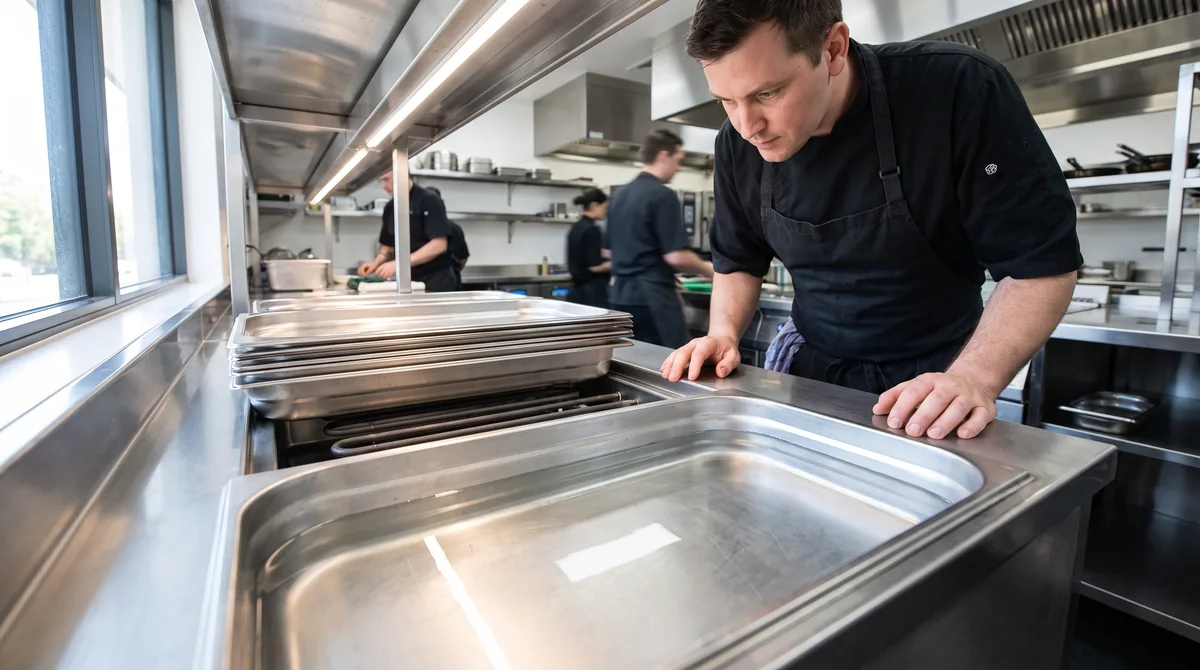
Bain maries are specified by their gastronorm pan layout, not by litres. A unit described as "3 x 1/1" holds three full-size gastronorm pans; the same footprint might instead be configured as six 1/2 pans or a mix.
Plan the layout from your menu:
- List the items you need to hold at once during your busiest service.
- Assign a pan fraction to each. A large-volume item earns a 1/1; garnishes and sides fit 1/3 or 1/6.
- Choose the pan depth. Deeper pans hold more but hold heat differently and are harder to serve from cleanly. Depth also changes how much water a wet unit needs.
- Add a spare well if you can. A menu changes, and a fully committed bain marie has no room for a special.
- Check the pans are included — on many units they are not, and the pan set is a real cost.
Pan sizes are a standard system, which is what makes swapping and planning practical. See stainless steel gastronorm pans for the sizes and depths available.
Benchtop, drop-in and mobile
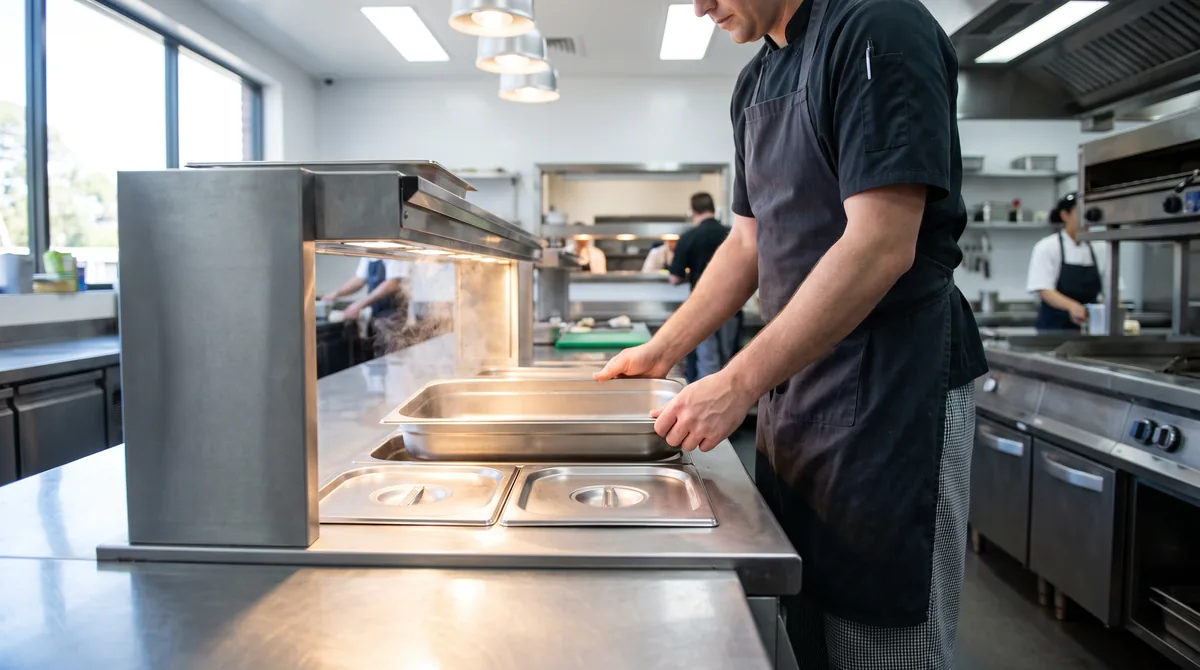
Benchtop units sit on a counter and plug in. They are the flexible choice: easy to move, easy to replace, and easy to add a second one when the menu grows.
Drop-in modules are built into a servery or counter, giving a flush, finished look with no visible cabinet. They belong in a designed fit-out, and they commit you to that pan layout for the life of the counter.
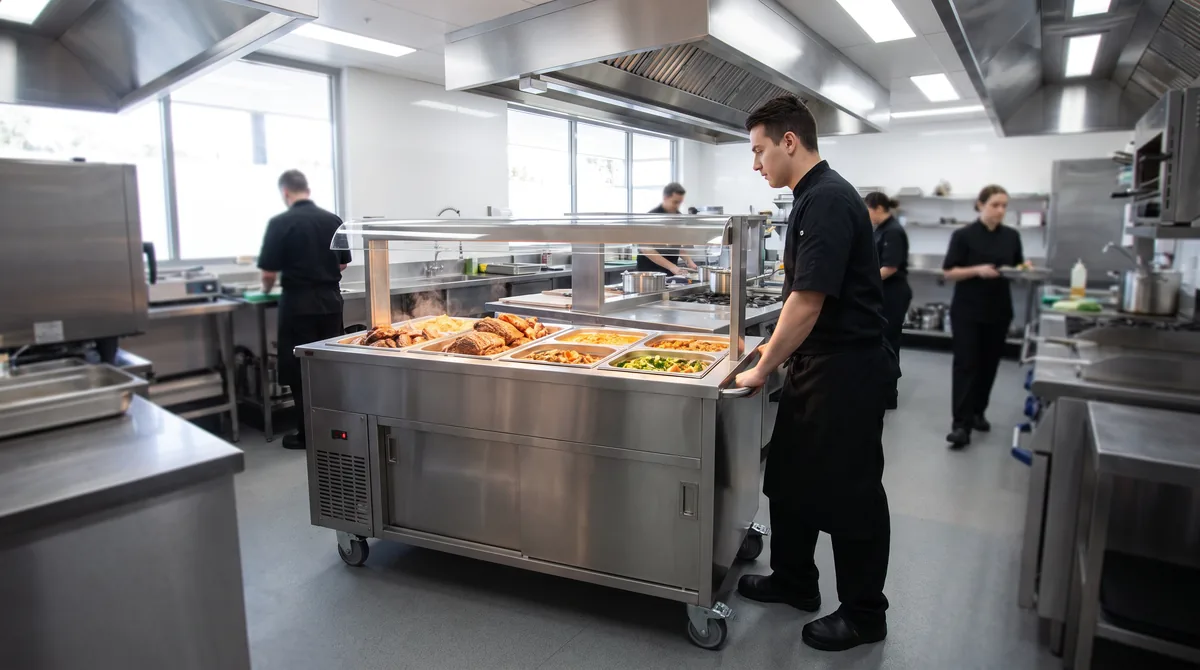
Mobile and buffet units are on castors with their own cabinet, for function service, catering and rooms that change layout. They trade some robustness for the ability to be where the service is. If your job is buffet or function service rather than a fixed servery, look at buffet display equipment alongside bain maries.
Where a bain marie sits among the neighbours
Several pieces of equipment solve adjacent problems, and buying the wrong one is common.
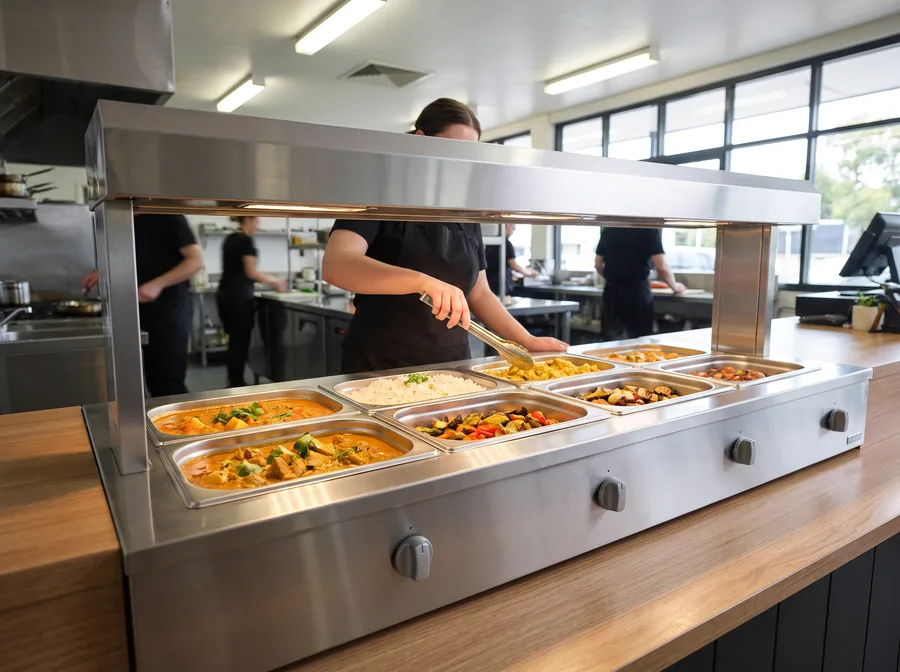
- Hot food display — a bain marie with a customer-facing glass superstructure and lighting. If customers are choosing from it, you want a display unit, not a bare bain marie.
- Hot holding cabinet — an enclosed, usually humidity-controlled cabinet that holds plated food, trays or full gastronorm racks. If you need to hold volume out of sight, especially plated food or banquet trays, this is the machine. See hot holding cabinets.
- Food warmer / heat lamp — radiant heat over a pass to hold a plate for a short moment before it goes out. Different job entirely; it does not hold bulk food.
- Pie warmer — a display cabinet for a specific product, usually with its own humidity behaviour.
If you are holding bulk food in pans on a servery, the bain marie is right. If you are holding plated food, holding volume behind the scenes, or merchandising to a customer, one of the others probably is.
Controls, elements and build quality
- Thermostat type and range. A control that lets you set and hold a stable temperature across the service is worth more than a high maximum. Check what the range actually is on the model, and whether the control is per-well or for the whole unit.
- Element access. On a wet unit, elements sit under or around the tank; on a dry unit, under the wells. Whether an element can be replaced without replacing the machine is a ten-year question worth asking now.
- Tank construction. Look at the gauge and finish of the stainless, the corner radii — square internal corners trap residue — and whether the tank is a pressed single piece or welded.
- Drain tap. On a wet unit this is the difference between a manageable close-down and a job nobody wants. Check the tap position and the clearance beneath it.
- Pan supports and adaptor bars. These divide a well for smaller pans. They are usually accessories, not inclusions.
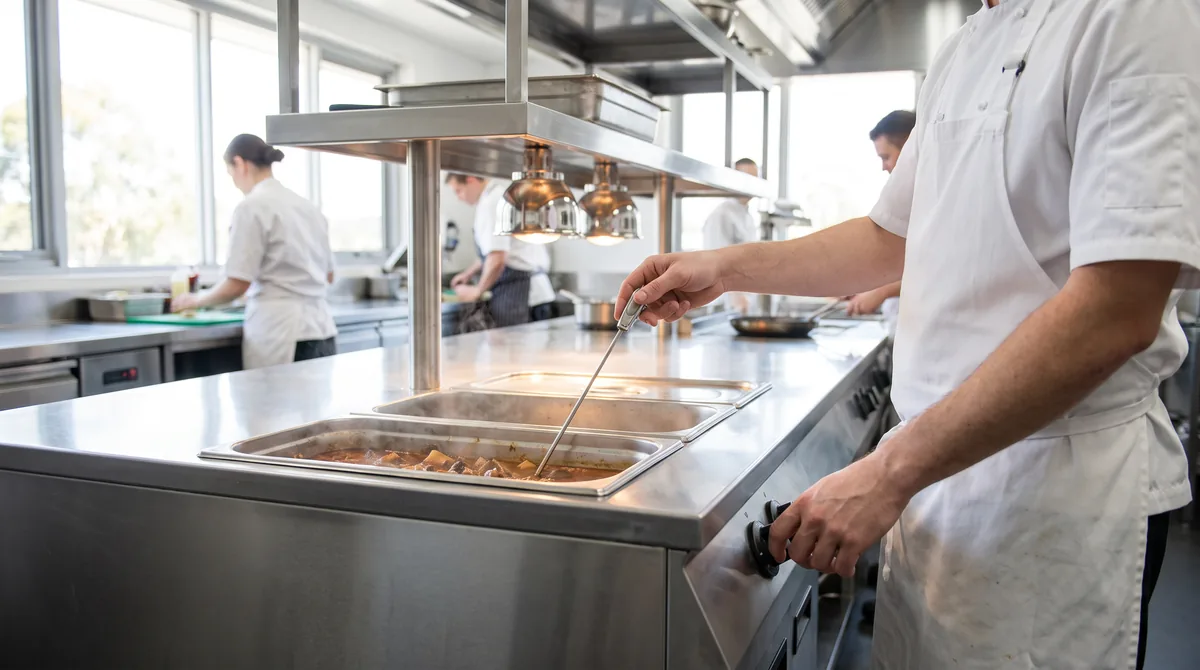
Hold temperature is a food-safety control, not a dial setting
Hold food at the temperature your local food-safety requirements specify, check it with a calibrated probe rather than the unit's thermostat, and confirm the unit maintains it in every pan position under a real load — not just the centre well on an empty run. A bain marie holds food; it does not bring it up to temperature and it does not reheat.
Cleaning and daily operation
- Fill before you switch on on a wet unit, and never run the tank dry.
- Top up during service. Evaporation is constant, and a falling water level changes how the unit holds temperature.
- Drain, clean and dry the tank daily. Standing water overnight causes staining, smell and scale.
- Manage scale. In hard-water areas the tank and elements will scale, which reduces heat transfer and eventually damages elements. Descale to the manufacturer's procedure at the interval they state, and consider treated water for the fill if your supply is hard.
- Check the seals and pan fit regularly. A warped pan sits badly and holds badly.
For the wider habits that keep equipment alive, see maintenance habits that extend commercial equipment life.
Decided wet or dry, and the pan layout? Compare bain maries on the exact supplier model number, with live retailer prices and price history — never matched on product names.
Compare bain maries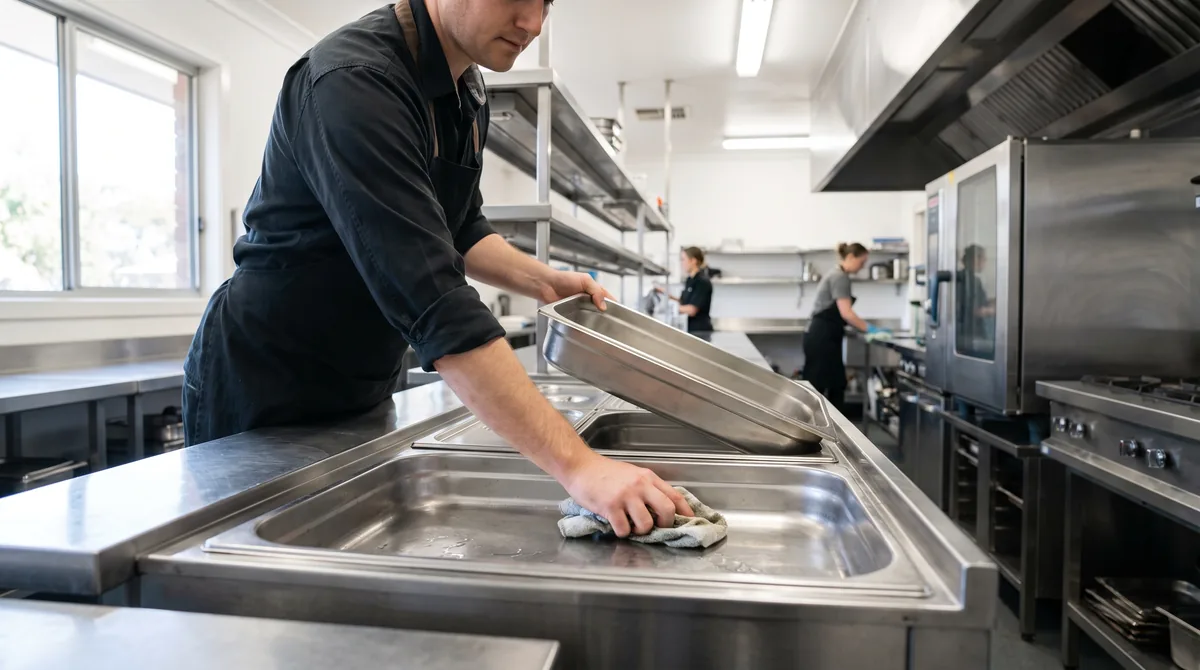
Comparing specific models
Bain marie listings look interchangeable and are not. One series routinely spans wet and dry variants, different pan layouts in the same external footprint, benchtop and drop-in versions, with and without pans included, and different electrical connections — behind model numbers that differ by a suffix.
That is why every comparison on this site is matched on the exact supplier model number rather than on product names; see why model numbers matter. Prices shown on the site include GST.
Compare like for like on: wet or dry, pan layout and pan depth supported, whether pans and adaptor bars are included, thermostat range and whether control is per-well, drain tap fitted, tank construction, electrical requirement, warranty terms and local service coverage.