


Commercial Deep Fryer Buying Guide: Sizing, Oil and Configuration
Recovery, not capacity, is what fails you on a Saturday. How to size a commercial deep fryer to your service, and what pot volume really costs you in oil.
In this article
Most fryer purchases go wrong in the same way: the buyer sizes on capacity and gets caught out by recovery. A fryer that holds plenty of oil but cannot bring it back to temperature between drops will hold up your entire service on a Saturday night, and no amount of pot volume fixes that.
Sizing a fryer to your service, not your menu
The arithmetic that matters is about your busiest interval, not your day.
- Covers at peak. Take the busiest thirty or sixty minutes you actually trade, not the daily average.
- Portions that go through the fryer. Not every dish does. Count the ones that do, including sides that ride along with mains.
- Portions per basket. Overloading a basket is the fastest way to drop oil temperature, which produces greasy food and slows everything after it. Work from a realistic basket load.
- Drops per interval. Portions divided by portions-per-basket gives the number of drops your peak demands.
- Recovery between drops. Here is the constraint. After a basket of cold product goes in, the oil temperature falls and the fryer has to bring it back before the next drop cooks properly. Recovery behaviour is model-specific — ask for it, and take it seriously.
The number you want from a supplier is not "how many kilos per hour". It is: for this exact model, what is the recovery behaviour with a full basket of frozen product, and what happens on consecutive drops. A fryer that has to be nursed between drops is a fryer you will resent.
Add headroom. Specifying at exactly your peak leaves nothing for a function, a delivery surge or a busier summer than last year.
Oil capacity and what it really costs you
Pot volume does two jobs at once, and they pull in different directions.
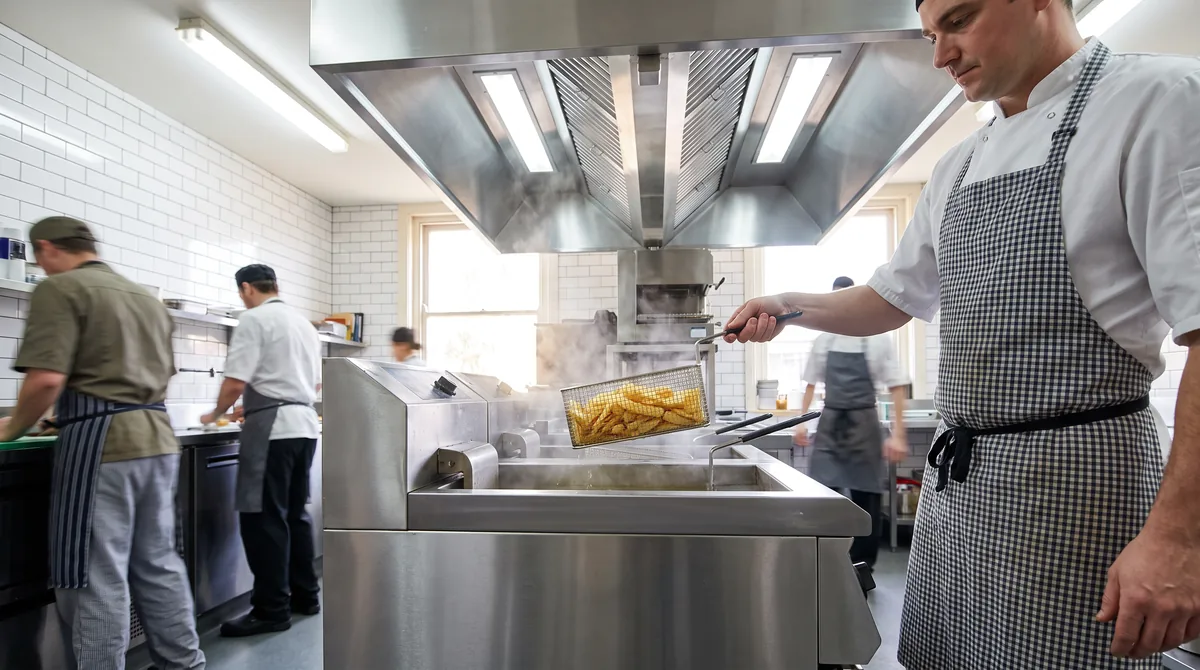
A larger pot carries more thermal mass, so it recovers better after a drop and holds temperature more steadily across a service. It also holds more oil, which means every oil change costs more and a full change is a bigger job.
A smaller pot is cheaper to fill and quicker to change, but it swings harder in temperature and recovers more slowly relative to the load you put in it.
Over a year, oil is usually the largest single running cost of a fryer — larger than the energy it uses. What shortens oil life:
- Carbon and crumb left in the pot. Debris burns, darkens the oil and accelerates breakdown.
- Frying different products in one pot. Battered fish, crumbed product and chips all shed different things. Mixing them shortens oil life and moves flavour between dishes.
- Running too hot. Higher temperatures than the product needs degrade oil faster.
- Not filtering. Filtering is the single highest-return habit in fryer operation.
Ask for the exact model's oil capacity from the specification sheet rather than a category generalisation, and factor a realistic oil cost into your comparison of two machines.
| Configuration | Earns its space when | Cost of choosing it |
|---|---|---|
| Single large pot | You fry essentially one product in volume | No separation; one oil, one temperature |
| Twin pot | Fish and chips share a fryer, or you want two temperatures | More bench, more connections |
| Separate units | You need to keep trading while one pot is changed or cleaned | Highest cost and footprint; most resilient |
| Dedicated allergen pot | Gluten-containing crumb must stay away from everything else | Non-negotiable where it applies — this is a food-safety obligation, not a preference |
Gas or electric
This is a services decision more than a cooking one.
Gas fryers need a gas connection sized for the appliance plus the flue and ventilation arrangements that go with it. Connection is work for a licensed gas fitter.
Electric fryers need adequate circuit capacity at the position, which for a commercial fryer is often substantial and may mean three phase. Connection and any switchboard work is for a licensed electrician.
Recovery behaviour differs between the two by model rather than by fuel — do not accept a blanket claim that one recovers better. What usually decides it in a fit-out is what is already available at the position, and what changing that would cost. Get the exact model's stated requirement from the manufacturer's documentation and hand it to your licensed trade before you commit. If you are pricing services across a whole kitchen, see budgeting a commercial kitchen fit-out.
Single, twin and multi-pot configurations
Separate pots are not primarily about volume. They are about keeping things apart.
Two or more pots are worth the bench space when:
- You need allergen separation — gluten-containing crumb away from everything else is the common case, and it is a real food-safety obligation rather than a nicety.
- Fish and chips share a fryer today and your fish tastes like chips.
- You want different oil, or different temperatures, for different products.
- You want to keep trading while one pot is being changed or cleaned.
One larger pot serves better when:
- You fry essentially one product in volume, and thermal mass and recovery matter more than separation.
- Bench space is genuinely scarce and the menu does not demand separation.
A twin-pot unit and two single units are not the same thing: two separate units let you turn one off in a quiet period and keep trading if one fails, at the cost of more bench and more connections.
Freestanding, benchtop and drop-in
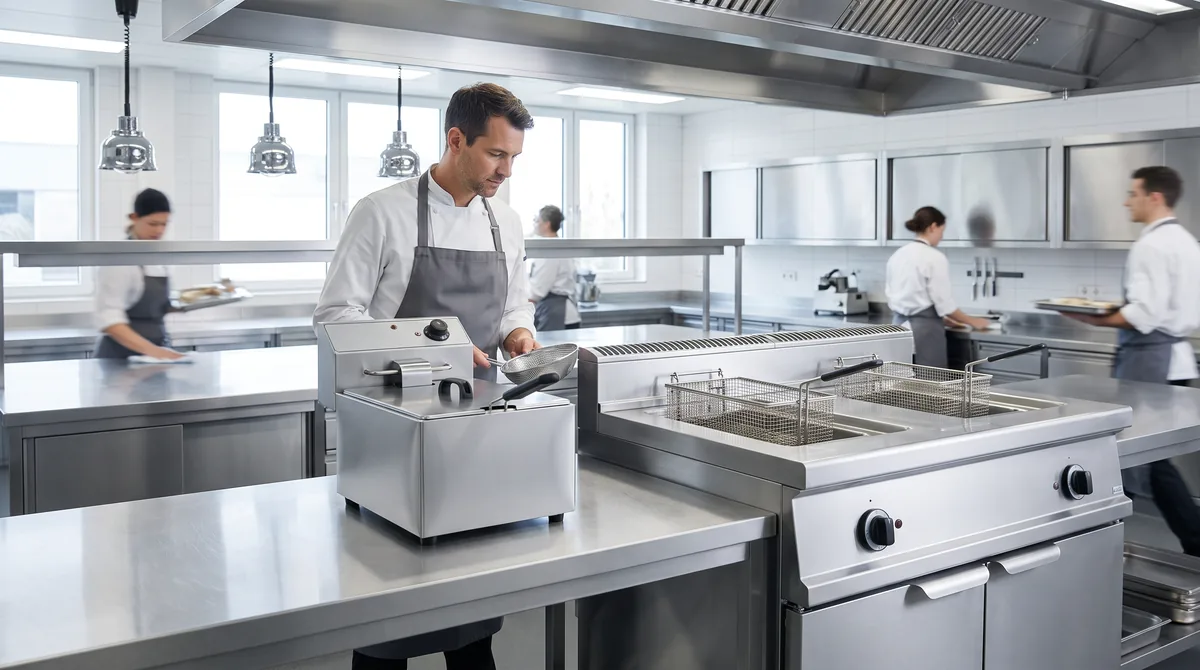
Freestanding fryers are the standard commercial format, designed to sit in a cooking line at working height with the pot depth and recovery capability a busy service needs. The deepest range of commercial models is freestanding, and that is where to start: compare freestanding deep fryers.
Benchtop units suit low volume, a second product, or a site where a freestanding unit will not fit. They are limited by pot size and by the bench they sit on.
Drop-in units are built into a bespoke cooking suite. They belong in a designed fit-out rather than a replacement purchase.
Match the format to the line layout you have. A fryer in the wrong position on the line adds a step to every plate.
Filtration, drainage and the close-down routine
This section decides whether your oil cost is reasonable or awful.
Built-in filtration pumps the oil through a filter and returns it to the pot. It makes filtering a routine step rather than a project, which means it actually happens. Separate filter trolleys serve multiple fryers and cost less per fryer, but they add handling.
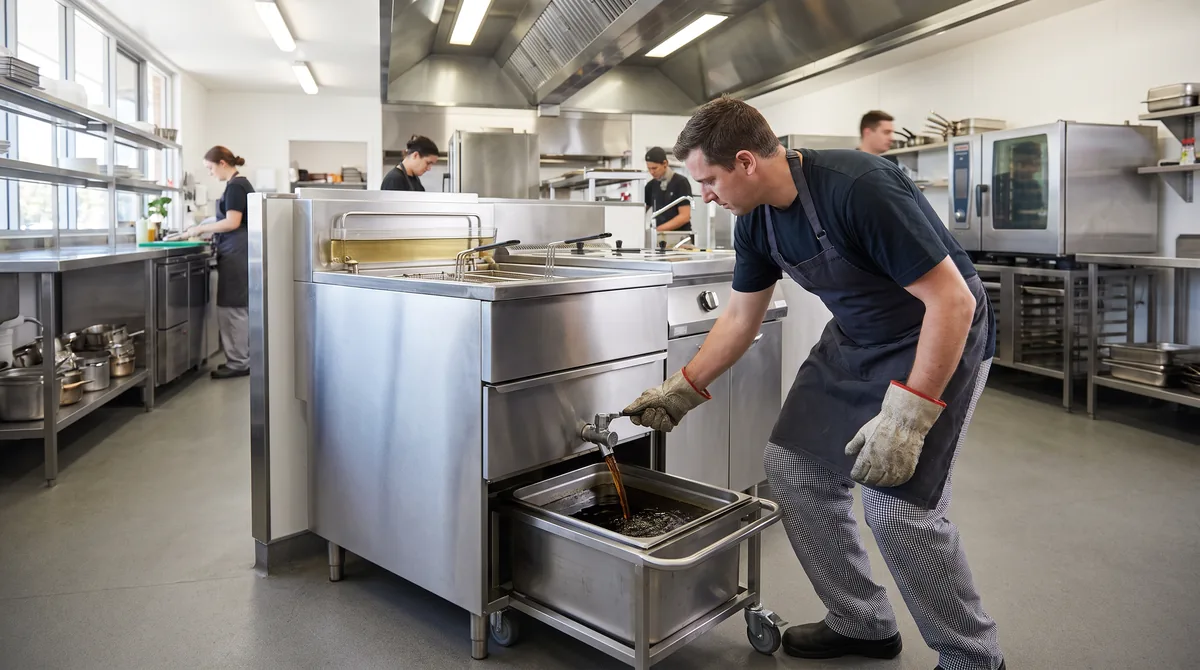
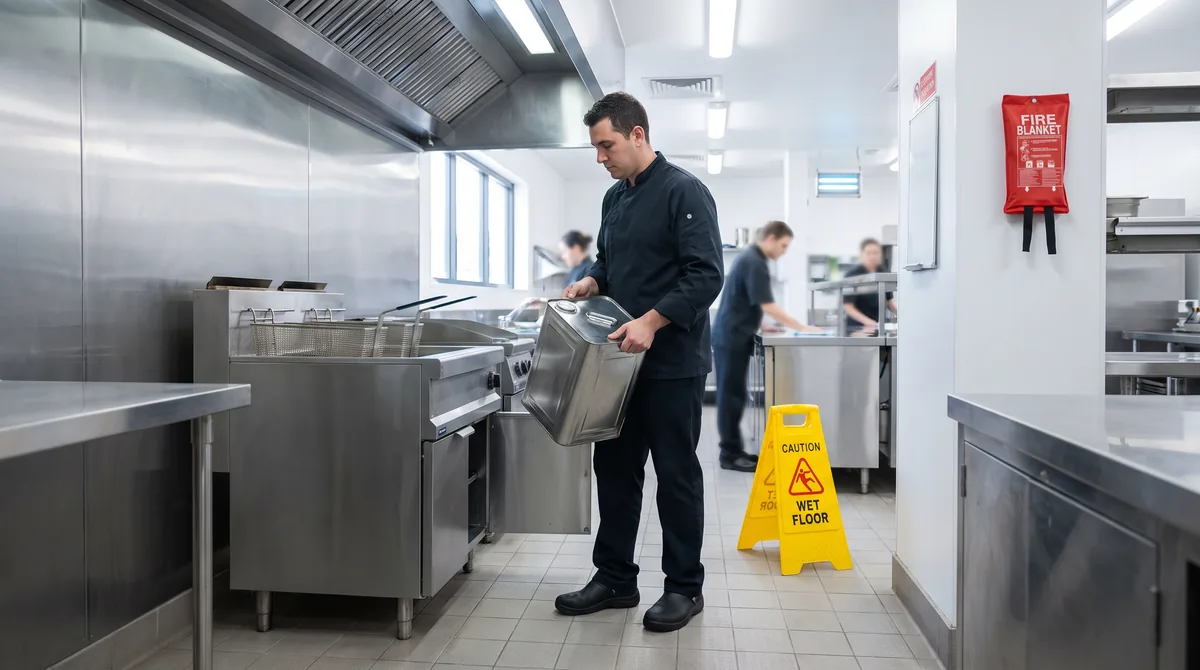
Drain taps matter more than they sound. A well-positioned tap with a container that fits under it turns an oil change from a hot, awkward job into a manageable one. Check the tap position and the clearance beneath it against the container you will actually use.
A close-down routine that works:
- Skim debris through service, not just at the end.
- Filter at the interval your volume demands, while the oil is still workable.
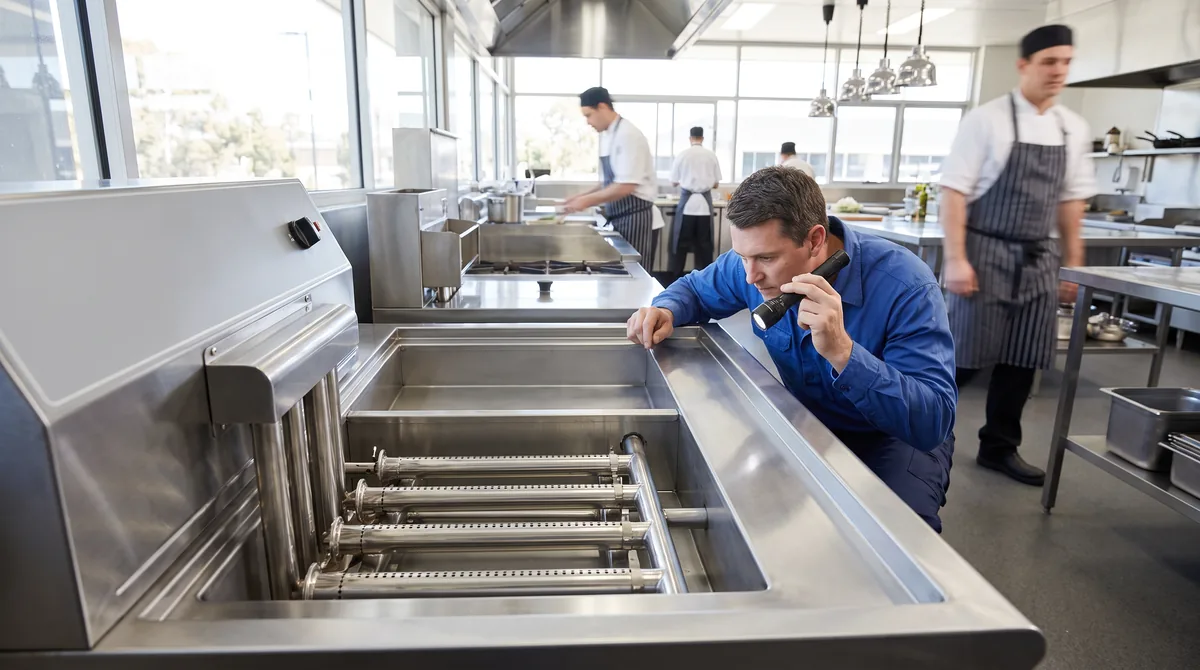
- Drain, clean the pot and check the element or tube surfaces are clear.
- Boil out to the manufacturer's procedure at the interval they state.
- Check baskets, hooks and lids for damage.
For the wider habits that keep cooking equipment alive, see maintenance habits that extend commercial equipment life.
Safety and the things people forget
The device that stops a fryer becoming a fire
A working high-limit cut-out is what protects an unattended fryer when the thermostat fails. Confirm the exact model has one, and that testing it is part of the service schedule — not something assumed to be fine because the fryer still heats.
- Thermostat and high-limit cut-out. A working high-limit device is what stops an unattended fryer becoming a fire. Confirm the exact model has one, and that it is tested as part of servicing.
- The splash zone. Nothing that must stay dry — no electrical outlet, no paper, no dry goods — belongs within reach of a fryer.
- Neighbours on the line. A fryer beside a fridge makes the fridge work against local heat, and a fryer beside a water source is a hazard. Plan the line, not just the appliance.
- Ventilation. A fryer is commercial cooking equipment and normally sits under mechanical exhaust ventilation. Whether your canopy covers the new position and has capacity for another appliance is part of the purchase decision. See canopies and ventilation.
- Oil disposal. Used cooking oil has to be disposed of properly. Requirements are set locally, so check with your council or waste contractor rather than assuming.
Know the pot configuration and fuel? Compare freestanding fryers on the exact supplier model number, with live retailer prices and price history — never matched on product names.
Compare deep fryers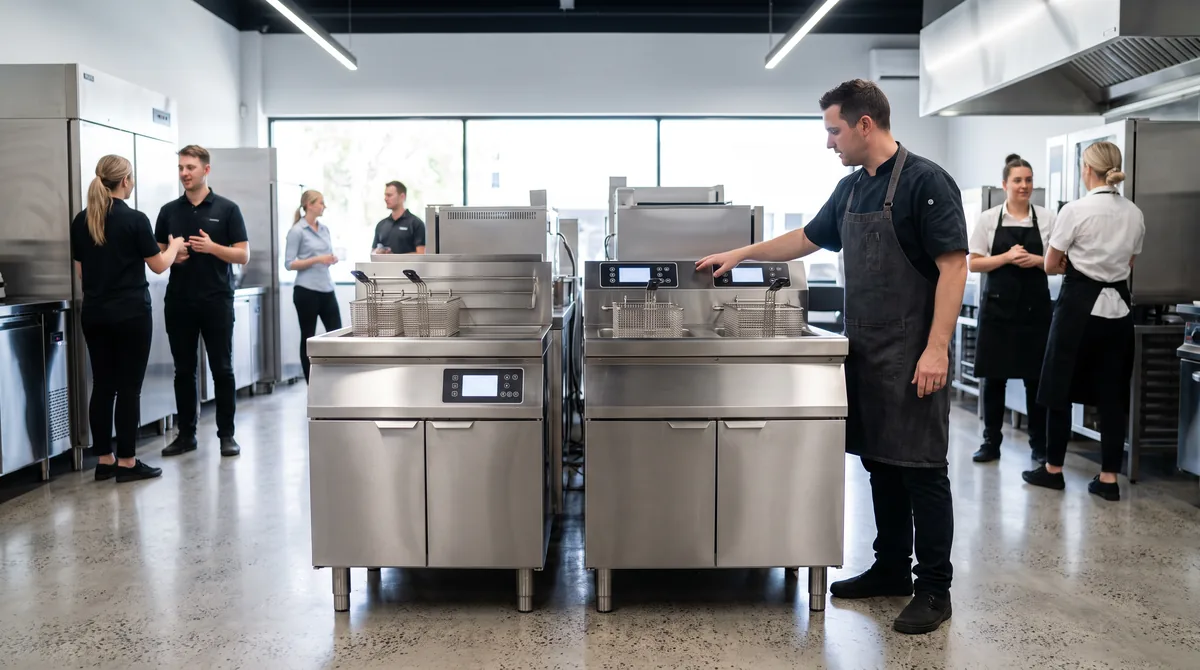
Comparing specific models
Two fryer listings can look identical and be different machines. One series routinely spans different pot volumes, single and twin configurations, gas and electric variants, with and without built-in filtration, and different power connections — behind model numbers that differ by a suffix.
That is why every comparison on this site is matched on the exact supplier model number rather than on product names; see why model numbers matter. Prices shown on the site include GST.
Compare like for like on: pot volume and configuration, gas or electric and the exact supply required, recovery behaviour from the manufacturer, filtration built in or not, baskets and lids included, drain tap position, high-limit protection, warranty terms and local service coverage.