


Commercial Coffee Machine Buying Guide: Espresso, Automatic and Batch
Traditional espresso, bean-to-cup or batch brew? How to choose a commercial coffee machine from your menu, your peak, your staff model and what your site can supply.
In this article
- The three systems, and who each one suits
- Calculate peak output before you choose
- One, two or three groups
- Site preflight
- The grinder and the water system are part of the machine
- Staffing, cleaning and repeatability
- What ownership actually costs
- Compare exact models, not series names
- Questions to ask a supplier
- Frequently asked questions
- Where to go next
Your menu, your busiest fifteen minutes, who is making the coffee, and what your site can supply between them decide which commercial coffee machine you need. Brand comes last. A machine chosen around a barista you do not employ, or a bench that cannot carry it, will disappoint no matter how good it is.
This guide separates the three machine systems, shows how to size groups against real peak demand, and lists the site checks that decide what is installable. It is deliberately price-light — current figures belong in a dated price report, not in an evergreen guide.
The three systems, and who each one suits
| System | Best fit | Who operates it | Site demands | Trade-off |
|---|---|---|---|---|
| Traditional espresso | Cafés, restaurants and bars where coffee quality is a selling point | Trained baristas, consistent staffing | Plumbed treated water, drainage, dedicated circuit, solid bench | Highest ceiling in skilled hands; output falls away without that skill |
| Automatic / bean-to-cup | Offices, hotels, venues with rotating or untrained staff, self-serve | Any staff member, minimal training | Plumbed treated water, drainage, dedicated circuit; some models need less bench | Repeatable at the push of a button; less control over extraction, and cleaning cycles are non-negotiable |
| Batch brew / filter | Function catering, breakfast service, high-volume black coffee | One operator brewing to a schedule | Plumbed or tank fill; drainage varies by model | Very high volume per operator; not espresso, and holding time limits quality |
Most Australian venues buy a traditional espresso machine with a separate grinder. Bean-to-cup makes sense where staffing is the constraint rather than the coffee. Batch brewing complements either when you serve a lot of long black or filter at breakfast.
Compare live options across all three in the commercial coffee machine category.
Calculate peak output before you choose
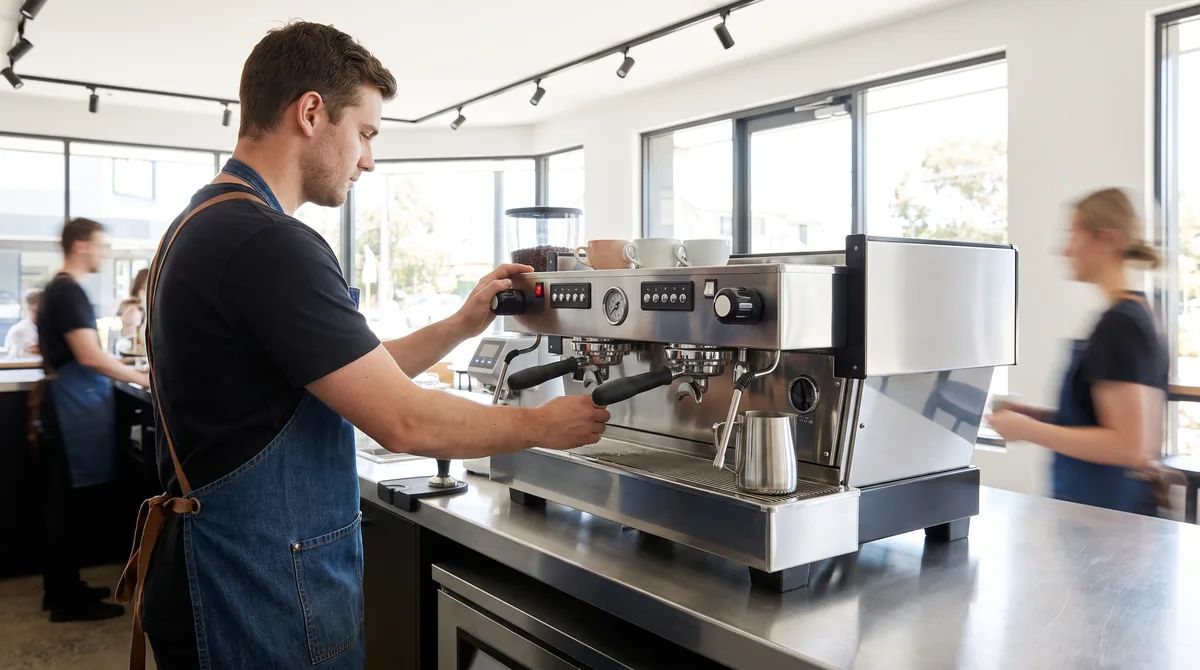
Drinks per hour is not the useful number. What breaks a coffee service is a fifteen-minute peak where orders arrive faster than one operator can extract, steam and pour.
Work through it in this order:
- Find your busiest interval. Not the day's total — the fifteen or thirty minutes when a commuter rush, a function break or a breakfast sitting lands.
- Count drinks, and count milk drinks separately. Milk drinks need steam and pouring time; a long black needs neither. A menu that is mostly flat whites is steam-limited, not group-limited.
- Count the operators. Two groups do nothing for you if one person is working them. A second group earns its cost when a second pair of hands is on the machine.
- Add the grinder. A grinder that cannot keep pace with the machine is the real bottleneck in a lot of cafés, and it is the cheaper half of the pair to get wrong.
- Allow for recovery. Boilers and heat exchangers recover between shots and between steaming. Sustained output under continuous load is lower than a first-shot figure suggests.
There is no honest universal drinks-per-hour number for a machine type, because it depends on your drink mix, your staffing and your workflow. Ask a supplier for the exact model's boiler capacity and steam recovery, then test the workflow rather than the specification.
One, two or three groups
Group count is a decision about simultaneous work, not about volume alone.
- One group suits a low-volume site, a second service point, or a venue where one person makes every coffee and the peak is modest.
- Two groups is the common café configuration. It lets one operator run two extractions in parallel, and it lets a second operator work the machine during a rush.
- Three groups belongs in high-volume sites with multiple baristas and the bench length to let them work without colliding.
More groups also mean a larger boiler, a heavier machine, a bigger electrical demand and more bench. Buying a group you never staff is buying all of those costs and none of the benefit.
Site preflight
Do these checks before you shortlist. Each has ruled out a machine someone had already chosen.
- Water supply and treatment. Almost every plumbed machine needs treated water. Untreated hard water scales boilers and destroys them, and the treatment specified depends on your local water and on the manufacturer's requirement for that model. This is a purchase-time decision.
- Drainage. Espresso machines need a drain for the drip tray and for backflushing. Check where the nearest drain is before you site the machine.
- Electrical supply. Power draw varies substantially with boiler size and group count. Some models are single phase, some need three phase, and most want a dedicated circuit. Get the exact model's requirement in writing and have an electrician confirm the site can supply it.
- Bench load and depth. A multi-group machine with a full boiler is heavy, and the bench has to carry it while a barista leans on it. Check depth including the plumbing behind the machine.
- Clearance and ventilation. Machines shed heat. Leave the manufacturer's clearances above and behind, and do not box one in against a wall of stock.
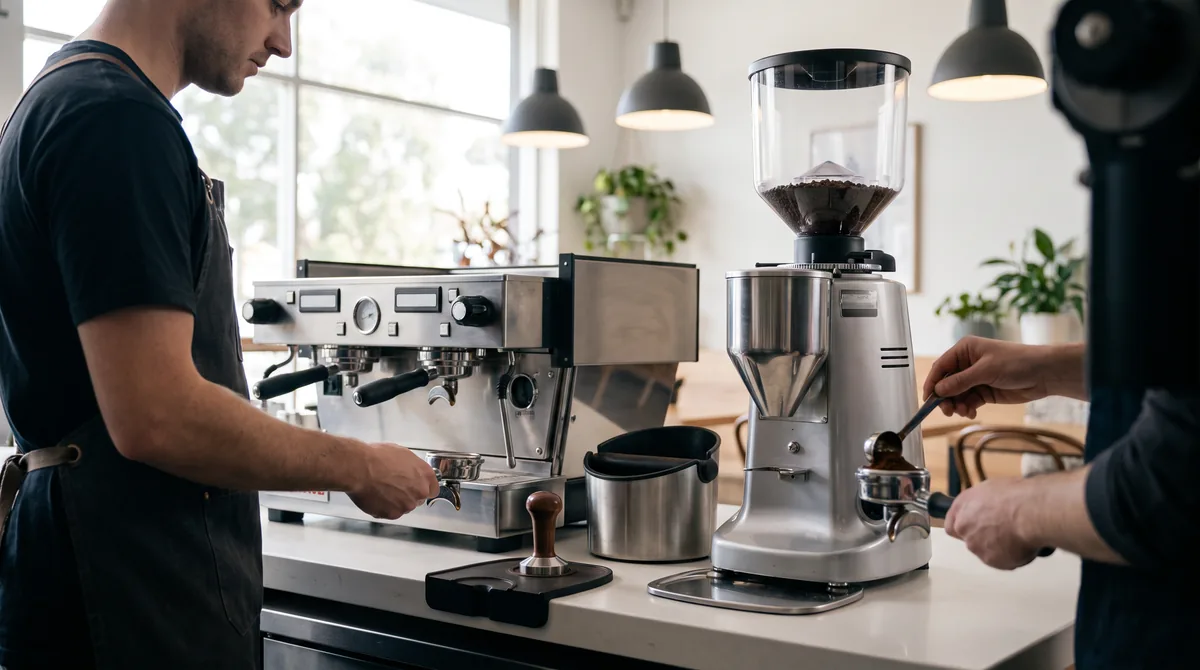
- Workflow space. Grinder, knock box, cups, milk fridge and pour space all have to fit around the machine. A machine that fits the bench but not the workflow slows every drink.
Verify the exact model's requirements against manufacturer documentation and with licensed trades before purchase.
The grinder and the water system are part of the machine
Two things get treated as accessories and should not be.
The grinder determines particle size and consistency, which determines extraction. A good machine with a poor or mismatched grinder produces inconsistent coffee, and no amount of machine quality recovers it. Budget for the grinder at the same time, and match its throughput to the machine.
The water system determines whether the machine survives. Scale is a leading cause of expensive boiler and element failures in venues with hard supply. The filtration or treatment the manufacturer specifies for your water is a running cost with a replacement schedule, not a one-off purchase.
Staffing, cleaning and repeatability
Choose the system your staff can actually run on a Sunday when your best barista is not rostered.
- Traditional espresso rewards trained, consistent staff and punishes turnover. If you cannot keep skill in the building, the quality advantage evaporates.
- Bean-to-cup trades that ceiling for repeatability. The trade-off is real, and it is not a compromise if consistency is what your venue needs.
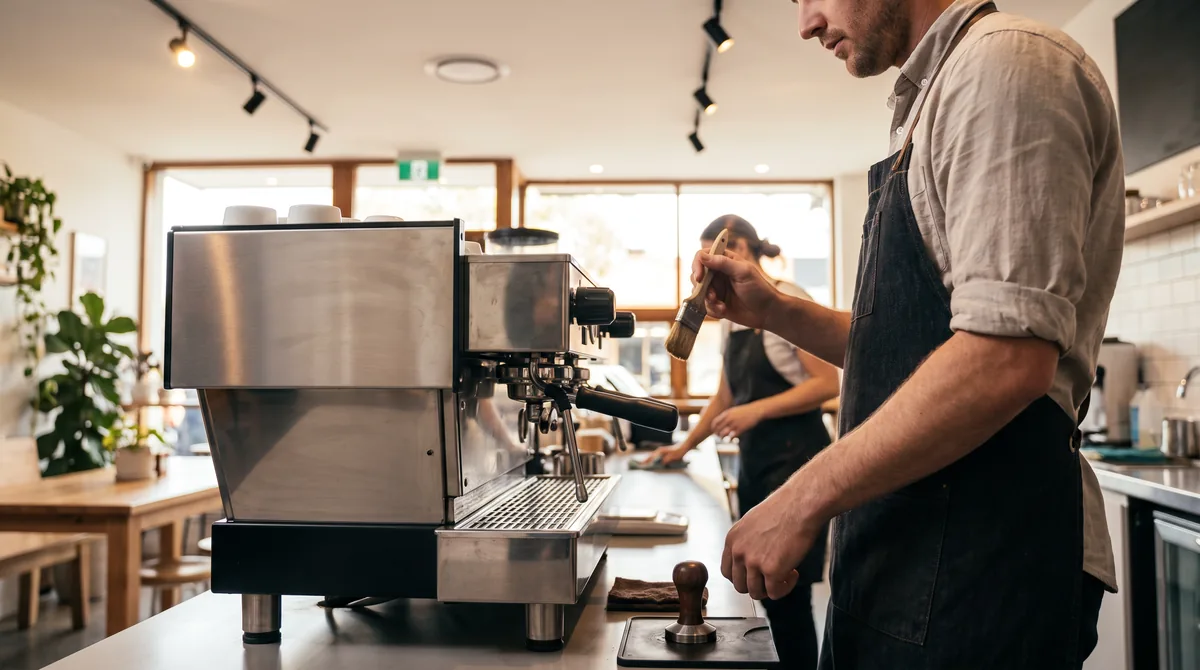
- Cleaning is not optional on any of them. Every manufacturer publishes a daily, weekly and periodic routine — backflushing, group seals, steam wands, milk lines, hoppers and burrs. Follow the exact routine for the exact model and build it into the roster like a prep task. Milk-line cleaning on automatic machines is a food-safety item, not housekeeping, and belongs in your documented food safety plan.
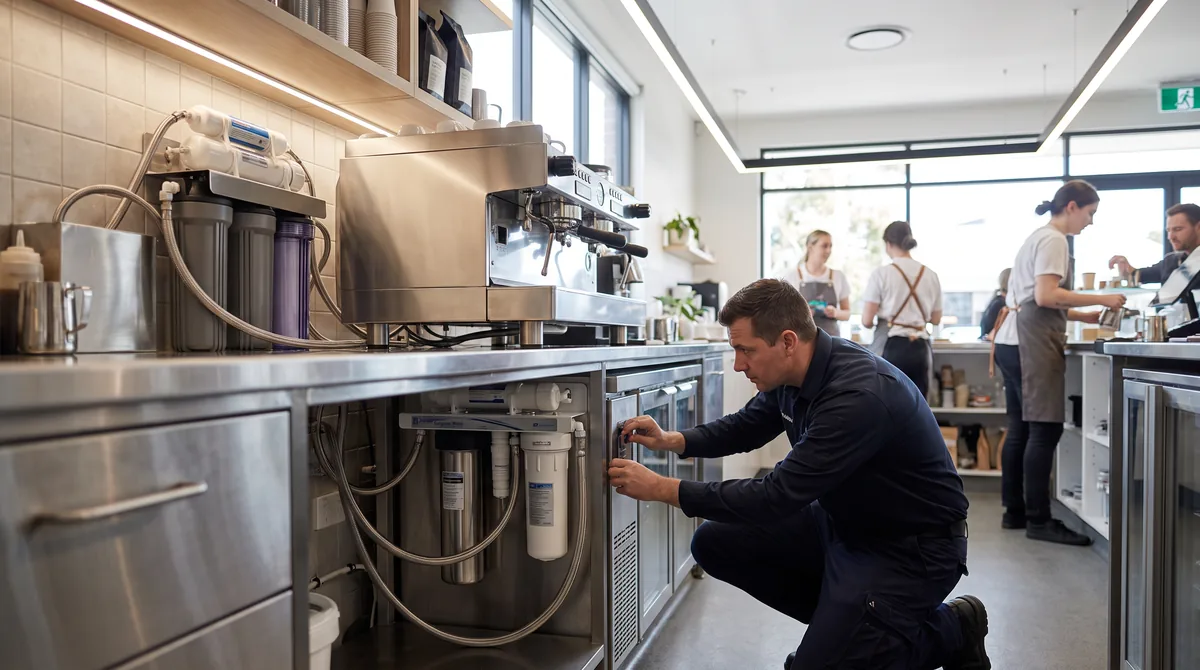
Budget the grinder and the water treatment with the machine
Quotes routinely price the machine alone. A grinder mismatched to the machine produces inconsistent coffee no amount of machine quality recovers, and untreated water scales boilers and destroys them. Both are part of the purchase, and the treatment cartridges are a recurring cost with a replacement schedule.
What ownership actually costs
Current prices belong in a dated report. The cost structure does not move:
- The machine, plus the grinder, plus the water treatment system.
- Installation: plumbing, drainage, electrical and any bench work.
- Consumables: coffee, milk, filters and treatment cartridges, cleaning chemicals.
- Planned servicing, seals and burr replacement.
- Downtime. A café that cannot make coffee has lost the day.
When the dated commercial coffee machine price report is published it will carry verified figures from live dealer listings with an as-at date. Until then, get written quotes for the exact model with the grinder, water treatment and site work itemised separately.
Compare exact models, not series names
Coffee machine series span very different builds. Within one family you will find different group counts, single-boiler and multi-boiler configurations, volumetric versus manual control, different electrical requirements and different inclusions — behind model numbers that differ by a suffix. That is why every comparison on this site is matched on the exact supplier model number rather than on product names; see why model numbers matter.
Compare like for like on: group count, boiler configuration, control type, electrical requirement, grinder included or not, water treatment included or not, warranty terms and local service coverage.
Settled on the system and group count? Compare commercial coffee machines on the exact supplier model number, with live retailer prices and price history — never matched on product names.
Compare coffee machinesQuestions to ask a supplier
- What is this exact model's electrical requirement, and does it need three phase?
- What water treatment does the manufacturer require for my water, and what does replacement cost?
- Is the grinder included, and is it matched to this machine's throughput?
- What is the installation scope, and which licensed trades do I need to arrange?
- What training is included, and is it delivered on site?
- What is the manufacturer's cleaning routine for this model, and what does it require daily?
- Where are spare parts held, and what is the response time in my area?
- What does the warranty exclude — scale damage in particular?
Frequently asked questions
How much does a commercial coffee machine cost?
It depends heavily on system, group count and inclusions, and prices move enough that a fixed figure in an evergreen guide would be misleading within months. Current verified figures belong in a dated price report drawn from live dealer listings. Budget for the grinder, water treatment and site work alongside the machine, because quotes often exclude them.
What is the best commercial coffee machine?
There is no single best machine. The right one is decided by your drink mix, your busiest fifteen minutes, whether you employ trained baristas, and what your site can supply in water, drainage and power. Rule out on site constraints first, then choose the system that matches your staffing model, then compare exact models within that shortlist.
What type of commercial coffee machine do I need?
Choose traditional espresso if coffee quality is a selling point and you can keep skilled staff. Choose automatic or bean-to-cup if staff rotate, training time is short, or the machine is self-serve. Add a batch brewer if you serve high volumes of filter or long black, especially at breakfast or for functions.
Do commercial coffee machines need plumbing?
Most do. Plumbed machines need a mains water connection, treatment appropriate to your water supply, and a drain for the drip tray and backflushing. Some smaller and some automatic models are tank-filled instead, which removes the plumbing requirement but adds a manual filling and emptying routine. Check the exact model.
How much power does a commercial coffee machine use?
Power draw varies widely with boiler size and group count, so a universal figure would be wrong. The manufacturer publishes the electrical requirement on the machine's data plate and specification sheet for each model. Give that exact figure to an electrician and confirm your site can supply it, including whether three phase is required.
How often should you clean a commercial coffee machine?
Follow the manufacturer's routine for your exact model rather than a generic schedule. In practice that means daily backflushing and steam-wand cleaning, daily milk-line cleaning on automatic machines, regular group seal and basket cleaning, and periodic deeper servicing. Milk-contact cleaning is a food-safety requirement and belongs in your documented food safety plan.
Bean-to-cup or traditional — which should we buy?
It is a staffing decision more than a coffee decision. Traditional espresso has the higher ceiling, but only in trained, consistent hands. Bean-to-cup delivers the same drink whoever presses the button, which is worth more in a hotel, an office or a venue with high staff turnover. Decide who will operate the machine on your worst-staffed shift, and choose for that person.
Where to go next
Compare live options in the commercial coffee machine category. If you are pricing a whole venue rather than one machine, see budgeting a commercial kitchen fit-out.