


Commercial Chest Freezer Guide: Sizing, Lids and Stock Control
When a chest freezer beats an upright, how to size one against your delivery cycle, which lid type suits your site, and how to keep frozen stock findable.
In this article
- Chest or upright?
- Commercial versus domestic chest freezers
- Sizing: work from stock, not from space
- Which lid?
- Temperature and monitoring
- Energy: compare like for like
- Baskets, zones and stock rotation
- Ownership cost and comparing exact models
- Questions to ask a supplier
- Frequently asked questions
- Where to go next
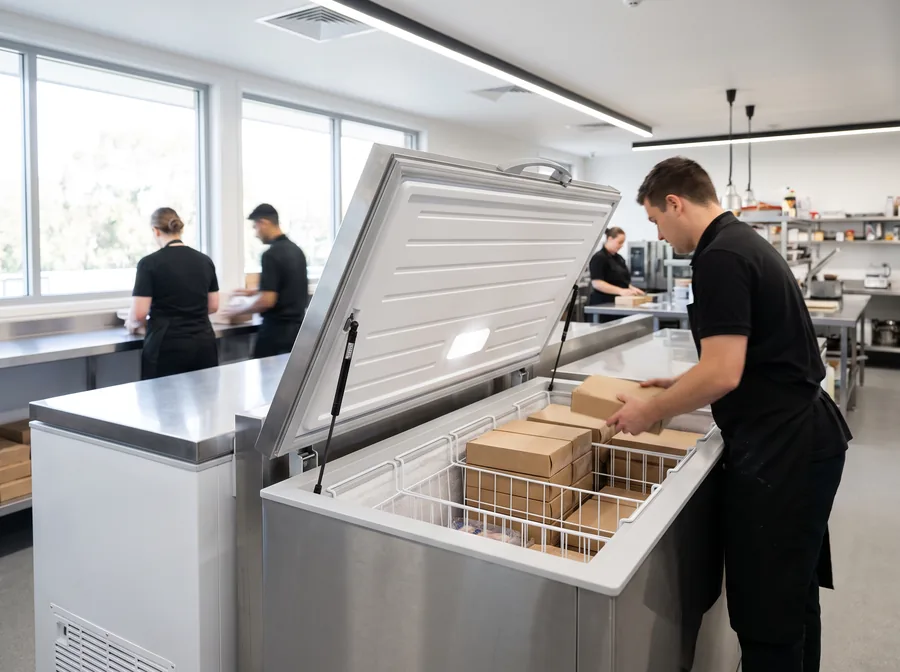
A chest freezer is the right answer when you need to hold a lot of frozen stock cheaply and you do not need to reach it often. It is the wrong answer when staff need fast, organised access during service. That trade-off — bulk versus access — decides the purchase before any specification does.
This guide covers the chest-versus-upright decision, sizing, lid types, temperature and monitoring, energy comparison and the stock-control habits that keep a chest freezer usable.
Chest or upright?
| Chest freezer | Upright freezer | |
|---|---|---|
| Access | Reach down; lower items are buried | Shelved, everything at eye or hand height |
| Organisation | Needs baskets and zoning to work | Shelves organise it for you |
| Volume per dollar | Generally higher | Generally lower |
| Footprint | Wide, needs lid clearance above | Tall, small floor area |
| Cold retention on opening | Cold air sits in the cabinet | Cold air spills out the door |
| Best for | Bulk reserve, long-hold stock, low-touch items | Service stock, frequent access, organised inventory |
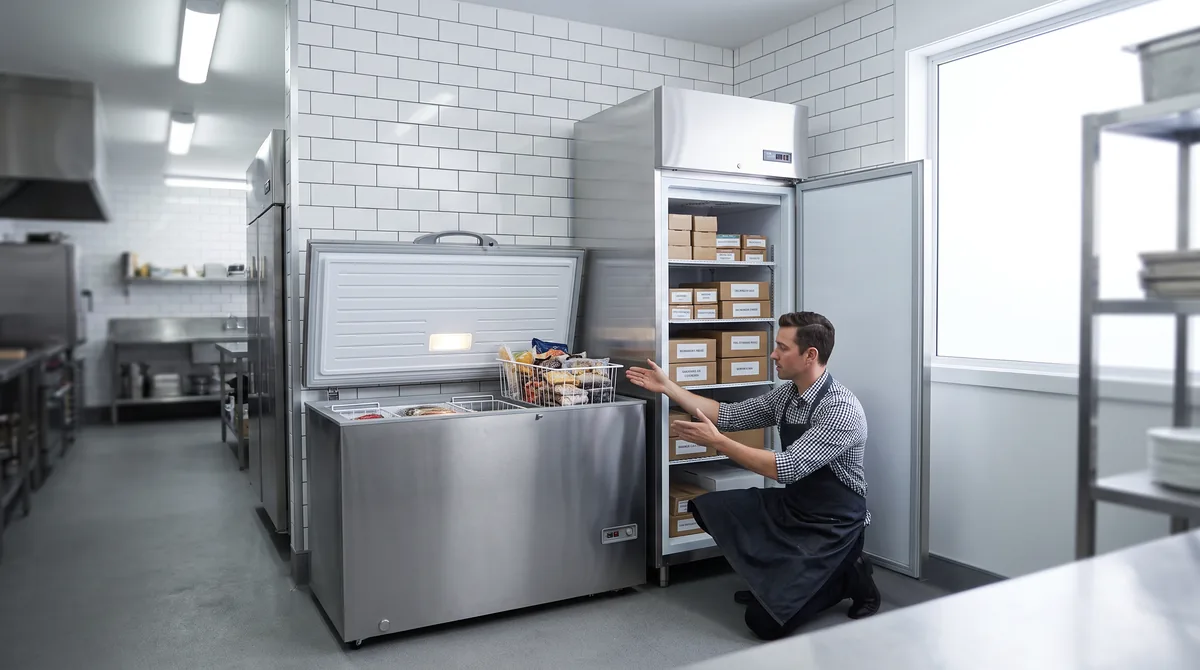
Rules of thumb that hold up in practice: reserve stock and infrequently touched bulk go in a chest; anything a chef reaches for during service goes in an upright or in underbench freezers at the line. Many kitchens run both, and that is usually the cheapest correct answer rather than a compromise.
For the wider refrigeration picture, start with how to choose commercial refrigeration.
Commercial versus domestic chest freezers
The difference is intended duty, and it is visible in the model documentation rather than in the marketing.
- Rated ambient. A commercial model states the ambient conditions it is designed to hold temperature in. A back-of-house corridor or an unairconditioned store room in an Australian summer is a harder ambient than a domestic laundry.
- Duty cycle. Commercial units are built for a heavier opening and loading pattern.
- Construction and serviceability. Heavier cabinets, replaceable lid seals, accessible condensers, and a parts and service network behind them.
- Warranty. Most domestic warranties exclude commercial use. If the unit is in a business, check the warranty terms of the exact model before you buy on price.
Where a supplier claims a unit is suitable for commercial use, ask for the manufacturer's stated intended use and rated ambient for that exact model rather than accepting the claim.
Sizing: work from stock, not from space
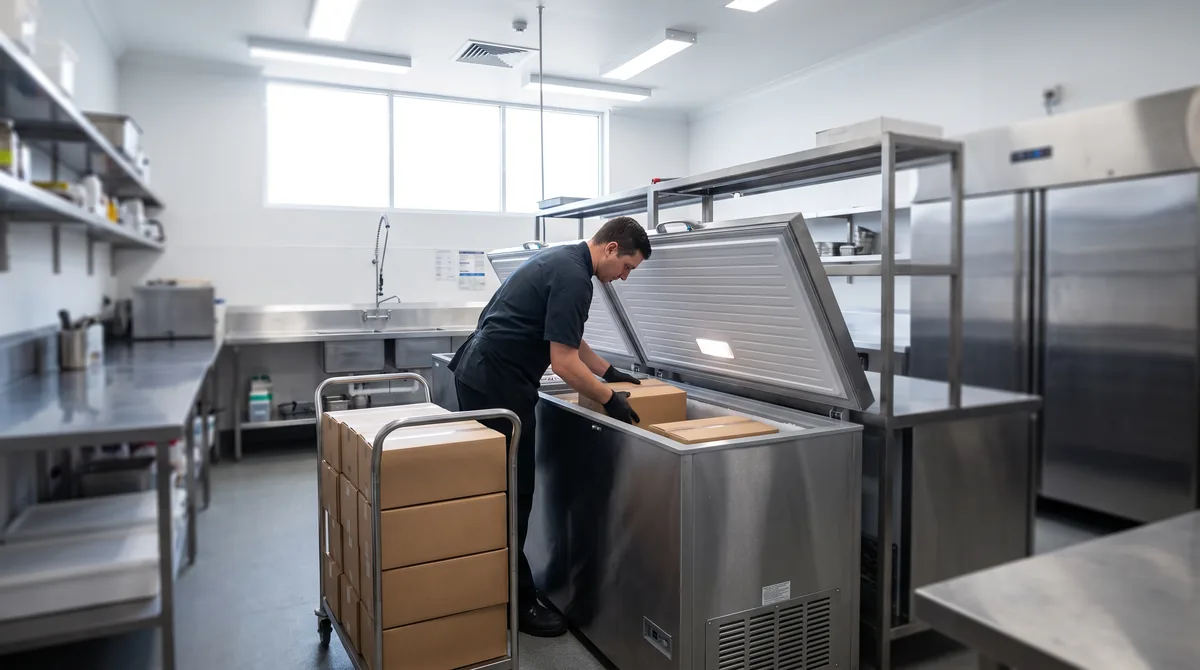
- List what actually goes in. Cartons, bags, portioned trays, ice cream tubs — count units, not litres, because that is how your stock arrives.
- Multiply by your delivery interval. How many days of frozen stock must you hold between drops? A weekly delivery needs far more than three drops a week.
- Add a reserve. Seasonal peaks, function bookings and a supplier missing a delivery are all normal. A freezer running at 100% full also loses the airflow it needs.
- Subtract for baskets and access. Baskets consume volume and are not optional if you want the stock to be findable.
- Check the lid clearance. A chest freezer needs vertical room for the lid to open fully, and staff need room to stand in front of it and reach down.
Internal litres is a comparison figure between models, not a promise about how much of your stock will fit. Where two models are close, compare internal dimensions against your largest carton.
Which lid?
| Lid type | Best for | Trade-off |
|---|---|---|
| Solid | Back-of-house bulk storage | Best temperature stability and lowest running cost; nothing is visible |
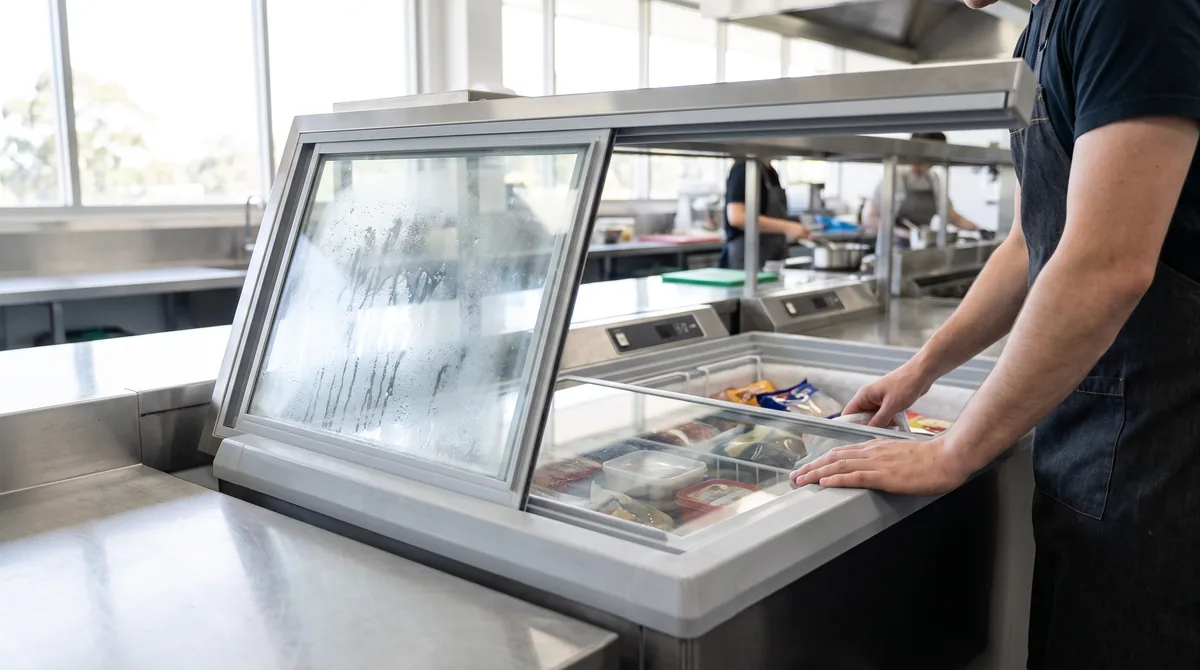
| Flat glass (sliding or hinged) | Retail-facing frozen product | Stock is visible and self-serve; glass is a heat path and adds running cost |
| Curved or domed glass display | Merchandising frozen product front of house | Highest visibility; highest running cost and most sensitive to warm, sunny sites |
If nobody is buying directly from the freezer, buy a solid lid. Glass earns its cost only when a customer is choosing from it.
Temperature and monitoring
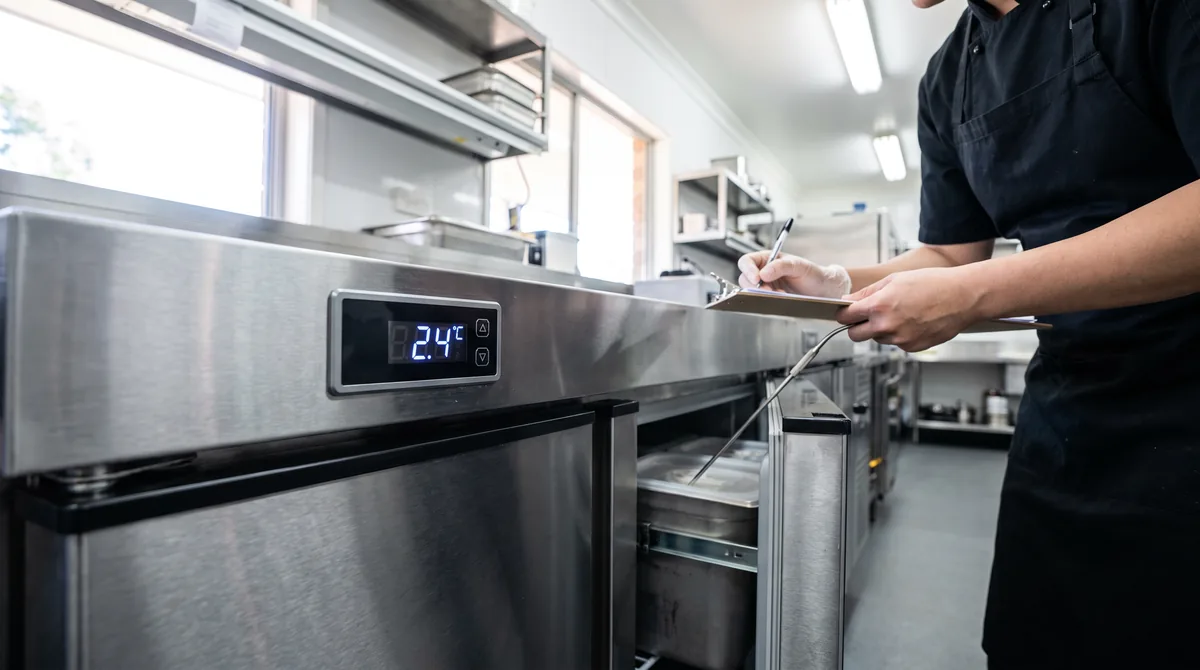
As with refrigeration, the requirement is expressed as food temperature, not a dial position. Frozen food must be kept hard-frozen, and the number that matters is the temperature of the product.
- Verify with a probe or a monitored thermometer rather than relying on the cabinet display.
- Log temperatures as your food safety plan requires.
- Follow Food Standards Australia New Zealand guidance and your state or territory food authority for the requirements that apply to your business.
- Chest freezers hold temperature well during a power interruption because cold air stays in the cabinet — but a lid left ajar defeats that entirely, and a chest freezer with a partly open lid is easy not to notice.
There is no universal correct dial setting to publish here. Set the cabinet so that the product holds the required temperature under your real load and opening pattern, then verify it.
Energy: compare like for like
Chest freezers are generally efficient for the volume they hold, but "chest freezers are always more efficient" is not a claim worth making — a glass-lid display chest in a warm shopfront can easily use more than a solid-door upright in a cool store room.
Compare the manufacturer's published or registered energy figures for the exact models you are choosing between, under comparable conditions. Where a model is covered by Australian energy efficiency registration requirements, ask for the registration details of that exact model. Do not convert nameplate wattage into an annual cost; that is not what nameplate power means.
A lid left ajar is the failure you will not notice
A chest freezer holds temperature well through a power interruption because cold air stays in the cabinet — but that same design hides a partly open lid, which can run for a shift before anyone sees it. Check the lid seal weekly, keep below the manufacturer's load line so the lid closes properly, and verify food temperature with a probe rather than the cabinet display.
Baskets, zones and stock rotation
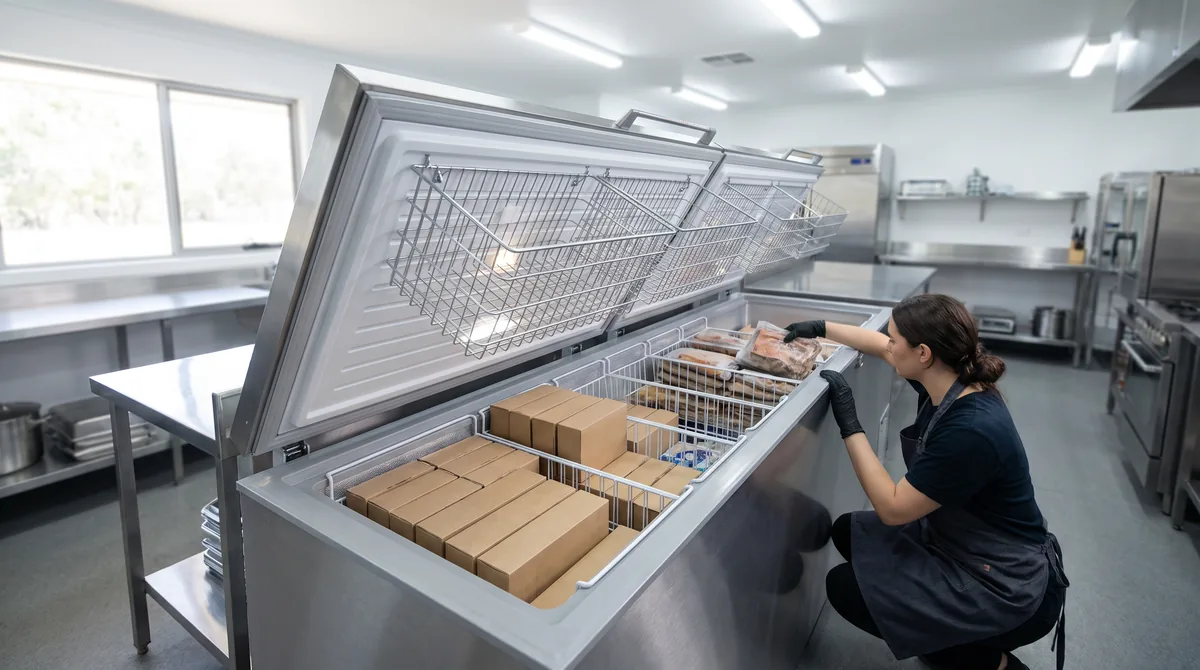
A chest freezer without a system becomes a dig site, and the stock at the bottom is the stock you pay for twice.
- Baskets, and enough of them. Baskets are how a chest freezer becomes navigable. Buy them with the unit and check what the model supports.
- Zone it. Assign each basket or section to a category — proteins, chips, bakery, ice cream — and label the outside of the cabinet with the map, not just the baskets.
- Date and label everything as it goes in. Frozen product loses its identity fast.
- Rotate on the way in, not on the way out. New stock goes underneath or behind; oldest stays on top or at the front.
- Keep the airflow. Do not pack above the load line the manufacturer marks, and do not block the cold-air path.
- Check the lid seal weekly. A seal that no longer closes is the most common cause of a chest freezer icing up and running constantly.
For the wider habits that keep any refrigeration alive, see maintenance habits that extend commercial equipment life.
Ownership cost and comparing exact models
Beyond the purchase price: delivery and placement, any electrical work, energy over the life of the unit, baskets, lid seals, and the value of stock a failure would destroy. That last item is often larger than the freezer.
Current market prices belong in a dated report rather than in an evergreen guide.
For the comparison, one series can span very different capacities, lid types, rated ambients and power connections behind model numbers that differ by a suffix. Every comparison on this site is matched on the exact supplier model number rather than on product names; see why model numbers matter.
Compare like for like on: internal volume and internal dimensions, lid type, rated ambient, baskets included, registered energy data, warranty terms and local service coverage.
Know the capacity and lid type? Compare chest freezers on the exact supplier model number, with live retailer prices and price history — never matched on product names.
Compare chest freezersQuestions to ask a supplier
- What ambient conditions is this exact model rated to hold temperature in?
- Is it stated by the manufacturer as suitable for commercial use, and does the warranty cover it?
- How many baskets are included, and how many does the cabinet support?
- Is the lid seal a replaceable part, and is it stocked locally?
- What are the required clearances, including above the cabinet for the lid?
- What is the registered energy figure for this exact model?
- Where are spare parts held, and what is the response time in my area?
Frequently asked questions
How much does a commercial chest freezer cost?
It varies with capacity, lid type and build, and prices move enough that a fixed figure in an evergreen guide would be misleading within months. Current verified figures belong in a dated price report drawn from live dealer listings. For budgeting, get quotes on the exact model with delivery, placement, baskets and any electrical work itemised.
What is the difference between a commercial and a domestic chest freezer?
Intended duty, and it is stated in the model documentation. Commercial units specify the ambient conditions they are designed for, are built for a heavier opening and loading pattern, use replaceable seals and accessible condensers, and are backed by a parts and service network. Most domestic warranties exclude commercial use.
Chest freezer or upright freezer for a commercial kitchen?
Chest for bulk reserve stock you rarely touch; upright for stock staff reach for during service. Chest freezers generally give more volume per dollar and hold cold better when opened; uprights give far better access and organisation. Many kitchens run both, which is usually cheaper than forcing one format to do both jobs.
What temperature should a commercial chest freezer be?
The requirement is about the temperature of the food, not a dial position, so there is no universal setting worth publishing. Follow Food Standards Australia New Zealand guidance and your state or territory food authority for the temperatures your business must hold, set the cabinet so the product meets them under your real load, and verify with a probe.
How much power does a commercial chest freezer use?
There is no useful universal figure — it depends on the model, the lid type, the load, the ambient and how often the lid opens. Compare the manufacturer's published or registered energy data for the exact models you are choosing between. A glass-lid display chest in a warm shopfront can use considerably more than a solid-lid unit in a cool store room.
What size commercial chest freezer do I need?
Count the stock units you must hold between deliveries, add a reserve for peaks and missed deliveries, then subtract the volume baskets consume. Check the internal dimensions against your largest carton, not just the litre figure. Leave vertical clearance for the lid to open fully and floor space for staff to stand and reach in.
How do you organise a commercial chest freezer?
Use baskets, assign each one to a category, and put a map on the outside of the lid so staff do not have to dig to find out what is where. Date and label everything as it goes in, rotate by loading new stock underneath or behind the old, and keep below the manufacturer's load line so air can circulate. Check the lid seal weekly.
Where to go next
Compare live options in chest freezers, or look at underbench freezers if the real problem is access at the line rather than bulk volume.