


Commercial Ice Machine Buying Guide: Sizing, Ice Types and Site Checks
How to size an ice machine for real conditions rather than brochure conditions, choose between cube, flake and nugget, and check your site before you shortlist.
In this article
- The decision sequence
- Sizing production and storage
- Configuration
- Ice types
- Which ice machine suits your venue?
- Air, water or remote cooled
- Site preflight
- Cleaning and sanitation
- GEMS registration — ask for the number
- Ownership cost and comparing exact models
- Questions to ask a supplier
- Frequently asked questions
- Where to go next
Choosing a commercial ice machine starts with sizing it for your peak daily ice demand under your actual operating conditions — not with the production figure on the brochure. Once the size is right, the decisions that follow are configuration, ice type and condenser type, and then whether your site can actually supply and drain the machine. Ice is the utility nobody thinks about until it runs out mid-service.
The decision sequence
- Peak daily demand, and the peak interval within that day.
- Realistic production for your ambient and water temperature — not the rated figure.
- Storage sized to bridge the gap between production rate and service demand.
- Configuration: self-contained, modular head plus bin, or countertop and dispenser.
- Ice type: cube, flake or nugget.
- Condenser: air, water or remote.
- Site preflight: water treatment, drain, power, clearance and heat.
- Compare exact models.
Have these four things in front of you
The manufacturer's production data for the exact model (not the headline figure), a recent water quality report or your supplier's hardness reading, a photo of where the drain sits relative to the machine position, and the spare capacity on the circuit at that location. Every decision below turns on one of them.
Sizing production and storage
These are two different specifications and both fail differently.
Production is kilograms per 24 hours, and the headline number is always quoted at some stated set of test conditions. Where those conditions are cooler than your kitchen, the machine will make less ice than the figure suggests: an Australian kitchen in February, with a commercial ice maker sitting near cooking equipment and mains water that is not cold, is a harder job than a temperate test bench. Manufacturers publish production curves or tables against ambient and water temperature for each model; ask for them, check which rating point a quoted figure uses, and size against the conditions your machine will actually live in.
Storage is the bin capacity. It buffers the difference between a steady production rate and a service that wants a lot of ice in a short window. A machine that makes enough over 24 hours can still leave a bar dry at 8pm if the bin is too small.
Work it out like this:
- Estimate daily kilograms by outlet — bar, kitchen, function, display, takeaway.
- Identify the peak interval and how much ice is drawn during it.
- Derate the machine's rated production for your ambient and water temperature.
- Size the bin to cover the peak draw plus the recovery time.
- Add headroom for summer, functions and growth. Ice demand is seasonal and the season that strains the machine is the season you need it most.
A worked example. A venue draws most of its ice between 5pm and 10pm. It cannot choose a machine simply because the 24-hour rated production exceeds its total daily consumption, because the machine does not make that ice in the five hours it is needed — it makes it across the whole day. The bin has to hold enough ice to carry the service peak while the machine keeps producing underneath it. Two machines with identical 24-hour production and different bin capacities are genuinely different purchases for that venue, and the smaller bin is the one that runs out at 8pm.
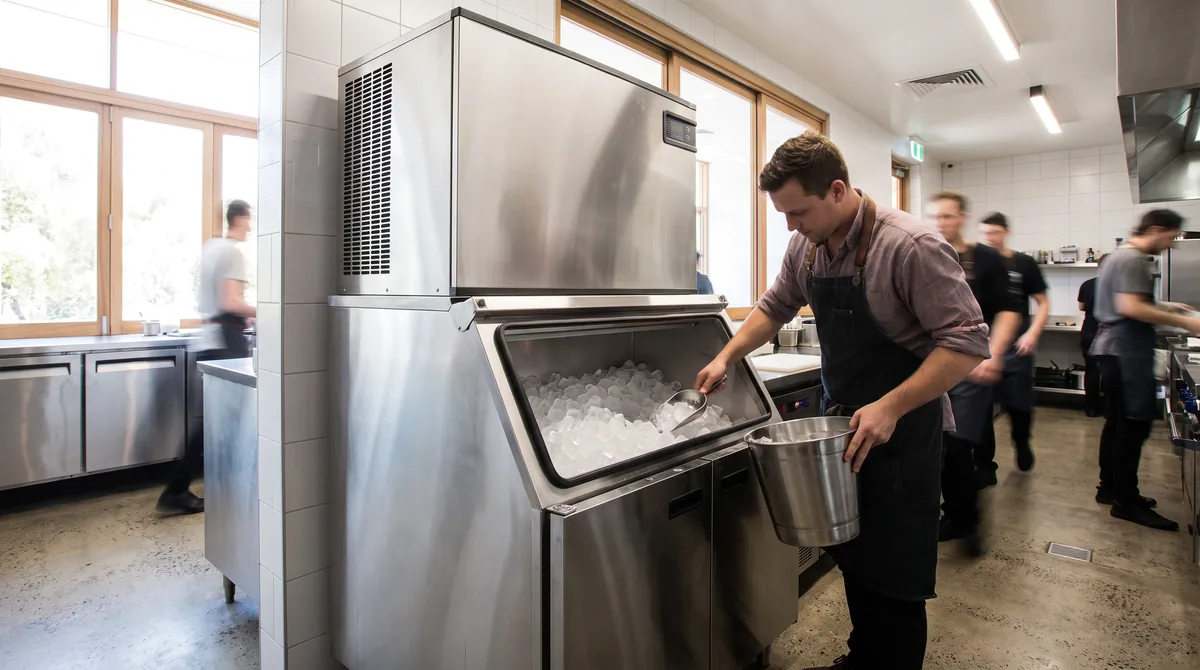
Two machines with identical 24-hour production and different bin capacities are not the same purchase. The smaller bin is the one that runs out at 8pm.
The reverse case matters too: a venue drawing ice steadily across a long trading day needs production rate more than storage, and a very large bin mostly holds melting ice.
Configuration
| Configuration | Best fit | Notes |
|---|---|---|
| Self-contained / undercounter | Bars, cafés, small kitchens | Machine and bin in one cabinet; simplest install, limited capacity |
| Modular head on a bin | Medium to high volume kitchens and venues | Head and bin sized independently; the bin must be a compatible model |
| Countertop and dispensers | Front of house, healthcare, self-serve | Dispensed rather than scooped; hygiene benefit at lower capacity |
If you choose a modular head, confirm bin compatibility for the exact head model. Head and bin are matched pairs, and an incompatible bin is a common and avoidable purchasing error.
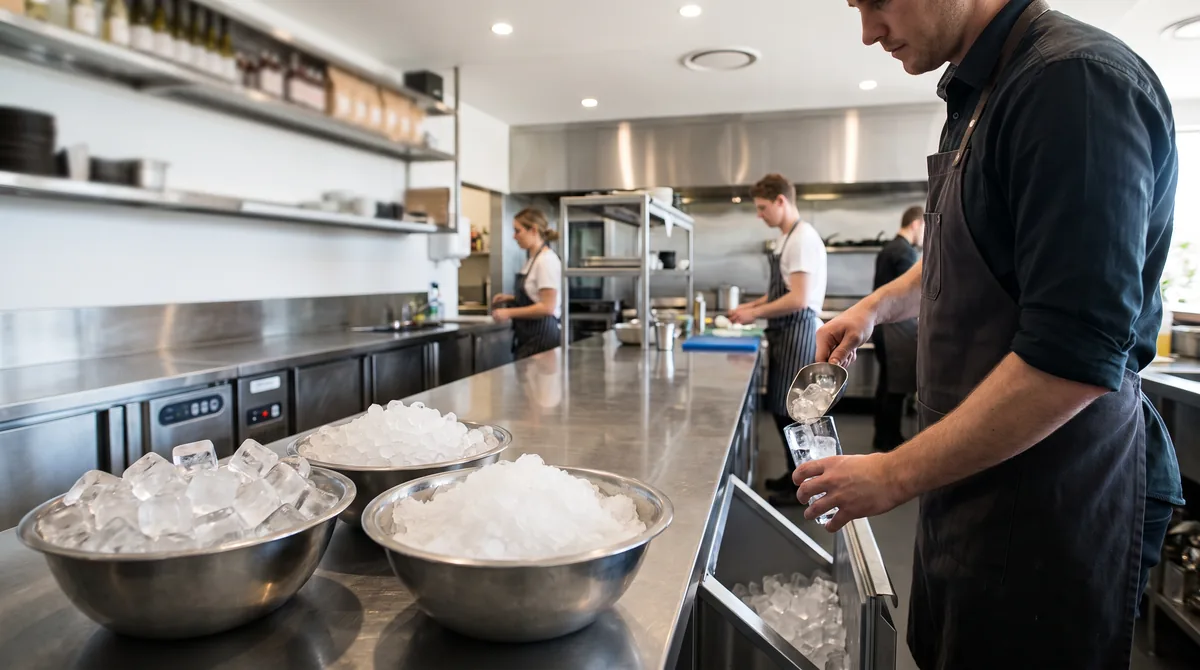
Ice types
| Ice type | Typical use | Why |
|---|---|---|
| Cube (full, half, gourmet) | Spirits, soft drinks, general bar service | Slow melt, clear presentation, standard for drinks |
| Flake | Seafood and produce display, food transport, therapeutic use | Large surface area, moulds around product, fast cooling |
| Nugget / cubelet | Blended drinks, healthcare, venues where guests chew ice | Soft, chewable, blends and dispenses easily |
The ice type is a menu and service decision. Choosing flake for a cocktail bar or cube for a seafood display will disappoint whatever the machine costs.
Which ice machine suits your venue?
Configuration and ice type answer different questions, and it helps to see them joined up. This is a starting point for the shortlist, not a substitute for the sizing work above — two cafés with different trading patterns need different machines.
| Venue | What usually drives the decision |
|---|---|
| Café | Compact footprint, drinks volume, undercounter or self-contained installation |
| Bar | Peak service demand in a short window, cube quality and presentation, bin capacity |
| Restaurant | Combined kitchen and beverage demand, recovery between service periods |
| Hotel or club | High daily volume across several outlets; modular head and bin, sometimes more than one machine |
| Seafood or produce display | Flake ice, and enough of it to re-dress the display through the day |
| Healthcare and aged care | Nugget or cubelet, and dispensers rather than open bins for hygiene |
| Function and event catering | Peaks that are large but irregular; storage and delivery planning matter as much as production |
Know the configuration and ice type? Compare every model on the exact supplier model number, with live dealer prices and price history — never matched on product names.
Compare ice machinesNarrow it further by the configuration you settled on: self-contained and undercounter, modular heads or ice storage bins — the bin has to be a model the head supports.
Air, water or remote cooled
- Air cooled is the default. It rejects heat into the room, so it needs clearance and a room that can take the heat. In a hot, enclosed space production drops and the compressor works harder.
- Water cooled rejects heat into the water supply, which suits hot or confined plant rooms. It uses more water, and some local water authorities restrict single-pass water-cooled equipment — check with yours before specifying one.
- Remote condensing puts the condenser outside the building. It keeps heat and noise out of the kitchen at the cost of a more involved and more expensive installation.
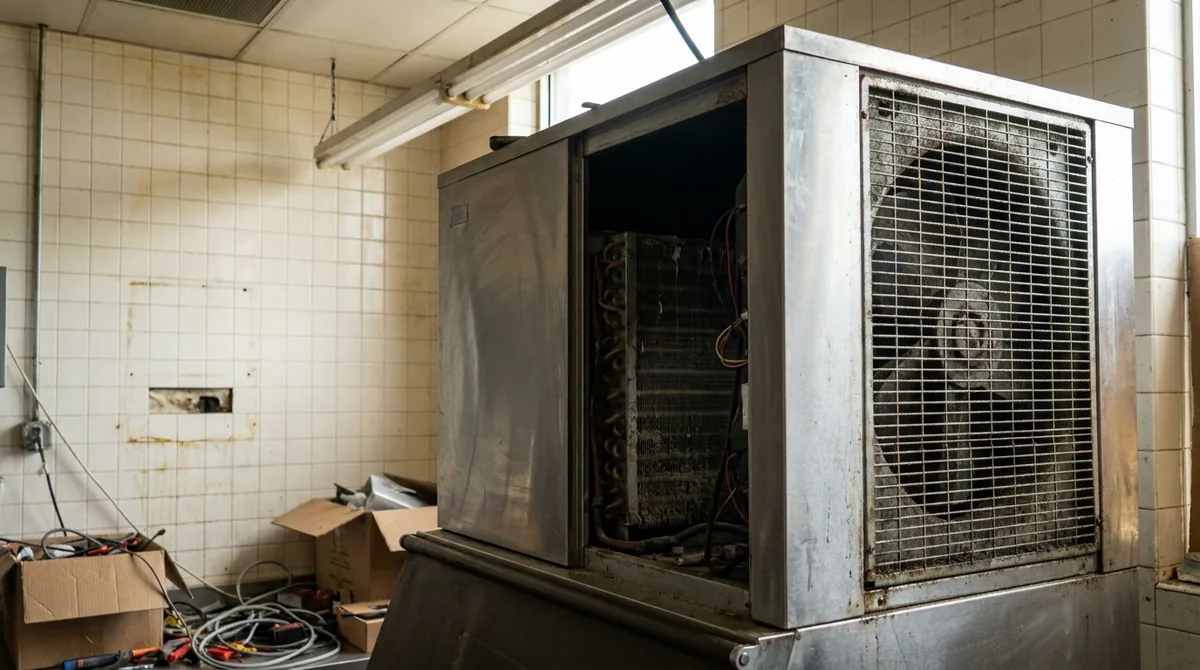
The right answer is usually decided by the room, not by preference.
Site preflight
What the machine needs from the building, before any specification matters:
- Water
- Mains supply at the machine, treated to the quality the manufacturer specifies for your local water. Untreated hard water is the shortest route to an expensive failure.
- Drainage
- A drain for the machine and, on most models, a separate gravity-fed drain for the bin.
- Power
- The circuit the exact model requires at that position, and whether it must be dedicated.
- Air
- The manufacturer's clearances at the condenser, and a room that can absorb the rejected heat.
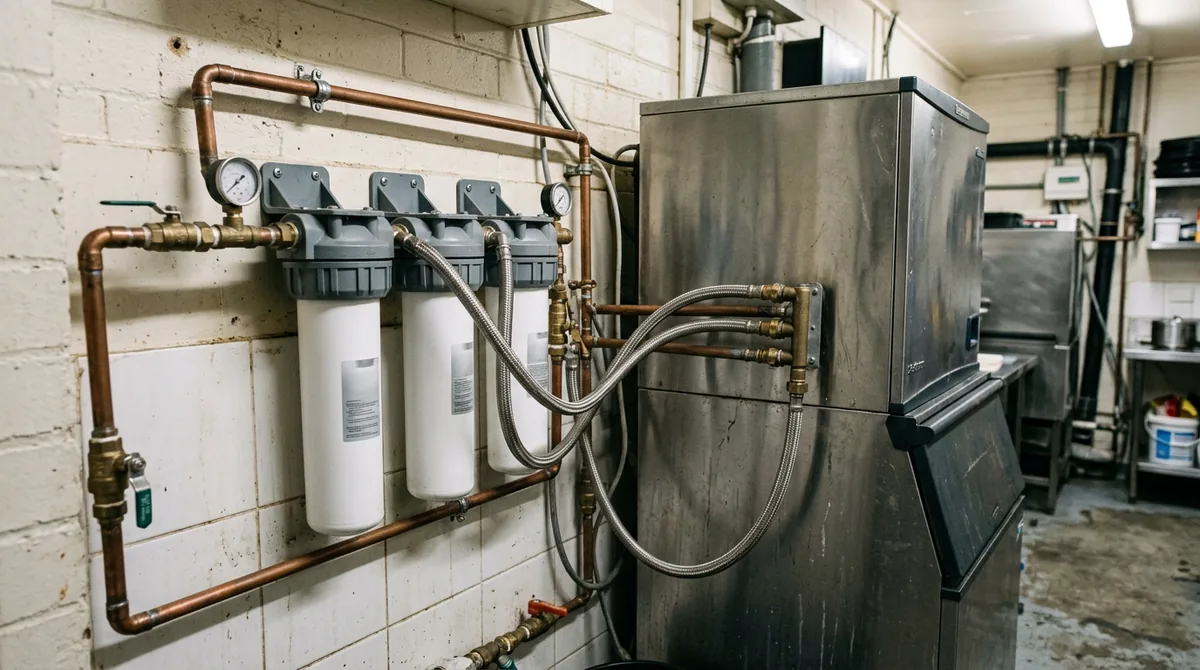
The drain trap that strands installations
Bin drains are gravity-fed on most models, so the drain has to sit below the outlet. This is discovered after delivery more often than any other requirement, and the fix is usually a pump, a plinth, or moving the machine. Check the drain height against the model's drawing before you order.
- Water supply and treatment. Ice machines need treated water. Scale is a common cause of ice-machine faults and expensive servicing, and untreated water also affects the taste of everything the ice touches. The filtration the manufacturer specifies for your water is a running cost with a replacement schedule.
- Drainage. Machines and bins both need drains, and bin drains are gravity-fed on most models — the drain has to be below the outlet. This detail has stranded a lot of installations.
- Power. Confirm the circuit at the location and whether a dedicated circuit is required.
- Clearance and heat. Leave the manufacturer's clearances at the condenser and above the machine. Do not site an air-cooled machine beside cooking equipment or in a sealed cupboard.
- Bin compatibility. For modular heads, verify the exact bin model the manufacturer lists.
- Access. Measure the delivery path as well as the final position.
Verify the exact model's requirements against manufacturer documentation and with licensed trades before purchase. This is a buyer's preflight, not an installation procedure.
Cleaning and sanitation
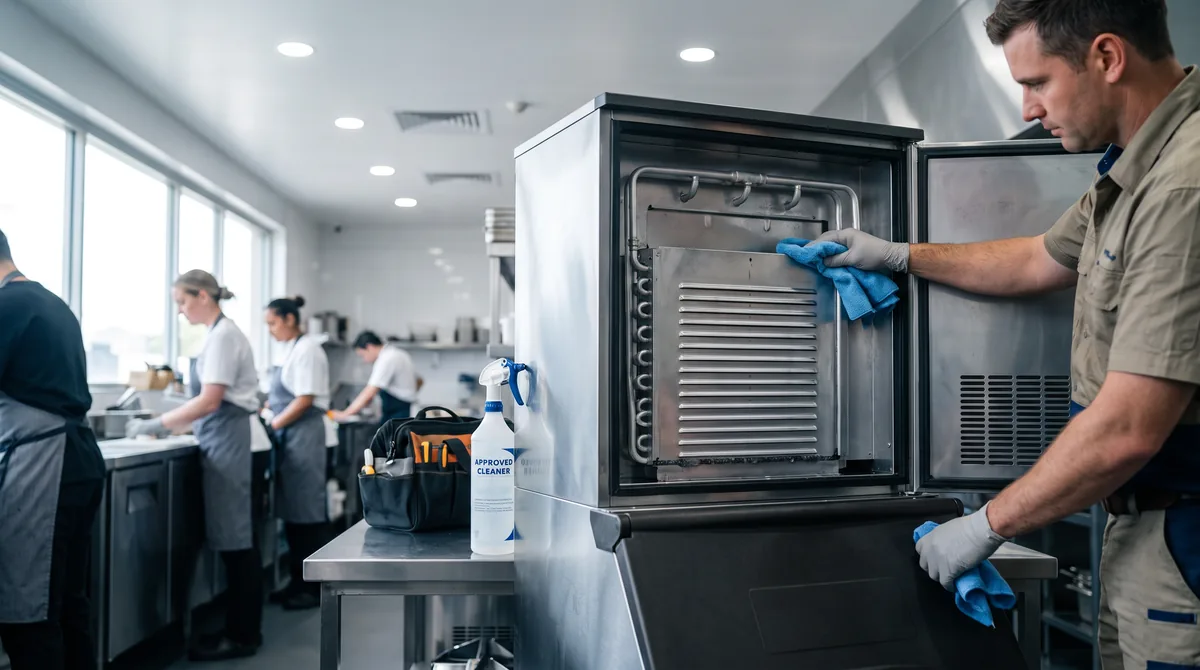
Ice is a food. Every manufacturer publishes a cleaning and sanitising routine for the exact model — typically a descale and sanitise cycle at a stated interval, plus filter changes, air-filter cleaning and bin cleaning.
Ice is a food, and the machine is food-contact equipment
Scale, biofilm and mould in the ice-making chamber and the bin are food-safety hazards, not housekeeping problems. Sanitising is a documented responsibility under your food safety plan: use only the chemicals the manufacturer approves, follow their procedure for the exact model, and keep the records. Isolate the machine electrically before any internal cleaning, and leave anything behind a panel to a qualified technician.
Follow the routine in the manual for your model rather than a generic schedule from a supplier's blog. The interval depends on your water and your environment, and it is a documented responsibility under your food safety plan. Build it into the roster and record it.
GEMS registration — ask for the number
Commercial ice-makers sold in Australia are now regulated under the Greenhouse and Energy Minimum Standards (GEMS) framework. The GEMS Commercial Ice-makers Determination 2025 was registered on the Federal Register of Legislation on 3 March 2025, and its supply obligations took effect on 3 March 2026.
Two things follow for a buyer:
- Covered models must be registered with the GEMS Regulator before they can be sold in Australia.
- Retailers must display the GEMS registration number when selling or advertising a covered model — in store, online or in print.
That gives you a straightforward check. Ask for the GEMS registration number of the exact model, and you can verify it against the regulator's public registration data yourself. A covered model being advertised without one is worth a question.
Coverage is defined rather than universal. The determination applies to models with a tested ice-making capacity up to and including 1,000 kg in 24 hours at a defined rating point of 32 °C ambient and 21 °C inlet potable water. Self-contained units, modular ice-making heads and remote condenser arrangements are all contemplated by it. Larger machines fall outside that capacity scope, so do not assume every ice machine on the market is covered — ask about the exact model number and confirm against current regulator guidance.
That 32 °C / 21 °C rating point is also useful in its own right. It is a defined, comparatively hot test condition, which makes registered data a fairer basis for comparing two machines than a headline production figure quoted at conditions the supplier chose.
Ownership cost and comparing exact models
Beyond the purchase price: installation by licensed trades, water treatment and its replacement cartridges, water and energy, cleaning chemicals, planned servicing, and the cost of buying bagged ice while the machine is down.
Current market prices belong in a dated report rather than in an evergreen guide, because they move.
For the comparison, one series can span very different production rates, ice types, condenser types and bin pairings behind model numbers that differ by a suffix. Every comparison on this site is matched on the exact supplier model number rather than on product names; see why model numbers matter.
Compare like for like on: rated production and the production curve, bin capacity and compatibility, ice type, condenser type, power requirement, water treatment included or not, warranty and local service coverage.
Questions to ask a supplier
- What is this exact model's production at my ambient and incoming water temperature, and at which rating point is your quoted figure measured?
- What is the GEMS registration number for this model, or is it outside the determination's capacity scope?
- Which bin models is this head compatible with?
- What water treatment does the manufacturer require, and what do replacements cost?
- What are the required clearances, and where does the heat go?
- Where must the drains be, and does the bin drain run by gravity?
- What is the manufacturer's cleaning and sanitising interval for this model?
- Where are spare parts held, and what is the response time in my area?
- What does the warranty exclude — scale damage in particular?
Frequently asked questions
How much does a commercial ice machine cost?
It varies widely with production capacity, configuration and condenser type, and prices move enough that a fixed figure in an evergreen guide would be misleading within months. Current verified figures belong in a dated price report drawn from live dealer listings. Budget the water treatment, installation and drainage work alongside the machine.
What is the best commercial ice machine?
There is no single best machine. The right one matches your peak demand under your real conditions, produces the ice type your service needs, and fits what your site can supply in water, drainage, power and heat rejection. Rule out on site constraints first, then compare exact models within the shortlist that survives.
What size commercial ice machine do I need?
Estimate daily kilograms across every outlet, identify your peak interval, then derate the machine's rated production for your ambient and incoming water temperature using the manufacturer's production data. Size the bin to bridge the peak draw and recovery, and add headroom for summer and functions. The rated 24-hour figure alone will oversell what you get.
Cube, flake or nugget ice?
Cube suits spirits, soft drinks and general bar service because it melts slowly and presents well. Flake suits seafood and produce display and rapid cooling because it packs around product. Nugget or cubelet suits blended drinks, healthcare and venues where guests chew ice. Choose from the menu and the service, not from the machine price.
How often should a commercial ice machine be cleaned?
Follow the interval and procedure in the manual for your exact model. Typically that means a descale and sanitise cycle at a stated interval, plus water filter changes, condenser or air filter cleaning and regular bin cleaning. Ice is a food, so the routine belongs in your documented food safety plan with records kept.
How do you install a commercial ice machine?
Installation is work for licensed trades, not a DIY job, and this guide deliberately stops at the buyer's preflight. What you need to confirm before buying is treated water at the machine, drains positioned to run by gravity where the model requires it, the correct electrical supply, the manufacturer's clearances, and somewhere for the condenser heat to go.
Air cooled or water cooled?
Air cooled is the default and rejects heat into the room, so it needs clearance and a room that can absorb the heat. Water cooled suits hot or confined plant rooms but uses more water, and some local water authorities restrict single-pass water-cooled equipment — check yours. Remote condensing moves heat and noise outside at the cost of a more involved installation.
Where to go next
Compare live options in the ice machine category. For the routines that keep one running, see maintenance habits that extend commercial equipment life.